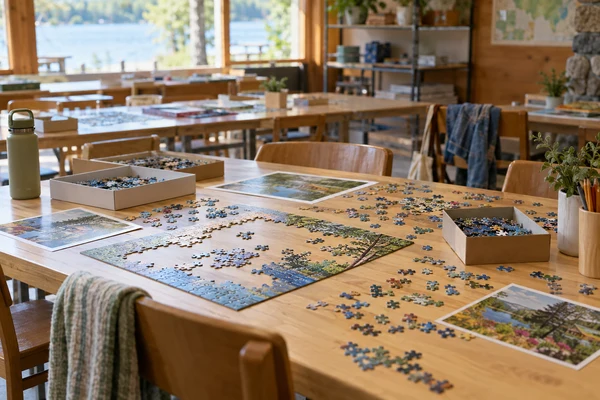
For group activities, choose a puzzle around the number of participants, the available time and table space, and the way pieces will be managed before and after the session. A custom puzzle for summer camp needs a usable activity plan as well as an appealing image. A custom puzzle for family game night needs an appropriate shared experience without assuming every participant has the same interests or skill. This guide focuses on group-use sourcing, facilitator preparation and component control. It complements our school and corporate team-building guides by addressing repeated programme use rather than educational outcome claims or employee engagement campaigns. The examples below are hypothetical. Proposed review and inspection steps do not imply completed tests, proven programme benefits or specific supplier capabilities.
Specify the session rather than only the puzzle
Write the activity context first: the group size, participant range, available table area and scheduled session window. Identify whether the puzzle is a central activity, an optional station or something participants can return to throughout a programme. A camp table open all afternoon has different needs from a short family event between other activities. Avoid turning the schedule into a promise that a certain count will be completed within a fixed time.
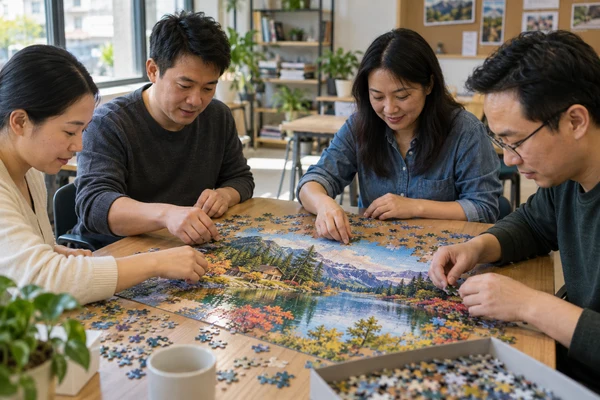
State the participation pattern. Will one group work on a complete image, several groups work on separate sets or participants move between tables? Shared pieces can create a bottleneck if one person controls the reference image or occupies the useful assembly area. The brief should explain the intended access and facilitator role. Do not assume that a larger physical puzzle automatically accommodates more active participants.
Define the outcome in practical terms: participants can join, understand the task and leave the components ready for the next group. If there is a learning objective, record it separately and have an educator review it. A custom family puzzle can offer a shared pastime without proving social or cognitive improvements. The team-building puzzle guide addresses a different organisational use; retain the session-specific focus here.
Choose imagery that invites shared discussion
Images with distinct regions can give participants useful starting points. A nature scene with recognizable animals, plants and landscape areas may allow different people to work on different parts. A repeated pattern can create a more demanding experience, but it may be less suitable for an open activity station where participants come and go. Compare the actual artwork rather than assigning difficulty from piece count alone.
Consider the programme's cultural and local context. A camp theme should be understandable to the intended participants without relying on unexplained symbols or exclusive experiences. A family event might favour a broad scene rather than private photographs that not every visitor recognizes. Ask the programme owner to review imagery for relevance, permissions and any sensitive subjects before commissioning final artwork.
Use an original or appropriately licensed illustration or photograph. The U.S. Copyright Office's photographer guidance helps explain why an accessible image is not automatically available for merchandise reproduction. Record the actual permitted use. If the puzzle will appear in programme publicity, review that use separately from manufacturing, and do not imply permission to photograph participants merely because the activity materials are approved.
Match the format to table access and participant context
Ask for finished dimensions, piece dimensions and the proposed cut, not just a count. A group needs room for the assembled image, loose pieces and hands moving around the table. A crowded surface can make a suitable puzzle frustrating. Installation preparation in this context means the activity layout: surface condition, lighting, reference placement and a practical route for participants to join without moving someone else's work.
Review the range of handling needs and the intended age context. Avoid calling a single product suitable for all ages without an appropriate assessment. A child-oriented programme requires review of the relevant product requirements and supervision arrangements. The CPSC small-parts guidance explains important U.S. age-related considerations. Other markets and programme settings require their own review; group use does not remove those obligations.
Compare the educational format reference or retail puzzle reference with the actual session needs. Ask the supplier what construction and packaging can be proposed. A source category is a starting point for discussion, not confirmation that a particular count, material or classroom service is available.
A hypothetical setup review
Lay out a representative image area, loose-piece area and reference position on the intended table before committing to the format. This can be done with a measured paper outline while physical samples are pending. Invite the facilitator to review access from the available sides. Record any space constraint explicitly so artwork and piece count are not selected independently of the activity setting.
Plan collaboration without turning the puzzle into a test
A facilitator can invite participants to sort colours, look for edges or describe where a piece might fit. Give suggestions that leave room for different strategies rather than prescribing one correct way to participate. A custom puzzle problem solving activity should be described as an opportunity to explore choices, not an assessment of intelligence or cooperation. Some participants may prefer observing or joining only briefly.
If the programme has an educational purpose, state the actual objective and a suitable discussion prompt. The NAEYC practice guidelines support contextual educator judgement for young-child settings. That framework does not validate a particular camp activity or justify learning claims for every age. Let the responsible educator adapt the activity to the learners rather than expecting the product alone to deliver an outcome.
Specify how the facilitator handles a group that does not finish. Leaving a partial image for the next session, photographing only the puzzle or resetting the set are different options. Review permissions before capturing people. If the activity becomes a race, consider whether time pressure excludes participants who need longer to examine pieces. The project brief should identify the intended tone so promotional copy does not promise a cooperative experience while instructions create a competition.
Plan a usable group activity kit
Share your session pattern, table constraints, participant context and proposed image. We can discuss the format and pack components that need review before sampling.
Create a component-control system for repeated use
Each complete set needs an identifier that staff can recognize quickly. Use a kit number or colour-coded storage reference rather than participant names. Keep the puzzle image, box and reference component connected to that identifier. Where several identical sets are used, decide how pieces will be kept from migrating between tables. This is an operational arrangement to review; it does not imply a supplier provides back printing or individually numbered pieces.
Provide a cleanup method that staff can realistically follow. State who gathers pieces, checks for obvious mixing and stores the set. A detailed count after every session may be impractical for a large puzzle, so the programme owner should decide an appropriate completeness review and escalation method. A missing component should be logged with the set identifier and image reference rather than guessed from a general description.
Ask how damaged or incomplete sets will be handled. Is the programme prepared to retire a set, use a spare complete kit or request a replacement under an agreed service? Do not assume individual missing-piece replacement is available. Keep the missing-piece prevention guide as a broader reference, and add the specific repeated-use and table-reset procedure your staff need.
| Step | Record | Action owner |
|---|---|---|
| Setup | Kit identifier and image | Facilitator |
| Activity | Reference and session notes | Programme staff |
| Reset | Completeness observations | Assigned staff member |
| Exception | Damage or missing component | Programme owner |
| Next use | Current instruction version | Site coordinator |
Review representative kits and facilitator instructions
Request a sample that represents the planned image, cut, box, inner containment and reference component. Ask which materials and construction details are final. A visual mock-up cannot demonstrate repeated opening or piece handling. The buyer's review should check whether the facilitator can set up the activity using the proposed instructions without seeking additional information from the designer.
Write observable acceptance points: the reference image matches the puzzle, the kit identifier is clear, the box can contain the full set and the instructions explain setup and cleanup. Factory testing and shipment inspection can be scoped around agreed physical and packing attributes. They should not be described as proof that participants will cooperate or enjoy the session. Any required product-safety evidence remains a separate workstream.
Try a representative setup with the intended facilitator or programme staff where feasible. Record practical observations such as a reference picture visible from only one side or packaging that is awkward to repack. Label the exercise as a buyer usability review, not a formal performance test unless a valid protocol has been established. Reapprove changed components and retain the final instruction version with the product record.
Define a stop-and-reset decision
Programme staff need a clear response when a kit appears incomplete or damaged during the session. Tell them whether to pause the activity, offer another complete set or continue only under an approved programme arrangement. The facilitator should not decide that a damaged piece is safe because replacing it would disrupt the timetable. Record the issue using the kit identifier and follow the responsible product and programme owners' instructions.
For repeated activities, create a separate ready-for-use status from an in-storage status. A box returned to the cupboard is not necessarily checked and available for the next group. Assign the person who can mark the kit ready after reset, and identify where held kits are stored. This can be a simple operational record rather than a complex tracking system. The important point is that the next facilitator can see the status without reconstructing the previous session.
Review whether the reference component, instruction sheet and storage box can be replaced or reprinted under the agreed scope. Those items may be easier to manage than an individual puzzle piece, but availability still needs confirmation. Keep approved reference files accessible to programme staff where appropriate and prevent an outdated image from being used with a revised puzzle.
 PuzzleZa
Organize delivery and site receiving for the programme
Group-use orders often go to a central store before kits are issued to sites or teams. Identify the actual receiving point and the person who will distribute complete sets. Ask for pack and carton information needed to plan storage. Quantity scenarios should distinguish the number of participating groups, number of complete kits and any spare sets. Do not substitute participant count for product quantity without explaining the planned sharing arrangement.
Prepare a receiving checklist with image versions, set quantities, component references and any approved exceptions. A custom puzzle classroom activity used within a wider camp programme should have its own instructions and kit record so it is not confused with another lesson or game. Confirm whether the supplier's scope ends at bulk delivery or includes any site-specific packing. The quotation must state the agreed arrangement rather than assuming it.
Review the Shenzhen factory overview alongside the product brief when evaluating a supplier. Ask specific questions about the proposed construction, pack contents and inspection arrangement. Keep site setup responsibilities with the programme owner and logistics responsibilities with the relevant parties. A factory overview cannot establish the suitability of a particular activity for every site.
Use programme observations to improve the next release
Collect feedback that can become a product or instruction change. Useful observations include frequent mixing between identical sets, unclear opening instructions, insufficient reference visibility or a difficult image region. Avoid collecting personal participant data where anonymous operational feedback is enough. A programme's positive comments should not be transformed into unsupported claims about learning, confidence or family relationships.
Review whether the issue comes from the product, the setup or the facilitation. A congested table may require fewer participants or another layout rather than a new cut. Confusing image labels may require a revised reference component. Document the proposed correction, affected files and approval owner. Keep the previous version traceable so stored kits can be matched to the right instruction sheet.
Before the next order, confirm the current quantity, site plan and physical specification. Ask whether any components have changed and whether new approval is needed. Send PuzzleZa the session brief with table constraints, age context, image idea and kit scenarios. A defined group-use plan gives the manufacturing discussion a practical basis while leaving programme outcomes to appropriate evaluation.
Frequently asked questions
How many pieces suit a camp session?
There is no universal count. Consider the session window, participant experience, image complexity and available table space. Ask for finished dimensions and review a representative format. A schedule should include a sensible unfinished-puzzle plan rather than promise that every group will complete the same design within a fixed time.
Can one puzzle serve a mixed-age family event?
Review the actual participant context and product requirements. Shared use does not establish universal age suitability or remove small-parts considerations. The facilitator can offer different participation roles, but product selection and safety review need their own evidence. Avoid advertising a single configuration as suitable for everyone without assessment.
What should a group activity instruction include?
Explain table preparation, reference-image access, how participants join and what happens if the session ends before completion. Add cleanup, storage and issue-reporting steps. If a learning objective is claimed, have an educator review its prompt and evidence. Keep the activity optional or guided according to the programme's intended tone.
How can identical sets be kept separate?
Assign recognizable kit identifiers and keep boxes, reference components and activity tables linked to them. Agree a practical cleanup and exception log. Confirm any requested supplier marking capability rather than assuming it. A complete spare set may be an option, but individual piece replacement needs a specific service agreement.
What information is needed to source activity kits?
Provide the participant context, session pattern, table space, intended markets and image idea. State the number of complete sets, spare-kit scenarios and receiving arrangement. Include facilitator notes and approval roles. This gives a supplier a defined scope for discussing product construction, packaging and inspection without guessing the programme design.
Conclusion
Group-use puzzles should be sourced as complete activity systems: the image, physical format, reference information, setup and reset procedure all matter. Plan realistic participation, keep components controlled and review the facilitator's handover before release. Use actual programme observations to improve specific details. This makes camp and family activities easier to operate without promising outcomes the product itself cannot establish.
Send a camp or family-event sourcing brief
Provide kit quantities, intended markets, facilitator requirements and the receiving plan. PuzzleZa can review the product scope and identify manufacturing questions to resolve before quotation.
Sources and scope
Sources reviewed on 2026-10-09. Manufacturing examples and review checklists are planning guidance, not claims about completed customer projects or guaranteed results. AI-generated images illustrate the topic and do not document an actual inspection.
- U.S. Copyright Office: photographer guidance — Review rights for activity imagery and public use.
- CPSC: small parts guidance — Age-related requirements remain relevant for shared activities.
- NAEYC: practice guidelines — Educator judgement for contextual young-child learning activities.