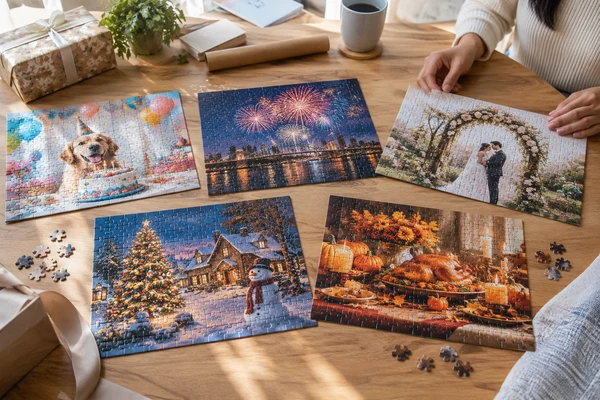
Build a celebration puzzle gift range around recurring occasions, a clear recipient profile and a manageable number of genuinely different products. Anniversary, graduation, retirement, birthday and housewarming gifts can share a manufacturing platform while using distinct visual stories. They should not be reduced to the same design with five interchangeable slogans. A custom anniversary puzzle may celebrate a shared place; a custom graduation puzzle may mark a transition without displaying private academic information. This guide addresses evergreen gift-range planning for retailers and brand owners. It is separate from announcement and reveal puzzles, where completing the image discloses news. The planning examples here are hypothetical and do not imply proven sales, completed customer projects or available customization services.
Map occasions to recipient needs before designing
Start with the gifting relationship. A spouse choosing an anniversary gift, a colleague selecting a retirement present and a friend attending a housewarming do not need the same tone. Write a short statement for each: who gives the puzzle, who receives it, and what the gift acknowledges. This helps a designer distinguish a romantic place-based image from a workplace farewell or a welcoming home theme. Avoid assuming that a single recipient age or household arrangement applies to an entire occasion.
Decide whether the product is intended for immediate shared assembly, an individual hobby session or a keepsake. Each use affects the image, physical format and reference information. A gift assembled during a celebration needs a different practical brief from a detailed puzzle intended for a quiet weekend. Treat the event setting as a constraint, not as a reason to promise an assembly time. Image repetition and participant familiarity matter alongside the nominal piece count.
Use a range map to identify overlaps. A custom birthday puzzle and a custom housewarming puzzle might both feature a favourite landscape, but their cards and retail descriptions should explain different gifting moments. If two products offer no meaningful difference beyond an occasion label, consider one flexible design with an approved card variant. The objective is a coherent assortment buyers can understand, not the maximum number of nearly identical listings.
| Occasion | Useful image direction | Avoid assuming |
|---|---|---|
| Anniversary | Shared place or memory | Relationship title |
| Graduation | Transition or achievement | Private academic details |
| Retirement | Interests and next chapter | Recipient's age |
| Birthday | Recipient's interests | Milestone number |
| Housewarming | Welcoming place or home theme | Exact address |
Create a visual language for each celebration
An anniversary theme can communicate a shared memory through a meaningful place, an original illustration or a licensed photograph. Avoid automatically placing names and dates across the central image; the recipient may prefer a design that can be displayed afterwards. A graduation theme can express a new beginning through architecture, travel or abstract pathways. Institutional crests, school photographs and copyrighted illustrations need permissions appropriate to the intended reproduction.
A custom retirement puzzle can acknowledge a person's interests rather than defining them only through a former job. Hobbies, a local scene or a restrained workplace reference may be more useful than dense tribute text cut across many pieces. Ask the gift buyer whether the recipient has chosen retirement language publicly. A product should not expose a personal transition or financial assumption that the giver has not verified.
Specify common visual rules across the collection: image quality, brand-mark placement, reference-image treatment and the balance between pattern and plain areas. Keep the occasion-specific story within that system. The Copyright Office's photographer guidance provides a starting point for understanding photographic ownership. Your range record should identify the actual rights holder, permitted use and any credit requirement for every approved image.
Separate evergreen inventory from personalized orders
Evergreen stock should remain useful across dates and recipients. A house-themed illustration without a particular address can serve a wider customer group than a photograph of one home. A scenic anniversary puzzle can be stocked without committing to names. Personalized variants introduce a different workflow: customer input, proofreading, matching and correction approval. Establish whether the business is launching a stocked range, a made-to-order service or both, then ask the supplier to confirm the feasible manufacturing scope.
Map each variable field to a physical component. A date printed on the puzzle face affects the artwork; a message card can potentially vary without altering the common puzzle. A sleeve may change retail presentation but still require matching. Do not describe a component as easy to personalize until the actual process is understood. Clarify which party collects information, prepares files, approves wording and checks that the correct component reaches the correct pack.
Plan an approved generic fallback for missing names, uncertain dates or customers who prefer no personalization. Do not let the template invent a relationship title or anniversary number. The ICO's data-minimisation principle supports limiting personal information to the purpose. Apply relevant privacy requirements to the actual retail workflow, including access and retention, rather than copying full customer records into artwork folders.
A hypothetical two-layer range
A retailer could keep several generic occasion images in stock and offer an approved note-card treatment separately. That is a planning model, not confirmation of a supplier's service. Compare its handling and matching needs with fully personalized faces before adopting it. The customer should understand exactly which part of the product will change and what they must approve.
Choose a consistent physical platform with purposeful exceptions
Common dimensions, box structures and reference formats can make a range easier to explain and receive. Confirm the actual proposed specification before building artwork around it. Piece count alone does not establish finished size or piece dimensions. Consider available table space, visual complexity and the intended gift positioning. A celebratory gift does not automatically need a large count; an approachable scene may serve a casual recipient more comfortably.
Exceptions should have a commercial reason. A retirement edition positioned for an experienced hobbyist may justify a more detailed format, while a housewarming design intended for a family evening may favour a clearer image. Explain these decisions in the product description without guaranteeing suitability for everyone. Compare the 500-piece retail reference and the gift-set reference as discussion starting points.
Review the whole gift opening. The reference image should show the exact final crop, the card should remain legible and the box should store pieces after use. If gift wrap is offered, decide whether it hides information needed for stock identification. Ask whether any ribbon, sleeve or additional item changes the pack dimensions or shipping arrangement. Keep the physical component list explicit so different quotation scopes can be compared on the same basis.
Compare your celebration concepts
Share the occasion map, preferred format and proposed personalization locations. We can discuss which components could be common and which need separate review before you develop final artwork.
Define occasion copy and proofing rules
Short, appropriate copy is usually more effective than a paragraph of sentimental language printed across a puzzle. Give the artwork room to provide the activity, and use an insert for longer context where appropriate. Review whether a phrase assumes marriage, a particular degree, a specific age or home ownership. Inclusive copy can remain warm while avoiding facts the product team does not know about the recipient.
Establish a proofing checklist for names, dates, possessives, accents and local spelling. Graduation years and milestone numbers deserve explicit confirmation. A date may use different day-month conventions across markets; remove ambiguity with an approved written format. Where translations are planned, a competent language reviewer should assess the entire message in context, including the relationship between the box, card and image. Machine-generated text should not receive automatic final approval.
Record the person who can approve emotional tone separately from the person who approves file output. A designer may identify text near a cutting line, but the gift buyer owns the sentiment. Use the announcement and reveal-puzzle guide only where hidden-message timing is part of the product. For an evergreen celebration range, the occasion should be understandable before purchase and should not depend on a surprise mechanism.
Approve samples as a coherent assortment
Review representative samples together rather than approving each occasion in isolation. This reveals inconsistencies in crop treatment, logo position, card size and box hierarchy. Ask the supplier what each sample represents: a visual proof, a construction example or the proposed finished pack. If one occasion uses different materials or finishing, mark that exception in the specification instead of assuming approval of a common platform covers it.
Create observable checks for the customer experience. The box should identify the image and occasion accurately; the reference picture should match the puzzle; personalized components should match the approved file; and the opening should reveal the intended card position. Factory testing and shipment inspection can be planned around agreed attributes. These are prospective buyer review steps, not statements that a particular inspection has occurred or that any product has passed a test.
Ask a retail colleague unfamiliar with the range to describe the difference between the variants. If they cannot distinguish them, the assortment may need clearer imagery or copy. Treat this as an informal review rather than a sales forecast. Record the specific change required and its owner. When revisions alter more than one component, recheck the complete pack so the box does not describe an old image or an obsolete personalization option.

 PuzzleZa
Prepare listings and stock records for recurring demand
Each retail record should explain the actual product: image, piece count, finished dimensions, box contents and the extent of personalization. Keep photographs and mock-ups consistent with the approved version. Do not use a generic photograph to imply that all occasion variants include the same extra accessories. If the listing shows an optional card or frame, make its status clear and check that staff can answer the same question consistently.
Separate occasion tags from product identifiers. An evergreen scene might be searchable under several gifting occasions without becoming several physically different SKUs. Conversely, a different puzzle image or pack configuration may require separate identification. GS1's GTIN Management Standard supports reviewing identification when products change; apply the relevant rule with the trading partner instead of treating each marketing tag as a new product.
Plan receiving, storage and replenishment around the physical assortment. Keep counts for common puzzles and personalized components distinct where needed. Review customer questions to see whether occasion descriptions create confusion. Use actual sell-through and returns data once available rather than invented conversion assumptions. A recurring range can improve through small, documented changes to image choice, copy or pack contents without constantly replacing the entire assortment.
Plan the retail customer's approval boundary
Tell customers what they will approve before production: the photograph or illustration, the printed message, the crop and any personal fields. Explain which physical details are fixed in the chosen product and which are still subject to the agreed sample process. A customer should not approve a screen preview believing that it confirms the exact texture, colour and cut of the manufactured puzzle.
Define how a late change affects the order workflow. If a graduation date changes after release, the retailer must identify affected components and ask whether production can be held or revised. Do not promise that an email sent after approval will automatically stop the job. Publish a clear correction route and keep the customer service team aligned with the actual manufacturing arrangement. This prevents a thoughtful gift from becoming an improvised exception that no one owns.
Create a reusable release brief and review cycle
Keep one master record with the common physical specification and a separate sheet for each occasion's approved artwork and copy. Include image rights, variable fields, file versions, sample references and packaging contents. Name the person responsible for updating dates or institution-specific information. An old proof should remain traceable but visibly superseded so a future buyer cannot mistake it for the current release.
For the next order, confirm whether materials, artwork, packing or customer requirements have changed. Do not assume an earlier quote, production arrangement or permission remains valid indefinitely. The factory overview can support supplier evaluation, while a project discussion establishes the specific scope. Ask questions using the controlled record so the factory sees a coherent range rather than unrelated gift concepts.
Send the range map and representative artwork to PuzzleZa's enquiry page with quantity scenarios and intended markets. Explain which variants are evergreen and which require personal information. A concise release brief makes product application, file review and shipment planning easier to discuss. Preserve space for unresolved decisions rather than filling unknown specifications with optimistic assumptions.
Frequently asked questions
Can five occasions share one puzzle format?
Potentially, if the common dimensions, construction and packaging suit each recipient context. Confirm the actual platform and distinguish artwork-specific approvals from common approvals. A shared format does not mean all designs have equal difficulty or that quantities can be combined automatically for a supplier's manufacturing minimum.
Should anniversary dates be printed on the puzzle?
Only when the brief and recipient preference support that choice. A card or sleeve may preserve a more reusable image, subject to the production scope. Agree the date format and confirm it before release. Do not infer a milestone number or relationship description from incomplete customer information.
What makes a retirement design different from a birthday design?
The underlying recipient story should differ. Retirement might focus on interests, a meaningful place or a chosen next chapter, while birthday imagery can be broadly celebratory. Avoid reducing the recipient to an age or former role. Use copy and artwork that remain understandable without disclosing private circumstances.
How do we prevent personalized packing errors?
Use one approved variable-data file, a clear product identifier and a documented matching check. Separate common stock from recipient-specific components and maintain an exception log for changes. Confirm the actual packing method with the supplier. A generic sample can approve appearance but cannot verify every real customer's data.
What should the range brief include?
Provide the occasions, intended recipients, common format, distinct artwork concepts, personalization locations and quantity scenarios. Include permissions, market languages, approval owners and complete pack contents. State whether the product is stocked or made to order. This lets the supplier discuss a defined scope without assuming unconfirmed services or lead times.
Conclusion
An evergreen celebration range needs distinct recipient stories, a disciplined common platform and reliable variant records. Choose imagery that remains worth assembling after the occasion, keep personal information proportionate and approve the complete pack. Then refine the collection with actual retail observations. The strongest brief makes every occasion understandable while keeping the manufacturing and handover process manageable.
Build a reviewable celebration range
Send representative images, market languages, quantity scenarios and the planned pack contents. PuzzleZa can review the product questions and prepare a scoped discussion for sampling and quotation.
Sources and scope
Sources reviewed on 2026-10-09. Manufacturing examples and review checklists are planning guidance, not claims about completed customer projects or guaranteed results. AI-generated images illustrate the topic and do not document an actual inspection.
- U.S. Copyright Office: photographer rights — Review rights for photographs reproduced on merchandise.
- ICO: data minimisation — Limit personalization records to their defined purpose.
- GS1: GTIN Management Standard — Review product identification when sellable variants change.