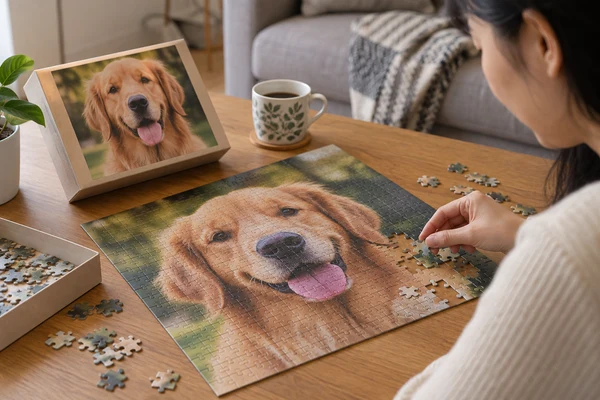
A custom pet photo puzzle needs a recognisable portrait, useful visual detail and a respectful approval process. For a B2B gift range, establish image rules that protect ears, eyes, whiskers and distinctive markings; then confirm the crop and any personalised text before printing. Choose a background and format that support assembly rather than simply filling the available space with a pet's face. This guide is for photo-gift brands and retailers developing dog, cat, collage and memorial collections. It focuses on subject-specific image decisions, message accuracy and privacy, while the wider order-handling workflow should be agreed separately for the actual manufacturing arrangement.
Define the custom pet photo puzzle range before accepting images
Decide which options the first range will support: one portrait, two pets, a collage, a pet-and-owner image or a memorial design. Each option creates different composition and text decisions. A tightly defined portrait template can be easier to review than an unrestricted design service, but it should not force every photograph into the same crop. Document which files fit the template and when the buyer needs another layout.
Specify the sellable product independently of the personal image: finished dimensions, piece format, board reference, finish, box and included reference material. A custom dog photo puzzle and a custom cat photo puzzle may share that construction while needing different portrait rules. Tell the manufacturing partner what is common and what varies; do not assume a personalised range automatically uses a particular minimum quantity or printing workflow.
The 500-piece retail format is one possible discussion reference for an adult gift range. Confirm its suitability through the actual image and sample. Customers may value a compact keepsake or a longer assembly experience, but the range should describe what it physically includes. Avoid medical, therapeutic or guaranteed emotional-benefit claims simply because the subject is a beloved animal.
Select portraits with recognisable features and useful detail
Ask for the original available image rather than a screenshot of a social post or a heavily compressed message attachment. Inspect focus on the eyes and face, not just the background. Check whether the animal's distinctive markings remain visible at the proposed print size. A large file can still contain a blurred pet, and sharpening cannot turn an out-of-focus portrait into a detailed capture.
Consider the animal's colouring against its surroundings. A black dog on a dark sofa may need review of fur and contour separation; a white cat against bright bedding may have weak edges. Adobe's shadow and highlight guidance explains local tonal correction and the risks of excessive adjustment. Use restrained comparisons where useful, and ask for another image when the source lacks the information needed for a believable print.
Look beyond the face for assembly landmarks. A textured blanket, garden path or distinctive toy can help distinguish regions. Large empty walls and uniform skies can make surrounding pieces repetitive. That may be intentional for an experienced audience, but a mainstream gift should not gain difficulty accidentally. The image-selection guide covers general composition; add pet-specific checks for markings, eyes and the relationship between the subject and its background.
| Feature | Review question | Practical response |
|---|---|---|
| Eyes and expression | Are they in focus at the intended scale? | Request a clearer original if necessary |
| Ears and whiskers | Will the crop remove identifying detail? | Adjust layout or choose another format |
| Dark or pale fur | Does the contour remain distinguishable? | Compare restrained tonal corrections |
| Background | Does it provide useful landmarks? | Review the full composition, not only the face |
Approve the crop without changing the animal's identity
Show the finished image boundary and proposed safe area in the approval preview. Leave room around ears, paws and tails where they are part of the chosen composition. Do not place a pet's name across an important eye or marking just because a template provides a fixed text box. The format should serve the image, and the image should remain recognisable after printing and cutting.
Distinguish a crop from a creative alteration. Removing a background, changing a collar or inventing a missing ear changes the photograph more substantially than trimming its edges. Explain any proposed alteration and obtain approval rather than quietly substituting an idealised pet. This matters especially when a customer identifies the animal through an unusual marking or accessory that a designer might otherwise regard as a distraction.
Use the preview to confirm both subject and orientation. A mirrored portrait can reverse distinctive markings even if the composition still looks attractive. A phone's display rotation can also conceal an unintended orientation during review. Include a stable image thumbnail with the approved version, then use the same source for the puzzle and reference card. If the layout changes after approval, identify the revision clearly and check the affected features again.
Ask for a different composition when the template does not fit
A full-body dog portrait and a close-up cat face do not necessarily suit the same aspect ratio. Offer a clear alternative route: another photograph, more surrounding space or a different approved layout. Avoid enlarging the head until ears are clipped or adding generated scenery without explanation. A simpler accurate composition is often more useful than an elaborate preview that no longer represents the customer's photograph.
Build collages and family scenes around a clear visual hierarchy
A custom collage photo puzzle should have a deliberate reading order. Choose a main image and a small group of supporting images rather than treating every upload as equally important. Keep borders, spacing and background style consistent. Review whether each pet remains identifiable at the final scale; a face that looks clear in the original can become too small when several photographs share one puzzle.
For a custom family photo puzzle that includes pets, assess human and animal features together. A layout that protects the dog's face while cutting off a person's head is not ready for approval. Avoid forcing different lighting conditions into a false impression that all photographs were taken together. A visible collage can preserve the source images honestly while still creating a coherent gift design.
Confirm which image belongs to each optional name. Multi-pet layouts need an unambiguous relationship between portrait and text. If a customer supplies the names Milo and Luna, do not infer their order from file upload timestamps. Present the labelled layout for approval and retain the approved mapping. For names with accents or unusual characters, check the actual exported print file rather than assuming the template font has rendered every character correctly.
Review your pet-photo range
Share cleared example images, proposed formats and personalisation options. We can discuss the sample questions and artwork boundaries for your B2B programme.
Handle memorial wording with accuracy and restraint
A custom memorial photo puzzle may carry a name, dates or a short remembrance chosen by the customer. Offer neutral optional wording and allow the customer to supply their own message. Do not assume the reason for the purchase or add a loss-related phrase to an ordinary pet portrait. A memorial option should be explicit, with its message shown in the same approval view as the image.
Treat dates as a transcription task, not a design guess. Clarify the requested date format and confirm ambiguous numerical dates before printing. Show the name, date and complete line together so the customer can judge both accuracy and layout. If a line breaks awkwardly, propose the revised placement without changing its meaning. Preserve the exact approved wording as part of the production reference.
Use respectful customer-facing descriptions. Explain the physical keepsake and personalisation options without promising that the product heals grief or provides a particular emotional outcome. Review packaging copy so it does not reveal a private message before the recipient opens the gift unless that is intended. A plain external identifier can support handling while keeping the remembrance inside the retail pack. The buyer should specify that requirement rather than expect packing staff to infer it.
Separate reproduction permission from privacy and promotional use
A customer appearing in a photograph does not necessarily own the image rights. The U.S. Copyright Office explains that the photographer is generally the initial copyright owner, subject to exceptions such as qualifying work made for hire. Establish an appropriate permission process for the markets you serve. A professional pet portrait may need permission covering the intended printed product, not merely permission to view or share a digital copy.
Customer files can also contain people, names, addresses on tags or other identifying details. The UK Information Commissioner's Office sets out purpose limitation, minimisation, storage and security principles. These provide a useful reference where applicable, while the responsible business needs to determine its actual obligations. Define why each file is used, who needs access and how long the relevant versions are retained.
Do not treat a production upload as permission to use the portrait in advertising, a sample gallery or an AI tool. Establish any additional permitted use separately. For internal layout demonstrations, use cleared example imagery and invented details. Share only the information a reviewer needs for the task, and keep private message approval within the agreed channel. These are practical design boundaries that should be reflected in the brand's actual systems and partner instructions.
Review believable print detail and the complete gift pack
Use representative sample imagery to establish the product's print and handling standard, then clarify how individual personalised artwork will be approved. Do not imply that every consumer order receives a bespoke physical proof unless that service is actually agreed. A digital artwork approval and a physical construction sample answer different questions. The buyer should explain their combined role in the range before making a customer-facing promise.
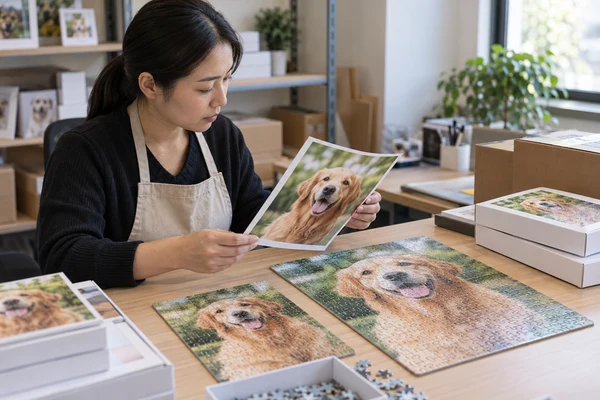
Inspect fur texture, eye detail, collar colour and important contours on the sample. Adobe's adjustment guidance cautions against excessive correction; this matters when lifting dark fur creates halos or unnatural colour. Check the proposed finish under ordinary table lighting and compare the puzzle with its reference image. Exact appearance across different materials should be assessed through the actual sample rather than guaranteed from a screen preview.
During agreed factory testing, compare selected units with the released construction and relevant artwork records. At shipment inspection, review the specified pack configuration, components and visible condition. The wider personalised-order guide covers identity handover; here, add the pet-specific acceptance features and sensitive-message requirements. Keep observations factual and do not describe selected checks as proof that every unit has been individually assembled.
- The released crop preserves approved subject features and orientation.
- Names, dates and portrait-to-name mapping match the approval.
- Puzzle and reference image use the intended personal artwork.
- Private details and additional image uses follow the agreed instructions.
 PuzzleZa
Send a subject-specific brief to the manufacturing partner
Describe the image types the range will accept, template boundaries and the construction to be quoted. Include representative cleared examples of a dark-coated dog, pale cat and multi-image layout if those options are planned. Explain how rejected files, creative corrections and customer approval will be handled. This helps the partner assess the actual work without assuming that all pet photographs need the same preparation.
Use the factory discussion to confirm proposed formats, sample scope and the limits of the intended manufacturing arrangement. Ask what information is required to quote standard construction separately from variable artwork work. Keep unknown quantity patterns and service responsibilities visible. A factory's general ability to make custom puzzles does not establish a one-order-at-a-time consumer service or a particular turnaround commitment.
Bring the range through PuzzleZa's contact page with quantity scenarios and the relevant customer requirements. Include a concise privacy instruction for the production files rather than sending unnecessary customer information with the first enquiry. Review the ICO's principles where applicable and align the final arrangement with the brand's approved policies. A recognisable portrait and clear approval are the foundation of a trustworthy personalised gift.
Frequently asked questions
What photograph works best for a pet puzzle?
Choose a clear original with focused eyes, recognisable markings and useful separation from the background. Check it at the intended print scale and protect ears or other important features in the crop. A large file alone does not prove image quality; blur, compression and weak tonal detail still need review.
Can dark fur be improved before printing?
Potentially, if the source contains recoverable detail. Compare restrained local corrections and inspect contours for halos or unnatural colour. If the original has featureless dark regions, request another image rather than promising restoration. Approve the printed appearance on representative material and distinguish it from a bright digital preview.
How should a multi-pet collage be approved?
Show the complete layout at a realistic scale, with each portrait and optional name clearly associated. Confirm crop, orientation, spacing and the relative size of important subjects. Keep the exact approved version. Do not infer which name belongs to which animal from upload order or silently alter distinctive features.
Should memorial wording be added automatically?
No. Make it an explicit option and show the complete requested text for approval. Confirm names, dates and ambiguous date formats without guessing. Describe the gift respectfully and avoid promising emotional or therapeutic outcomes. Keep any private remembrance inside the intended component rather than exposing it through unnecessary external labels.
Can customer pet photos be reused in marketing?
Only when the relevant rights and permitted use have been established separately. A production upload should not be treated as general promotional permission. Images may include identifiable people or private details, and the photographer may own copyright. Use cleared sample imagery for demonstrations and follow the responsible brand's applicable privacy policies.
Conclusion
A custom pet photo puzzle range should preserve identity, support a satisfying image and make personal approval dependable. Set portrait and collage rules, confirm sensitive wording and review representative printed construction before promising the finished gift. Keep image permissions and privacy boundaries explicit as the range develops.
Prepare a personalised gift brief
Contact PuzzleZa at info@PuzzleZa.com with your construction, quantity scenarios and image-approval requirements, or use the enquiry page. Avoid sending unnecessary private customer details.
Sources and scope
Sources reviewed on 2026-09-28. Manufacturing examples and review checklists are planning guidance, not claims about completed customer projects or guaranteed results. AI-generated images illustrate the topic and do not document an actual inspection.
- Adobe: shadow and highlight detail — Local tonal correction and the risks of excessive adjustment when reviewing fur detail.
- U.S. Copyright Office: guidance for photographers — The general distinction between photo subjects and photographic copyright ownership.
- UK Information Commissioner's Office: data-protection principles — Purpose, minimisation, retention and security considerations where UK data-protection rules apply.