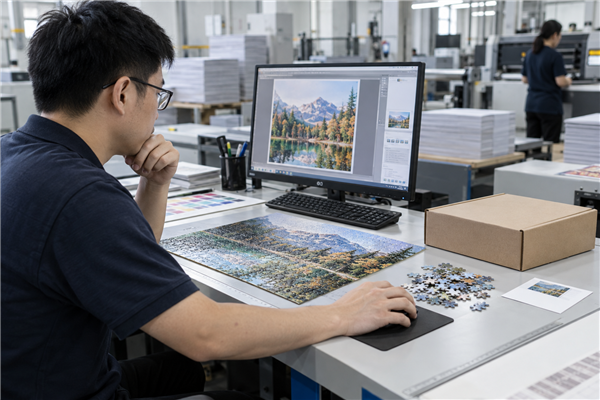
A personalized puzzle is not merely a standard jigsaw with a different image. Once a brand accepts customer photos, names or messages, the operation must connect the online order, image file, proofing decision, printed product, box and shipping label without mixing one customer’s data with another’s. A dependable personalized puzzle order process starts by reducing avoidable variation and documenting the handovers between storefront, prepress, production and fulfillment. This guide is for B2B brands building or improving a photo-gift program; it does not replace market-specific privacy, consumer or product-compliance advice.
Start with a decision-ready project brief
Start with an order architecture rather than an open-ended customization promise. Define the available formats, such as a personalized 500 piece puzzle and a personalized 1000 piece puzzle, their finished sizes, box style, expected source-image requirements, proofing rule, turnaround assumptions and customer-service escalation path. Every option should have a stable SKU or operational code. Shopify’s guidance, for example, notes that product variants can carry their own inventory, shipping and other details; the same principle is useful even if a brand uses another storefront. The factory or fulfillment partner needs a clean order record that connects the chosen format to the approved artwork and packing instruction.
A practical brief also makes comparisons fair. Give potential suppliers the same core information and ask them to identify assumptions rather than silently filling gaps. This keeps commercial choices visible: which part of the specification creates customer value, which detail is driven by the sales channel, and which item needs a decision from your team. It also gives the factory a usable starting point for installation preparation, prepress review and packing planning.
What a buyer should define before requesting a quote
- Target customer, sales channel, destination market and launch milestone.
- Quantity scenario, finished size, proposed piece count and product application.
- Artwork status, ownership or licensing position, and every planned printed component.
- Packaging direction, inserts, barcode or label needs, and any retailer routing requirements.
- Sample approvers, required factory testing, shipment inspection and freight handover owner.
Buyer checkpoints for this decision
- Each sellable format has a stable SKU or operational code, finished size, piece count and box specification.
- The order record, uploaded image, approved crop, proofing status and production file share one traceable identifier.
- The business defines which image issues can be automatically flagged and which need a human decision before print.
- Packing and dispatch checks match the order ID, product format, address label and protective packaging before release.
Personalization reliability is built from controlled handovers, not from an assumption that a good-looking image will automatically become the correct delivered product. A consistent naming convention and a clear exception queue are often more valuable than adding many loosely controlled options.
Choose the product around the customer experience
The most useful personalization programs give customers meaningful choices while keeping production paths manageable. Limit the first release to combinations that have a clear commercial purpose: a defined piece count, size, box direction and approved crop format. If a customer can choose a name line, message or date, decide where that data is shown and how it is validated. Do not treat photo upload, special text, image crop, print proof and order release as separate informal tasks. They are one controlled product record. A custom photo puzzle from picture should not enter print until the asset, crop and order identifier agree.
When comparing options, ask what changes for the person who receives the product. A specification should have a visible reason: perhaps it protects detailed art, makes an educational activity clearer, supports a gift-worthy unboxing sequence or fits a retailer's shelf. This discipline prevents a common sourcing error in which individual choices look attractive on their own but do not form a coherent customer experience when packed together.
It is also useful to make trade-offs explicit. A more complex format may affect development work, component control or logistics. A simplified pack may improve fulfilment but leave less room for story content. Neither result is inherently right or wrong. The value of a B2B manufacturer conversation is that product, creative and operational implications can be reviewed together while the option is still affordable to change.
Common sourcing risk to avoid
Avoid using a customer image, message or proof from one order as a generic production example or keeping it in a shared folder indefinitely. The operational goal is to reproduce the approved order, then retain or delete data according to the business’s documented purpose and applicable obligations.
Design the option set before opening photo uploads
Personalization can create more combinations than a team can safely manage. The solution is not to eliminate choice; it is to define the choices that the operation can reproduce. Start with a small format matrix. For each format, record the finished puzzle dimensions, piece count, board and finish, box construction, internal component list, price logic, shipping profile and production route. A customer should see a clear distinction between a personalized 500 piece puzzle and a personalized 1000 piece puzzle rather than a vague selector whose physical result is unclear.
Then decide what belongs in a conventional product variant and what should be collected as order-specific input. Piece count, size and box option are usually stable product choices. A photo, name or short message may be order-specific information. Separating those jobs gives the storefront, prepress and factory a more reliable handover. It also helps customer-service teams explain what can change after an order is placed and what requires a new proof or revised production file.
For growing programs, calculate operational complexity before adding options. A second size can multiply the number of artwork templates, box files, shipping profiles and fulfillment checks. A controlled launch gives the team real evidence on rework, file quality and packing errors before it expands the catalog. This is more useful than offering every combination and discovering the process only after customer orders arrive.
- One visible format name, size and piece count for each sellable option.
- One template and safe-area rule for every format and box artwork version.
- One accepted route for photo upload, replacement, proofing and release.
- One order identifier that stays with the digital file, physical product and shipment.
Turn photo puzzle image tips into a repeatable artwork check
Photo puzzle image tips should be operational rules, not a long marketing disclaimer. Tell customers what helps an image reproduce well at the actual finished size: a source image with enough detail, a clear focal area, reasonable brightness, a crop that leaves important faces or objects away from trim and no expectation that a tiny phone screenshot will print like a high-resolution original. Use the exact template for the selected format so the preview resembles the production crop rather than a generic square mock-up.
Set a clear exception path. An automated system can flag a missing file, unsupported format, unusually small image dimensions or a crop that leaves important areas outside the safe zone. A trained person should decide ambiguous cases, such as low contrast, very dark artwork, heavy compression or a photo where the puzzle cut may make the main subject difficult to recognize. The point is not to judge the customer’s image taste. It is to prevent an avoidable mismatch between the expected and produced result.
If the brand uses a proof, specify what the proof means. Does the customer approve the crop only, or the final printed appearance as well? Is there a response deadline? What happens if no response arrives? Give prepress teams the same rule set that customer-service teams communicate. This keeps a personalized puzzle order process consistent even when seasonal order volume grows.
Build a file-to-carton chain of custody
Once a proof is approved, the order should move through a simple chain: approved file, production queue, printed component, die-cut puzzle, bagged unit, retail box, shipping carton and dispatch label. Each handover must carry the order identifier. In a batch of unique products, the identifier is more dependable than visual memory. Scanning or checking it at key points helps reduce the risk that two similar landscape images or two versions of a name message are packed into the wrong shipment.
Factory testing in this context can verify that the correct physical format and approved production file are paired, that pieces separate cleanly, that the bag and box are present, and that the visible packing result matches the controlled record. For a personalized program, shipment inspection or dispatch verification also needs to consider identity pairing—not simply the cosmetic condition of a generic sample. Create an exception log for mismatches, damaged units, late proofs and reprints so the business can find a process cause rather than only handling a single complaint.
Finally, design receiving and customer-service preparation before dispatch. Retain a practical order trail: order ID, selected option, proof status, production date, carrier handover and any reprint decision. Keep access narrow and retention purposeful. This allows the business to answer a delivery question, investigate an exception or plan a repeat order without treating customer assets as a permanent shared library.

 PuzzleZa
Use the sample as evidence, not as a formality
Sample approval has two layers in a variable-data program. First, approve representative physical products for every intended format, including the board, finish, cut quality, bag and box. Second, approve the operational workflow: image intake, file naming, crop review, automated or manual checks, proofing thresholds, production queue and pack verification. During factory testing, the team can check print appearance, piece separation, correct format and component packing against the specified order record. Shipment inspection should focus on the controls appropriate to the order model, such as sampled identity matching, correct box format, label pairing and protective packing. It should not be described as a substitute for the brand’s privacy, consumer or market obligations.
Bring the relevant teams into the review in the right order. Creative reviewers can confirm image, copy and visual hierarchy. Product and purchasing teams can check material, components and the commercial specification. Operations teams can review carton information, receiving limits and delivery readiness. Consolidate their feedback into one documented response so the factory receives a clear decision rather than conflicting comments from separate email threads.
The approved sample should answer a practical question for everyone involved: is this the product we are prepared to reproduce, pack, inspect and deliver?
Version control matters at this point. Reference the exact artwork, packaging and component versions in the sample-approval record. If a revision is needed, identify what changed, why it changed and whether another physical sample is necessary. This is not administrative overhead; it is the evidence quality and production teams use later when a project contains several files, SKUs or market versions.
Send Your Requirements
Share the product idea, quantity, artwork status and destination. We will help turn them into a practical custom puzzle brief.
Plan quality control, packing and delivery together
The fulfillment plan should state who owns each data handover and for how long data is kept. Customer images and names may be personal data, so use purpose-limited access, restrict files to the people who need them, and avoid storing unrelated customer material in production folders. The UK ICO’s data-minimisation guidance explains the general principle of keeping personal data adequate, relevant and limited to what is necessary for its purpose. Businesses serving other markets should obtain their own advice on applicable rules. In practical terms, use order IDs, controlled folders, access permissions and a documented deletion or retention process. At dispatch, match the packed item to the order record and keep only the production and shipment evidence that the business genuinely needs.
For the factory, an inspection plan is most useful when it focuses on the details that define your product: correct artwork and pack version, print appearance, die-cut or component checks where relevant, bagging, inserts and carton marks. For the buyer, that same plan makes shipment inspection easier to interpret because the inspector can compare selected finished units with a known approval reference. It also gives freight teams a more reliable handover point.
Keep a final release file with the approved specification, production contact, inspection observations, carton information and agreed shipment documents. This supports a smoother first delivery and becomes valuable information for replenishment. The goal is not to eliminate every uncertainty in a custom product. It is to resolve the important ones at the stage where a correction is still manageable.
Apply the guide to your next puzzle project
This workflow is useful for photo-gift brands, direct-to-consumer retailers, employee-recognition programs and travel, pet or family-image collections. It is particularly valuable when a business wants personalized puzzle wholesale support without losing the traceability that a customer expects from a made-to-order gift.
Use this article as a working conversation tool. Share it with the people who own artwork, purchasing, product compliance and freight, then collect the unanswered questions before a quote is requested. A precise enquiry helps a factory respond with relevant options and helps your internal team distinguish confirmed requirements from preferences that still need a decision.
For material and sourcing context, see Shopify guidance on product variants, Shopify guidance on using SKUs, ICO guidance on data minimisation. For project-specific manufacturing support, explore our custom puzzle formats, Shenzhen factory capability and production process.
FAQ
What is the most important control in a personalized puzzle order process?
Use one traceable order identifier from upload through proofing, production, packing and dispatch. It gives every team a common reference when similar images or several formats are handled at once.
Should a photo-gift brand offer both 500- and 1000-piece personalized puzzles?
It can, if each format has a clear customer purpose and the business has separate templates, product records, packing checks and shipping assumptions. Add options only when the operational path is defined.
How should a brand handle poor customer photos?
Publish useful image requirements, flag obvious problems early and define when a human review or customer confirmation is needed. Do not print an uncertain crop simply because the upload succeeded.
What should be checked before dispatch?
Verify the order ID, approved artwork or proof status, selected format, packed product, address label and protective shipping pack. Record exceptions before the parcel enters the carrier network.
Conclusion
A successful personalized photo-puzzle fulfillment program begins with a defined customer outcome and ends with an approved, inspection-ready pack. Align the brief, sample, quality checks and delivery plan early; it gives your team a better basis for an accurate quote and a more dependable first shipment.
Get a Quote