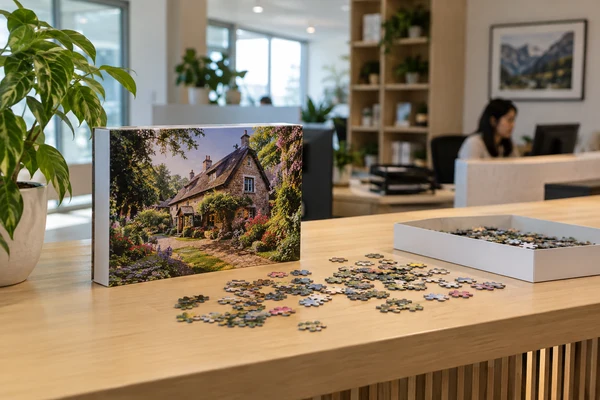
A successful real estate or employee onboarding puzzle gift begins with the recipient, the occasion and the information needed to produce the correct pack. Choose a relevant image, keep branding proportionate, and separate product approval from the recipient list. A custom puzzle for real estate gift programmes might celebrate a new home without exposing an address; a custom onboarding puzzle might express company values without turning the activity into compulsory homework. This guide focuses on the project brief, personalization records and distribution handover. It complements our broader promotional-puzzle guide by addressing the practical differences between an HR welcome and a property closing. The examples below are hypothetical planning scenarios, not reports of completed customer projects or promised results.
Define the occasion and the recipient's first impression
A property closing and a first day at work share a welcome moment, but they create different expectations. A home buyer may value an image of the neighbourhood, a tasteful architectural illustration or a simple message from the agent. A new employee may appreciate an informal activity that introduces the business without demanding unpaid preparation. Record what the recipient should feel and what they should understand when opening the box. This decision guides the tone of the image and accompanying card more effectively than a large logo.
Describe when and where the gift will be received. A closing gift handed over in person has different handling requirements from a pack shipped to a remote employee. An office welcome desk permits a larger box; a residential delivery must fit the recipient's actual receiving arrangements. Ask the project owner whether the puzzle is intended for individual use, a shared household activity or an optional team conversation. Do not infer that every recipient enjoys complex puzzles or has space for a long assembly session.
Create a brief with a primary audience, an opening context and an explicit exclusion. For a hypothetical HR project, the exclusion might be employee photographs or internal account information. For a property project, it might be exact addresses on the outside packaging. Use the broader branded promotional puzzle guide for campaign considerations, then add the privacy and handover controls that this more personal gift requires.
Choose imagery that remains appropriate after the welcome
A custom logo puzzle can communicate identity, but the recipient still needs an image worth assembling. Consider a restrained brand motif, original illustration, local landscape or workplace-related scene with a clear visual structure. A puzzle composed almost entirely of a flat logo can create large areas with few assembly cues. Review the balance between brand visibility and product application: will the recipient want to keep the finished image, and does it still make sense after the original occasion has passed?
For property gifts, distinguish an individual house photograph from a broadly reusable neighbourhood design. The first may need owner approval, photography permission and recipient-specific file control. The second can support a recurring programme with less personal data, subject to the image rights. Do not assume a photograph found in a property listing can be reproduced commercially. The U.S. Copyright Office's photographer guidance explains that photographic rights normally begin with the photographer, with particular exceptions.
An onboarding image should avoid confidential screens, employee identification badges and material that only current staff can interpret. A hypothetical illustrated scene of company values may work better than a photograph containing individual employees. Ask the brand reviewer and HR owner to approve the same final crop. If several office locations use different imagery, identify each version clearly and keep the common packaging text consistent. Confirm permissions for printing and promotional photographs before the artwork is released.
Decide where personalization belongs
Personalization can appear on the puzzle face, box, removable sleeve or separate message card. These locations create different production and correction consequences. A personalized puzzle face makes each item recipient-specific throughout manufacturing. A common puzzle with an individual card can preserve a reusable core product while the packing team handles variable information later. Ask the supplier which approach is feasible for the intended quantities; this discussion does not establish a minimum order or a variable-printing capability.
Keep sentiment separate from information used for delivery. A first name on an internal card may be enough to make a gift feel considered. Full legal names, exact home addresses, employee numbers or joining dates may have no useful role in the printed product. The ICO's data-minimisation guidance supports collecting and retaining only information needed for the defined purpose. Apply the relevant privacy rules to your actual programme and jurisdiction.
Specify punctuation, accents, name order and the treatment of missing fields. A personalized phrase can become awkward when a recipient has no preferred name on record. Provide an approved fallback rather than allowing a packing operator to improvise. Use a dummy recipient for the first layout review. The named final approver should then verify the actual variable-data file, while the supplier confirms the physical component and matching process. Limit access to the people who need it for that task.
Separate content data from routing data
Maintain one approved content record for the printed message and a separate controlled routing record for distribution. Connect them with a project identifier rather than copying unnecessary private information into artwork filenames. Agree how corrections, access and deletion will be handled before transferring the files. This operational structure supports privacy review without claiming that a particular spreadsheet or supplier arrangement is automatically compliant.
Match the format to a comfortable recipient experience
Choose piece count by the expected occasion, recipient range and available assembly space. A welcome gift that should feel accessible may benefit from fewer pieces and strong image cues. A detailed art puzzle can suit recipients who actively enjoy extended assembly. Avoid assigning a difficulty solely from piece count: repeated windows, plain sky and subtle gradients can affect the experience substantially. Ask for finished dimensions and a representative cut pattern before deciding what belongs in the pack.
A custom branded puzzle should be considered as a complete opening sequence. Can the recipient understand the image, remove the inner containment easily and find a reference picture? Will the box store the pieces after the first session? A discreet company mark may be more appropriate on the box or card than across the central artwork. Compare the promotional puzzle kit and premium gift-set references, then confirm the actual construction with the supplier.
Specify whether an agent's contact information or an HR support link belongs on the card. Keep those details secondary to the welcome message and review them for future validity. A gift should not direct a recipient to an expired campaign or an internal page they cannot access. If a QR code is proposed, approve its destination and print readability separately. Include a plain alternative contact route so the message remains useful when a phone or network is unavailable.
Plan the welcome experience
Send the gift occasion, recipient profile, artwork idea and proposed personalization location. PuzzleZa can discuss the product brief and the manufacturing questions that need confirmation before sampling.
Build a distribution and exception checklist
Map the path from approved goods to the recipient. Identify the person who receives cartons, stores packs, assigns recipients and authorizes replacements. Property gifts may be issued one at a time by agents; HR gifts may be handed over in monthly groups. These patterns require different internal records. Agree whether the supplier is delivering a bulk common product or performing recipient-specific packing. Never assume direct-to-recipient fulfilment is included in a manufacturing quotation.
Use an exception log for cancelled closings, postponed start dates, name changes and uncertain addresses. The project owner should decide whether an exception stops packing, holds dispatch or changes a card only. A colleague forwarding an old spreadsheet should not restart a cancelled item. Give the receiving team a concise matching reference and explain how to quarantine a pack that cannot be confidently assigned. Correcting a mismatch before handover is more controlled than asking the recipient to return a personal gift.
Keep counts at the right level. Record the quantity of common puzzles, personalized components and completed recipient packs separately. If a card is changed, the common product may still be reusable; a puzzle face containing the wrong name may not. This distinction helps a buyer understand the practical consequence without inventing a waste percentage. Agree who reviews remaining stock and what happens to unused personal components after the programme closes.
| Record | Owner | Release question |
|---|---|---|
| Common puzzle | Product buyer | Is the approved version identified? |
| Message data | HR or gift owner | Are names and fallbacks verified? |
| Routing record | Distribution owner | Are holds and corrections current? |
| Exception log | Programme lead | Who can authorize release? |
Review a representative complete pack before release
Request a sample that shows the agreed artwork, physical format, box, reference image and message location. A visual mock-up can review tone, while a physical sample can reveal opening and handling issues. Ask which details are represented and which remain provisional. For a recipient-specific programme, review a dummy example and a controlled matching demonstration before the real list is used. Sampling should answer a defined question rather than simply provide something attractive for management.
Write observable acceptance points. The card must use the approved name field; the reference image must match the puzzle crop; the box must open without damaging the message component; and the approved artwork must be clearly identified in the release record. Factory testing and shipment inspection should be scoped against those customer requirements. These are proposed review actions, not claims that testing has already occurred. Keep the buyer's final release decision attached to the exact file and sample versions.
Ask a colleague unfamiliar with the project to open the sample and explain what they believe it is for. This informal usability review can reveal confusing wording or an overlooked reference card. It does not establish a customer satisfaction score or predict engagement. Record observations as practical changes, such as moving a card to the first visible position or simplifying an instruction. Reapprove affected components after revisions; do not assume an earlier approval extends to a newly changed message.

 PuzzleZa
Prepare the receiving team and the enquiry route
Installation preparation for this application usually means setting up a welcome desk, gift cupboard or agent handover station. Provide the box dimensions, handling sequence and storage arrangement needed by that team. Keep personal packs away from public display where names might be visible. For remote distribution, ask the logistics owner to confirm transport protection and receiving requirements using the actual delivery route. A gift box is not automatically a shipping carton.
Give staff a short handover script that explains the optional puzzle activity and where to ask about a damaged pack. Avoid promises that the gift will build loyalty, improve retention or make a property purchase more memorable. These are outcomes a programme might evaluate, not guaranteed product functions. The staff member should know how to record an issue without requesting unnecessary personal information or photographing the recipient without permission.
Use the project enquiry page to submit the audience, format ideas, quantity scenarios and distribution method. Start with anonymized examples when reviewing variable content. The Shenzhen factory overview provides supplier context, but the proposed service scope still needs confirmation. Separate manufacturing questions from your organization's privacy, employment and property-transaction policies so the right people own the right approvals.
Retain a reusable programme record
After release, keep the common product specification, approved artwork, card template and distribution procedure together. Store personal records according to the approved retention arrangement rather than retaining them indefinitely because a reorder might occur. A reusable template should contain placeholders and formatting rules, not an old recipient list. Name the person who can authorize a new production batch and the person who can approve fresh variable data.
A custom promotional jigsaw puzzle used across several branches needs a controlled common core and clearly named local variants. For example, a hypothetical business may keep one puzzle image while replacing the branch contact card. Confirm whether the box contains information that also needs updating. Record retired designs and message versions so a receiving team does not accidentally issue obsolete stock simply because it looks similar to the latest pack.
Evaluate the programme through relevant observations: mismatched records, difficult opening, unresolved delivery exceptions and the usefulness of the chosen image. Collect feedback voluntarily and summarize it without attaching personal recipient details to a general product review. Improvements should become a specific revision brief with an owner and approval step. This creates a repeatable procurement process while keeping the gift thoughtful and proportionate to its occasion.
Frequently asked questions
Should every puzzle have the recipient's name?
No. A common puzzle with a personalized card can be a practical alternative where the brief permits it. Individual puzzle faces require more careful file matching and correction control. Confirm the supplier's feasible scope rather than assuming either route is available at every quantity. Choose the location that adds useful meaning for the recipient.
Can an agent use a house-listing photograph?
Confirm the photographic rights and any other permissions relevant to the intended use. Access to a listing image does not itself establish permission to print merchandise. Record the approved image, permitted product use and any credit requirements. A local illustration or licensed neighbourhood image may offer a less personal alternative.
What information belongs in an onboarding gift file?
Only the information needed for the approved content and matching process. Separate the printed message from delivery data, use a project identifier and define a fallback for incomplete names. HR and privacy owners should approve the actual handling arrangement. Do not add employee identifiers simply because they exist in a source database.
How should postponed recipients be handled?
Use a controlled hold status and one named person who can release it. State whether the change affects dispatch, the card or the entire puzzle face. Retain the current approved record and prevent old lists from reopening cancelled entries. Tell the receiving team how to isolate packs with unresolved matching questions.
What should we send for a first quote discussion?
Provide the audience, gift occasion, tentative artwork, format preference, quantity scenarios and distribution route. Explain whether personalization is on the face, box or insert. Use dummy names until real information is necessary and authorized. Include the intended approval owners and any fixed handover date as planning inputs rather than assumed commitments.
Conclusion
Real estate and onboarding puzzle gifts work best when the product and the recipient record are planned together. Define a useful image, a restrained brand presence and an appropriate opening experience. Then control names, approvals, exceptions and distribution through a clear handover record. A welcome gift becomes easier to repeat when its personal meaning does not depend on improvised production instructions.
Prepare a controlled business-gift brief
Share anonymized message examples, quantity scenarios, the intended format and your distribution arrangement. We can review the proposed puzzle and packaging scope before you approve real recipient information.
Sources and scope
Sources reviewed on 2026-10-09. Manufacturing examples and review checklists are planning guidance, not claims about completed customer projects or guaranteed results. AI-generated images illustrate the topic and do not document an actual inspection.
- U.S. Copyright Office: photographers and copyright — Image rights need review before merchandise reproduction.
- ICO: data minimisation — Limit personal information to the defined purpose.