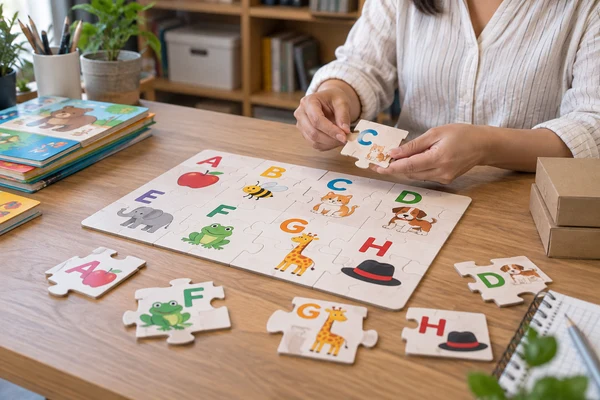
A custom alphabet puzzle or custom number puzzle should begin with a precise learning objective and an educator-reviewed content map. Decide what the learner will recognize, compare or explain, then connect the artwork and piece layout to that task. A correct sequence of letters is not enough if the accompanying pictures introduce ambiguous sounds; a number theme is not enough if quantities and numerals disagree. This guide helps education publishers and programme buyers prepare accurate content and a practical classroom brief. It complements our general school-puzzle and preschool development guides by focusing on language, quantity representation and lesson handover. Examples are hypothetical planning illustrations. A puzzle activity does not establish a developmental benefit or demonstrate safety compliance by itself.
Define one learning objective and its evidence
Begin with a sentence describing an observable task. For alphabet content, a learner might identify selected letter forms or connect a familiar word to an initial sound. For number content, the task might be matching a numeral to a quantity or ordering a short sequence. These are different objectives and should not be combined casually into one crowded image. Identify what an educator will ask and what response would show understanding.
A custom educational puzzle can support a lesson without becoming the entire lesson. Decide whether it introduces a concept, provides guided practice or supports informal discussion after teaching. The NAEYC definition of developmentally appropriate practice emphasizes play-based learning that responds to individual and cultural context. Use that principle to review the task with qualified educators; it does not certify the effectiveness of a particular puzzle or prescribe one universal design.
Separate the activity goal from a marketing claim. Saying that the illustration gives opportunities to discuss quantities describes an intended use. Saying that it guarantees faster mathematics learning requires evidence this brief does not supply. Record the age context, language, prior knowledge and support expected from an adult. The general educational-puzzle guide covers the wider buying framework; here the key record is the content-to-task map.
Build an alphabet content map with linguistic review
List every letter, word and illustration before commissioning final artwork. Decide whether the puzzle uses uppercase, lowercase or both, and choose letter forms appropriate to the teaching context. Different printed forms can be familiar in one setting and unfamiliar in another. Ask the curriculum reviewer to assess the selected typeface and handwriting conventions. A decorative font should not make a letter harder to identify merely to fit a brand style.
Review the relationship between the picture and the lesson. An image with several plausible names may be visually attractive but weak for initial-sound practice. The intended word should be familiar to the target learners and appropriate to their language variety. A picture named differently in another English-speaking market can create confusion. Do not assume an alphabet illustration can be translated by replacing the text while keeping every picture unchanged.
Check sequence, duplicated letters, omitted characters and repeated symbols against a controlled content sheet. Have an independent educator review the complete artwork after layout, because moving an image or resizing a label can change the relationship. Keep the source vocabulary and final printed word connected by an identifier. This is a prospective review process, not a claim that any design has already been evaluated in classrooms.
Choose the sound task deliberately
Letter-name recognition and initial-sound recognition are related but distinct tasks. State which one the puzzle is intended to support, and have an appropriate language specialist review ambiguous examples. Include an educator note where a picture has more than one reasonable name. Avoid presenting an illustrative vocabulary choice as a universal phonics sequence or a replacement for the publisher's curriculum.
Represent numbers consistently and honestly
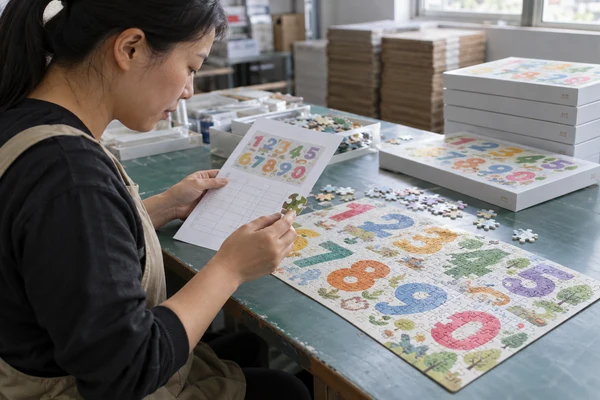
A numeral, a number word and a pictured quantity should agree. Count objects manually against the content map rather than relying on the apparent density of an illustration. Overlapping, cropped or partially hidden objects can make the intended total unclear. Decide whether all objects are deliberately countable and whether the learner is expected to count them one by one, recognize a familiar arrangement or compare groups.
Do not combine a counting task with decorative objects that look like additional countable units unless the distinction is clear. For example, a hypothetical illustration might show a group of apples beside unrelated stars; the educator should know which items the activity asks learners to count. If the puzzle includes zero, review whether an empty grouping is communicated in a meaningful way. Avoid implying that the absence of one pictured object automatically teaches the concept.
Use a consistent visual grammar across the number range. Numeral style, object scale and grouping conventions should not change unpredictably between panels. Where multiple representations are intentionally compared, explain that choice in the educator notes. Ask the reviewer whether the layout supports the intended task when partially assembled. The learner should not be forced to guess missing information that the lesson treats as already visible.
Decide how the cut relates to the educational content
The cutting pattern can support or interrupt a content relationship. A piece boundary through a small letter may make recognition harder; a group of objects split across several pieces may turn counting into a different task. Ask for the actual proposed cut layout where possible and review it against the content map. Do not infer piece size or finished dimensions from the count alone.
An activity can invite a learner to locate a letter within a complete scene or to connect matching content across pieces. Those approaches require different artwork and instruction design. Confirm whether the manufacturing process can support the proposed relationship; this article does not assert custom symbol-shaped cuts or particular tooling capabilities. Keep the brief flexible until the factory has reviewed feasibility, then approve the real layout rather than a conceptual sketch.
Evaluate contrast and visual clutter at the finished printed scale. Educational labels must remain recognizable, while assembly cues should not overwhelm the target symbol. A colourful design can still have indistinct text or repeated shapes that conceal the intended relationship. Compare the educational puzzle reference and children's puzzle reference, then request confirmation of the actual format and construction.
Review a partially assembled learning image
Educational content may be viewed before the puzzle is complete. Ask the educator to review several plausible partial states, not only the finished illustration. A numeral visible without its quantity group may invite an unintended answer; a letter cut across two pieces may be unrecognizable until joined. Decide whether that is a purposeful part of the task or a distraction. The answer depends on the lesson, not on a universal rule that every symbol must fit one piece.
Use a simple review record showing the content relationship, the possible interruption and the proposed response. The response might be moving a label, changing the illustration, revising the teacher prompt or selecting another feasible format. Ask the factory to review the actual physical implication of the change. Keep educator approval attached to the revised layout so the first concept does not continue circulating as the approved version. A partial-state review is a design exercise; it does not establish a measured learning improvement or replace review with real educators in the intended context.
Review your educational content map
Send the proposed letters, vocabulary or number representations together with the intended learning task. We can discuss the physical format and artwork questions that need manufacturing review.
Write teacher instructions that preserve the lesson
A custom learning puzzle needs clear activity notes describing preparation, prompts and the intended response. State whether the image is reviewed before assembly, discussed during the activity or used afterwards. An educator should know whether to model one example, ask open questions or let learners explore first. Keep instructions short enough to use at the table while preserving the purpose of the activity.
Distinguish puzzle completion from understanding. A learner may place a piece by colour without identifying its letter, or assemble a number panel without counting the pictured group. Include a prompt that reveals the target knowledge, such as identifying the symbol or explaining a quantity comparison. Treat the response as an observation within the learning context, not a diagnostic assessment or a developmental score.
Provide adaptations for language and participation differences without claiming universal accessibility. An educator may use selected regions, pair learners or offer a larger reference picture, subject to the actual lesson needs. NAEYC's practice guidelines offer a broader framework for contextual professional judgement. The publisher remains responsible for the suitability and accuracy of its activity notes rather than assigning that role to the manufacturer.
Review safety and physical use as a separate workstream
Content accuracy does not establish that a children's product meets destination-market requirements. Define the intended age group, materials, dimensions, components and markets, then ask the responsible compliance specialist or laboratory which requirements apply. Small pieces and detachable parts deserve deliberate attention. Warnings should follow the applicable assessment; they are not a shortcut around a prohibited product configuration.
The CPSC's small-parts guidance addresses U.S. children's products and explains important age-related restrictions. Confirm the actual scope with the appropriate professional. A classroom setting or adult supervision does not by itself make every product configuration acceptable. Other markets require their own review, and the proposed order should identify who supplies the relevant evidence.
Plan the physical sample review around handling, opening, reference visibility and storage. Factory testing can compare selected construction attributes against an agreed specification, while required laboratory testing addresses applicable product requirements. Neither a photograph nor an educator's favourable comment substitutes for that evidence. Record the approved component list and review any later substitution for both content effects and compliance implications.
 PuzzleZa
Approve content and product through distinct gates
Use an educator sign-off for letters, vocabulary, numbers, quantities and instruction accuracy. Use a product sign-off for the actual printed layout, cut, board, packaging and reference components. A technical reviewer can identify a label close to a piece boundary; the educator decides whether moving it changes the teaching relationship. Name one person who consolidates the comments so the supplier receives a single coherent revision.
Review a proof with the full content map beside it. Check the puzzle face, box image and teacher card against the same final version. A corrected numeral on the face must not remain incorrect in a reference image. Confirm what the proof represents and what still requires physical review. Retain the approved file and sample reference, then freeze the release version so a later unapproved edit cannot silently enter production.
Shipment inspection should include the correct language version, image and teacher-note component where those are part of the order. Write observable acceptance criteria and identify the decision owner. These are proposed checks, not reports of completed inspections. The Shenzhen factory overview provides supplier context, while the project-specific record establishes which content and physical checks the buyer requires.
| Gate | Reviewer | Question |
|---|---|---|
| Content | Educator | Do letters, words and quantities agree? |
| Lesson | Programme owner | Does the prompt reveal the target understanding? |
| Artwork | Designer and educator | Do scale and cut preserve meaning? |
| Product | Buyer | Does the complete pack match the specification? |
| Compliance | Responsible specialist | Is applicable evidence available? |
Prepare classroom handover and future revisions
A custom classroom puzzle should arrive with information that lets staff set up the intended activity. Installation preparation means table space, reference-image access, group allocation and component storage. State the finished size and the number of complete sets supplied. Provide a way to distinguish sets without placing learner names on the product. If several classes share materials, identify who checks completeness and handles damaged components.
Keep the educator notes, master image and approved content sheet available to the programme owner. Feedback should describe an observed issue clearly: a picture has several common names, an object count is hard to see, or a piece boundary interrupts a symbol. Do not treat one observation as evidence that all learners need the same change. Review proposed revisions with the appropriate educator and reapprove affected physical components.
Before a reorder, confirm whether vocabulary, curriculum context, language, artwork or construction has changed. New learning claims need their own evidence rather than stronger copy alone. Send PuzzleZa the content map and proposed product brief with age context, markets, quantity scenarios and approval roles. A well-defined brief allows manufacturing feasibility to be discussed without shifting educational responsibility away from the publisher.
Frequently asked questions
Does an alphabet puzzle automatically teach phonics?
No. Letter names, letter forms and sound relationships require distinct objectives and educator review. A learner can assemble an image using colour cues without demonstrating the intended language understanding. Include an appropriate prompt and accurate vocabulary, and avoid advertising learning outcomes that the product has not been shown to deliver.
Should alphabet pictures change between English-speaking markets?
Possibly. Familiar words, naming conventions and curriculum expectations can differ. Review the image-word relationship with educators familiar with the intended learners. Replacing a printed word alone may leave an unsuitable picture. Keep the approved vocabulary and language version identified across the puzzle, packaging and educator notes.
How do we check a number design?
Compare every numeral, word and pictured quantity against a controlled content map. Count visible objects and check whether cropping or overlap creates ambiguity. Review decorative elements that could be mistaken for countable units. Approve the complete printed layout after changes rather than relying only on an earlier illustration sketch.
Can the piece layout follow the learning task?
Ask the manufacturer to assess the specific proposal. A conceptual content map does not confirm that a particular cutting arrangement is available or suitable. Review the actual cut against labels and object groups, then approve the physical representation. Keep feasibility, lesson accuracy and safety requirements as separate approval questions.
What does the first enquiry need?
Provide the learning objective, language, age context, content map, intended activity and destination markets. Include proposed dimensions, component notes and quantity scenarios where available. Name the educator and product approvers. Explain required compliance evidence separately so the quotation discussion does not confuse educational suitability with product conformity.
Conclusion
Alphabet and number puzzles need more than appealing educational decoration. Start with a defined task, verify the content relationships and review how the printed scale and cut affect them. Give teachers a practical activity brief, distinguish assembly from understanding and maintain a separate safety workstream. A controlled content-to-product handover gives publishers a clearer basis for approval and future revision.
Prepare an educator-approved product brief
Share the age context, language, destination markets, content map and quantity scenarios. PuzzleZa can review the manufacturing scope while your education and compliance owners retain their respective approvals.
Sources and scope
Sources reviewed on 2026-10-09. Manufacturing examples and review checklists are planning guidance, not claims about completed customer projects or guaranteed results. AI-generated images illustrate the topic and do not document an actual inspection.
- NAEYC: developmentally appropriate practice — Learning activities should respond to individual and cultural context.
- NAEYC: practice guidelines — Educator judgement and contextual planning.
- CPSC: small parts guidance — Age-related small-parts requirements require separate review.