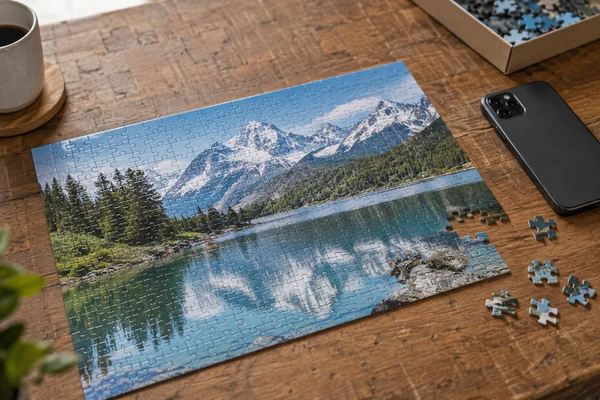
For a custom travel photo puzzle, choose the image for both its memory and its assembly structure, then retrieve the best available original file before preparing a print crop. A picture that looks attractive on a phone can contain compressed detail, distracting background subjects or broad areas that are difficult to assemble. A custom vacation photo puzzle therefore needs a curation and approval workflow, not just a file upload. This guide helps photo brands and gift teams move from mobile image selection to a controlled production brief. It focuses on source retrieval, image privacy and the final approved photograph, complementing our broader artwork and resolution guides. All project examples are hypothetical; no described review represents a completed factory test or a guaranteed printing result.
Curate travel photographs for assembly as well as memory
A strong holiday photograph is not always a comfortable puzzle image. A tiny figure against an uninterrupted sea may preserve an important memory but provide little variation across many pieces. A street scene with distinct architecture, vegetation and colour areas can offer more useful assembly cues. Start by identifying the memorable subject and then inspect the rest of the frame. Ask whether the image has enough varied regions to support the intended format without making an unsupported claim about assembly time.
Use a shortlist rather than accepting the first submitted photograph automatically. Compare subject position, sharpness, repeated patterns and large plain areas. A photo brand could ask customers to provide several originals and nominate a preferred image, subject to a defined editorial review. This hypothetical process needs a stated scope: are you selecting a crop, correcting basic exposure or offering a broader editing service? Confirm the supplier's role before promising any of those services to retail customers.
Consider how the travel story survives cropping. A wide panorama may lose the destination's identifying feature when fitted to a different aspect ratio. An attractive vertical view may place the horizon awkwardly in a horizontal puzzle. Show the proposed crop with the actual planned dimensions and ask the image owner to approve it. For wider image-selection principles, see our guide to selecting puzzle imagery.
Retrieve the original mobile file and preserve its history
A social-media upload is often an edited or resized derivative of the original photograph. A custom instagram photo puzzle should normally begin with the image owner's original capture or a suitable high-quality export, not a screenshot of the post. Ask where the source lives: the phone library, a cloud archive, a camera card or an editor's project. Record the filename and pixel dimensions before another application changes them. A large file size alone does not prove useful print detail.
Distinguish the unedited original from an approved edited version. Some customers want the colour treatment seen in their social post; others prefer a natural appearance. Retrieve the source first, then agree which appearance should be reproduced. Adobe's Lightroom export guidance explains export and sharing options. The correct settings depend on the chosen workflow and the factory's actual print requirements, rather than a universal instruction to select the largest number.
Keep a source-to-output record with the original filename, edit version, crop and export name. Avoid repeatedly saving compressed files through messaging applications. If the image owner provides only a small derivative, explain the limitation and review a smaller format or another image before accepting the job. Upscaling can change pixel dimensions, but it cannot confirm the authenticity of details that were not captured. Do not advertise generated detail as equivalent to original photographic information.
Review rights, people and private travel details
Travel images can contain more than a scenic subject. Inspect faces, vehicle registrations, hotel room numbers, tickets, passports and location information. A photograph may be appropriate in a personal album while unsuitable for a product listing or publicly displayed puzzle. Separate permission to manufacture the customer's own item from permission to use that image in marketing. A purchase should not silently create a broader promotional licence.
The U.S. Copyright Office's photographer guidance explains that photographic ownership normally begins with the person who takes the picture, with particular exceptions. A person appearing in a photograph is not necessarily its copyright owner. For commercial ranges, confirm the relevant image rights and any other permissions the proposed use requires. Treat this as a rights-review task rather than assuming a customer upload resolves every issue.
Collect only the information needed to prepare the image and fulfil the approved project. The ICO's data-minimisation guidance is useful for that principle. Review whether location metadata is needed in the production export and how image files will be accessed and retained. Apply relevant privacy requirements to the actual business arrangement; this guide does not establish compliance for a particular upload system.
Keep the permission record separate
A permission record should identify the exact image, intended reproduction and any permitted public use. A technical artwork folder should identify the approved file without containing unnecessary identity documents. Link records through a project code and restrict access according to the task. This makes it easier to review an image change without spreading personal travel information across unrelated production records.
Evaluate image quality at the proposed finished size
Assess sharpness on the area that matters, not only the full frame at phone scale. A mountain ridge can look clear while a foreground face is blurred by motion. Examine the proposed print crop at a meaningful viewing scale, then ask the supplier how it will be evaluated in the actual output workflow. Pixel dimensions, compression artefacts and the enlargement ratio all matter. Changing a resolution tag without adding useful source detail does not solve a weak photograph.
Calculate effective resolution from the pixels remaining after cropping and the intended printed dimensions. The calculation helps identify a constraint, but it is not a complete prediction of perceived quality. An image with fine architectural detail may reveal limitations differently from a deliberately soft landscape. Confirm the factory's requirements for the selected format and review the appropriate proof. For the numerical method, use the artwork requirements guide rather than treating every mobile file as print-ready.
Compare image alternatives before investing in extensive corrections. A slightly wider crop may preserve pixels and useful visual clues. A different photograph from the same trip may better fit the format. If the chosen memory depends on an imperfect image, explain what a proof can and cannot demonstrate. Do not promise that sharpening, noise reduction or AI enhancement will restore an exact face or distant detail. The customer must approve the final appearance of any substantive edit.
Review your travel-photo workflow
Share the source-file status, intended crop, format and customer approval process. We can discuss the artwork and pack questions to resolve before a representative proof is prepared.
Define cropping and editing limits before the proof
Write an editing brief with allowed changes and changes requiring fresh approval. Modest straightening, crop adjustment or output preparation may differ from removing people, changing a sky or reconstructing a landmark. A photo brand should explain this distinction in its customer workflow. The final puzzle should represent the image the customer knowingly approved, not an interpretation generated behind the scenes.
Keep important subjects away from vulnerable edges where the proposed crop or cutting pattern could interrupt them awkwardly. This is a visual review question, not a universal safe-zone measurement. Request the actual artwork template and finished-size information before setting boundaries. Consider the puzzle face, box thumbnail and reference image together: each may have a different layout, but they should not show contradictory scenes.
Version changes visibly. If the customer rejects a crop and supplies a new photograph, create a new approval record rather than replacing the file under the old name. A custom photo jigsaw from photo submissions depends on matching the right customer image to the right order and pack. Use descriptive project identifiers, thumbnails and a controlled current-version status. A filename such as final-new-latest does not give a receiving or inspection team a reliable reference.
Approve a physical representation of the final photograph
Ask what the proposed proof represents. A screen preview can verify the crop and message, while a printed proof can show an output appearance under defined conditions. A complete sample can add board, cut, finish and packaging review. Confirm which stages are appropriate to the project and what remains unverified. A digital preview should not be described as exact proof of the physical product's colour or surface.
Review recognizable subjects, shadow detail, bright areas and transitions that matter to the image. Compare the proof in sensible lighting and retain the approved reference. If an adjustment is requested, describe the issue concretely: a face is too dark, a horizon is cropped differently, or a reference image shows an earlier edit. Factory testing and shipment inspection can then compare agreed attributes against the released record. This is a proposed approval method, not a claim of completed testing.
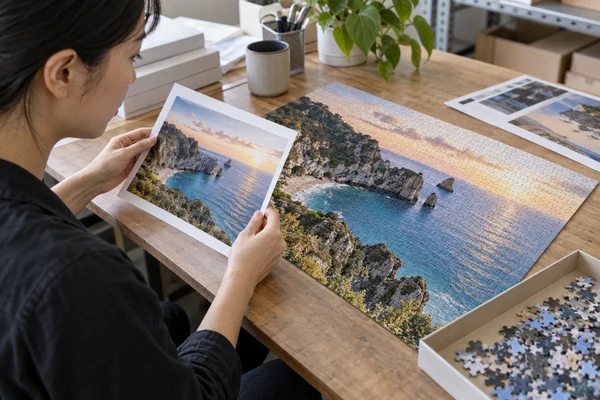
Include the box and reference picture in the same review. A beautiful puzzle can still be confusing if the lid shows another crop or the insert carries an old filename's image. Ask how the supplier will verify that these components belong together. Confirm the retail puzzle format or travel tin reference against the actual intended size, containment and opening sequence before release.
 PuzzleZa
Create the handover record for production and dispatch
The handover should contain the approved print file, crop, physical specification, packaging image and reference component. Identify the approval date and the person authorized to release the order. Separate an image selected for discussion from an image approved for printing. If multiple photographs are ordered together, use a matching list with a thumbnail and order identifier so similar coastal or mountain scenes are not confused.
Define the handling of failed uploads, replacement files and incomplete approvals. A job should not proceed simply because a deadline approaches while the image remains uncertain. Agree who contacts the customer and who can authorize a format change. For a bulk photo-brand programme, group projects only where the manufacturing arrangement permits it; do not assume individually different photographs can be combined into one unrestricted production quantity.
Provide the dispatch team with the information required for the agreed route and no unnecessary photo-history details. Installation preparation here is the recipient's assembly area and reference-image access, not a mechanical installation. State finished dimensions and pack contents clearly. The factory overview supplies background for evaluating the partner; the project record confirms the proposed file handling, packing and review scope.
| Stage | Record | Approval question |
|---|---|---|
| Source | Original filename and pixels | Is this the best available source? |
| Edit | Crop and output version | Does the owner approve the appearance? |
| Rights | Permitted uses | Is this reproduction authorized? |
| Pack | Face, lid and reference | Do all components match? |
| Dispatch | Order identifier | Is the correct pack assigned? |
Make future reorders possible without retaining everything
A repeat order should refer to a controlled product record, not an old email attachment chain. Retain the approved specification and relevant permission record under the business's agreed retention arrangement. Determine whether the customer expects image deletion after fulfilment or has authorized retention for a reorder service. Do not keep all original travel files indefinitely because one cropped output might be useful later.
Before reproducing an earlier design, confirm that the permission remains valid, the customer wants the same crop and the physical product has not changed. A revised box or format can require new output preparation even when the photograph is identical. Record substitutions and new approvals explicitly. Actual customer comments can identify issues such as a difficult plain-sky region or an unclear reference picture, but they should not be presented as universal conclusions about every travel photograph.
For buyers asking, 'how do I prepare a photo for a personalized puzzle', the practical sequence is to retrieve the original, choose a suitable crop, review rights and private details, and approve the final output with its pack components. Send PuzzleZa an anonymized project brief with the image status, intended format and quantity scenarios. This starts a focused manufacturing discussion without assuming access to sensitive files is necessary at the first enquiry.
Frequently asked questions
Can a social-media screenshot become a puzzle?
It may be limited by resizing, compression and interface elements. Retrieve the original photograph or a suitable high-quality export when possible. If only a screenshot exists, discuss the proposed print size and review a representative output before accepting the appearance. A larger pixel canvas does not itself recreate original detail.
Should we send the original or the edited photograph?
Keep the original available and identify the edited appearance you want reproduced. Agree the crop and export workflow with the supplier. A customer who prefers a social-media colour treatment should approve that specific output rather than assume the original capture will match it. Preserve the version history until the job is released.
Is permission from the person in the photograph enough?
Not necessarily. The photographer's reproduction rights and permissions relating to recognizable people can be different questions. Confirm the actual image ownership and intended use, especially for commercial collections or marketing. A customer upload should be accompanied by an appropriate rights process rather than treated as automatic clearance for public promotion.
Can enhancement make a blurry image print-ready?
Enhancement may alter appearance, but it cannot verify details absent from the source. Review another image or a different print size where appropriate. Substantive edits should be disclosed and approved. The acceptance question is whether the final physical representation meets the agreed expectation, not whether software reports a larger pixel count.
What must match across the finished pack?
The puzzle, box image and reference picture should show the released photograph and intended crop. Printed names or messages must match the approved content. Keep the file version, sample reference and order identifier connected. Inspectors and packing teams need a clear current reference to identify a mismatch before dispatch.
Conclusion
Travel photo puzzles need an image workflow that respects both the memory and the manufacturing brief. Retrieve a suitable source, curate for assembly, review rights and privacy, and approve one traceable crop across the complete pack. Explain limitations early and retain only the records needed for the agreed service. This gives photo brands a reliable basis for a product customers can understand before production.
Prepare a photo-puzzle production brief
Send the proposed format, quantity scenarios and an anonymized image example through the enquiry page. PuzzleZa can review the manufacturing scope and confirm what files are needed for the next step.
Sources and scope
Sources reviewed on 2026-10-09. Manufacturing examples and review checklists are planning guidance, not claims about completed customer projects or guaranteed results. AI-generated images illustrate the topic and do not document an actual inspection.
- Adobe: Lightroom export and sharing — Retrieve and export photographs with an understood workflow.
- U.S. Copyright Office: photographer guidance — Photographic ownership and permitted reproduction require review.
- ICO: data minimisation — Limit travel-photo personal data to a defined purpose.