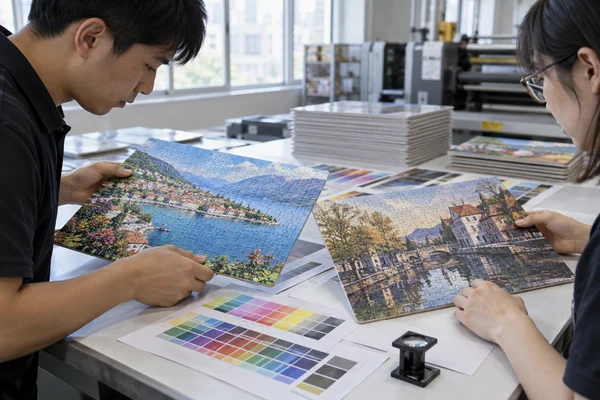
Custom puzzle digital printing often suits changing artwork, prototypes and limited quantities, while offset can suit repeated artwork and production volumes that justify its setup. Neither route guarantees better results. Choose by the actual substrate, image, finishing process, quantity per design and approval evidence. For purchasing teams, the decisive question is whether the sample represents the proposed production route. This guide explains how to compare printing proposals, assess what a proof can demonstrate and write a release record that protects the approved appearance through cutting, packing and future orders.
What changes between digital and offset puzzle printing?
Digital printing transfers image data through a digital print system without preparing a conventional image plate for each design. The term covers different technologies, so ask whether the proposed output uses toner or inkjet and which paper it will use. An attractive print from one system does not establish the behaviour of every digital process. The supplier should identify the route rather than offer digital as a single universal specification.
Offset uses image plates and transfers ink through a blanket onto the printing surface. In a cardboard puzzle construction, that surface may be a separate face paper later mounted to board. Ask how the print stage connects to mounting, coating and cutting. These later operations affect the finished object even when a loose printed sheet looks acceptable.
HEIDELBERG discusses application, material mix and order structure as printing-selection criteria. Apply that principle to your puzzle specification. It does not establish which equipment PuzzleZa uses or a minimum quantity for your project. Ask for a proposal based on the actual image and construction.
The buyer's decision should connect appearance and operations. A proofing route that allows frequent revisions can be helpful during development, while a repeat product needs a stable production reference. Before comparing cost, distinguish development prints from saleable finished units and confirm which process is proposed for each. This prevents an early convenience choice from becoming an undocumented manufacturing assumption.
Evaluate a custom puzzle small batch by artwork and construction
A custom puzzle small batch is not defined by one industry-wide quantity. The economics depend on quantity per design, sheet layout, printing surface, finished size and subsequent operations. Ten images sharing one box can still require distinct puzzle-face preparation. Give the supplier an artwork-by-artwork quantity table so the proposal reflects the actual order rather than an aggregated number.
Changing artwork is a separate requirement from low quantity. A photo-gift programme may have many individually different faces; a gallery launch may have one repeated image in a limited edition. Both are small in some sense, but their file handling and manufacturing needs differ. Describe whether each image repeats, whether customer data changes and whether packaging also varies.
Consider what remains common across the range. Board construction, finished dimensions and box structure might be shared while images vary. Commonality can simplify approval, but it does not remove the need to identify each printed SKU. Ask the supplier to state which operations are combined and which are priced separately. Treat possible efficiencies as quotation questions, not promised savings.
For a planning example, compare one image repeated across the order with several images splitting the same total. Keep quantities hypothetical until the buyer supplies its forecast. Request the same board, finish, box and delivery basis for both print routes. Compare the 500-piece retail puzzle format against your channel needs, then confirm the project-specific dimensions rather than assuming a product name specifies the print sheet.
| Requirement | Digital proposal | Offset proposal |
|---|---|---|
| Artwork variation | How are changing files controlled? | Which versions need separate plate preparation? |
| Substrate | Which supported face paper is proposed? | Which face paper and ink system are proposed? |
| Proof | Does it use the production system? | Does it represent production ink and substrate? |
| Reorder | What output settings are retained? | What files, colour targets and setup records are retained? |
Define custom puzzle print quality in observable terms
Custom puzzle print quality should be described through the artwork's important features: shadow detail, smooth gradients, clear fine lines, readable copy and consistent appearance between the puzzle and its reference image. A broad instruction to make it premium does not tell a printer what matters. Select representative areas and explain the customer consequence if those areas lose detail or change colour.
Review photographs and illustrations differently. A portrait can depend on natural skin tones; a map can depend on fine boundary lines; a painterly artwork can depend on subtle changes within a dark region. Choose a few reference areas on the actual image. Assess them at the proposed finished size instead of only viewing an enlarged screen crop.
A printer's resolution number is not a complete quality description. Image preparation, paper surface, ink or toner behaviour, output settings and finishing all contribute. Ask to see a relevant physical example and confirm its process and substrate. Do not infer a future order's appearance from a sample with a different surface or a promotional photograph.
Agree the review conditions. Compare samples together under consistent neutral lighting and use the approved physical reference where colour matters. Screen displays can differ, and a phone photograph introduces further changes. If your brand requires an instrumental colour target, ask the printer which measurement method and tolerance it can support; do not add an arbitrary numerical limit after the proof is produced.
Compare print routes for your artwork
Send your image, quantity per design, proposed size and finish. We can discuss which proof and finished sample would answer your buying questions.
What does a custom puzzle press proof actually demonstrate?
A custom puzzle press proof is useful only when its representativeness is documented. Ask which machine or process produced it, which paper and colour settings were used and whether the intended coating was included. The word proof can describe a layout print, a colour-managed contract proof or an actual production-process sheet. Those deliverables answer different questions.
A digital prototype can confirm crop, text and the overall design while leaving offset colour unapproved. Equally, an offset sheet can show print appearance while leaving the mounted board and cut untested. Mark the sample's approved scope clearly. If production changes route, request the additional evidence needed to approve the attributes that the earlier sample did not represent.
Separate file approval from physical approval
File approval confirms that the correct design, copy and component versions will be used. Physical approval confirms selected properties of a manufactured sample. Keep both references. A buyer can approve the layout of a PDF without accepting the surface feel or colour of a prototype, and that distinction should be visible to production.
For technical file review, Adobe Acrobat Output Preview supports checks such as separations and overprinting. These checks help find file issues; they are not a substitute for a production-representative physical print.
Keep a proof limitation note
Write a short note beside every approval: intended purpose, represented construction, unrepresented attributes and required next review. If a box is plain, its fit may be approved while its print remains open. This practical notation is especially valuable when several departments review samples at different times.
Review printing after mounting, coating and cutting
The finished puzzle is a layered, cut product. Printed face paper, adhesive, board and surface treatment need to work together. Ask for a mounted and cut sample when these attributes matter to the purchase decision. Loose sheets are easier to inspect for image detail, but they cannot demonstrate piece edges, separation or the way the surface behaves during assembly.
Check the effect of the proposed finish on the actual image. A gloss treatment can change reflections; a matte treatment can alter how the viewer perceives contrast. An embossed texture can affect tiny details. These are reasons to sample the combination, not reasons to label one finish universally superior. Our puzzle finish selection guide discusses the surface decision in more detail.
Assemble a section that includes fine detail and another that includes a broad flat colour. Examine the printed edge of adjacent pieces, rub-prone areas and separation after normal handling. Record any lifting, chipping or marking with close photographs and sample identifiers. The supplier can investigate the observed condition more effectively than a comment that the sample feels wrong.
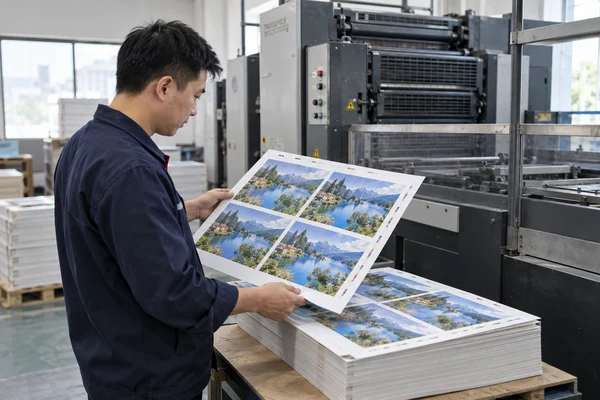
Packaging should also be checked with the finished print. A tightly packed bag, abrasive insert or inadequate separation between components can affect appearance after packing. Define the acceptable pack configuration and inspect a fully packed sample. When reviewing the PuzzleZa factory profile, use the conversation to confirm your project's actual print and finishing path instead of assuming equipment from an illustrative image.
 PuzzleZa
Compare custom puzzle sample cost by the questions answered
Custom puzzle sample cost should be evaluated against its scope. A layout print, a complete finished prototype and a production-process proof may involve different work. Request separate descriptions for artwork preparation, printing, mounting, cutting, packaging and sample delivery. A lower fee can represent a narrower sample rather than a cheaper route to the same approval evidence.
Ask how revisions are treated. Changing only a caption differs from replacing the puzzle image or finished size. Confirm which work the quoted sample includes and when additional charges need approval. Do not assume a sample fee is refundable, credited to production or inclusive of unlimited changes unless the supplier states that arrangement in writing.
The most valuable sample resolves a decision that could otherwise create an expensive production error. If your main concern is skin-tone reproduction, a plain structural box alone has limited value. If the artwork is already controlled but the pack does not fit, another loose colour print will not solve the packaging question. Match the sample to the unresolved risk.
Build a simple sampling budget with deliverable, purpose, cost status, review owner and remaining uncertainty. Unknown costs should stay unknown until quoted. Include the internal time needed to consolidate feedback and the freight arrangement for physical samples. Review the production approval stages so the paid sample results in a documented release decision rather than an attractive object that nobody formally approves.
Control production appearance and future reorders
Record the approved printing route with the artwork version, substrate reference, finish and proof identifier. Also retain the mounted and cut reference where available. If the route changes from digital development output to offset production, identify the new approval step explicitly. A production team should not have to infer permission from an earlier sample that used another process.
Keep colour expectations proportionate to the project. A visually approved artwork range may use a retained reference under agreed lighting. A brand with specified colour targets may need measured reporting. Decide before production which attributes are checked and how disagreements will be resolved. Avoid treating every normal process difference as an unspecified defect, while still defining what matters commercially.
Factory testing can compare selected printed and finished units with the released references. Shipment inspection should check selected saleable packs for correct artwork, reference image, box version and visible condition. These activities answer different questions from prepress review. A correct PDF cannot reveal a damaged finished box, and a good-looking box cannot prove that the intended file version was printed.
For reorders, ask whether paper, process or finish has changed. Review substitutions rather than assuming the retained settings guarantee identical results indefinitely. Adobe's colour-separation guidance is useful when checking spot colours and output preparation again. Pair technical file review with the retained physical sample so the new order preserves both content and intended appearance.
Use a printing-route worksheet before requesting a quote
Create one worksheet that describes the artwork, quantities, finished dimensions, face paper, board, finish, box and component list. Ask the supplier to complete its proposed route and any limitations. This makes custom puzzle offset printing comparable with the digital alternative while leaving the factory room to recommend a practical process.
Add the intended product application. A collector edition, a changing photo-gift order and a recurring bookstore range have different approval priorities. Name the target sales channel and which details the customer will inspect closely. The factory can then identify the relevant sample stage without guessing whether your priority is image fidelity, variable content or packaging presentation.
Before release, consolidate comments into one numbered instruction set. Resolve whether each item is a correction, an approved difference or a remaining decision. Save the final response with the proof references. Send the completed print brief to PuzzleZa when you need a route-specific discussion; a concise controlled brief supports a more useful quotation than a request for the best printing.
- Identify quantity per artwork and all changing elements.
- State which image details and colours need special review.
- Confirm the actual sample process, substrate and finish.
- Document what remains unapproved after each sample.
- Retain final files, physical references and substitution rules.
Frequently asked questions
Is digital printing always better for a short puzzle run?
No. Digital can be practical for limited quantities or changing artwork, but substrate, finished size, finishing and supplier workflow also matter. Request a proposal for the actual construction and quantity per image. Compare the complete scope rather than selecting by a general short-run rule.
Can a digital sample approve an offset production run?
It can approve layout and some visual decisions, but it may not represent offset colour, paper or finishing. Ask what the sample demonstrates and which attributes need a production-representative proof. Record this limitation alongside approval so the manufacturing route is not changed without the appropriate review.
What should we inspect on a printed puzzle sample?
Check crop, important image detail, copy, reference-image consistency and the intended finish. Also inspect the mounted board, piece edges, separation and packed components. Use relevant image areas and agreed lighting. The approval should describe observable requirements instead of relying only on a broad quality label.
Why do puzzle sample quotations differ?
They may include different preparation, printing, cutting, packaging, revision and delivery work. Ask each supplier to define its deliverable and what it represents. A complete finished prototype usually answers more construction questions than a loose layout print, but the right sample depends on your unresolved decision.
How can we maintain appearance on repeat orders?
Retain the released files, process description, substrate and finish references, approved physical sample and review conditions. Ask for notification when any material or route changes. Confirm the current production plan and inspect representative output against those references rather than assuming an old quotation controls every later order.
Conclusion
Choose custom puzzle digital printing or offset through the requirements of the image, construction and order structure. The sound decision connects a defined route to representative proof evidence and a controlled release record. Review the complete finished puzzle, document sample limitations and retain the references that future production will need.
Prepare a clear printing quotation
Share your artwork versions, quantity scenarios, packaging and sales channel with PuzzleZa. Use the enquiry page or email info@PuzzleZa.com for a project-specific discussion.
Sources and scope
Sources reviewed on 2026-09-28. Manufacturing examples and review checklists are planning guidance, not claims about completed customer projects or guaranteed results. AI-generated images illustrate the topic and do not document an actual inspection.
- HEIDELBERG: applications and digital-printing selection — Printing-route selection depends on applications, material mix and order structure.
- Adobe Acrobat: Output Preview — Separations and overprint checks during technical PDF review.
- Adobe: preparing documents for colour separation — Spot-colour and output preparation before print release.