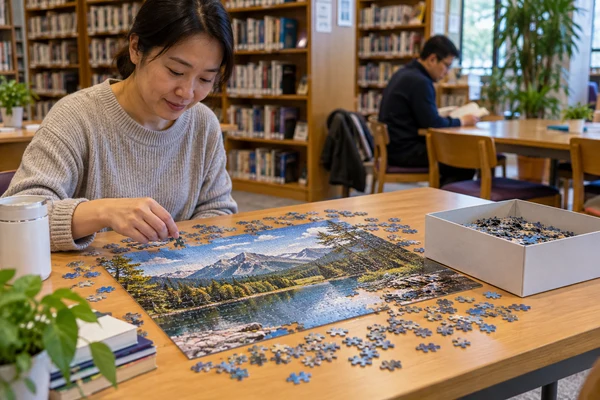
A custom puzzle for libraries should be specified around the service model: a shared table, a scheduled programme, a lending collection or a partnership kit. These uses require different space, packing and return procedures, even when the artwork is similar. Choose the operating model first, then review the image, pieces, reference materials and storage with the staff who will manage them. This guide helps library procurement and programme teams develop a usable resource and a realistic maintenance plan. It treats puzzles as optional activities and educational materials; it does not claim that a particular puzzle prevents cognitive decline, treats a condition or guarantees learning outcomes.
Choose how the library will offer the activity
A shared table supports informal participation over time, while a scheduled session gives staff a defined setup and closing point. Lending lets users take the activity home but adds circulation, containment and return work. A custom-designed resource can serve more than one model, but the programme team should identify the primary one so the product is not compromised by conflicting requirements.
For a shared table, decide who opens the pack, where unfinished work stays and when the puzzle resets. For a session, decide the group arrangement, supervision and time allowed for clearing the room. For lending, decide the borrowing record and what staff can realistically check on return. These decisions establish the operational brief before the factory selects packaging components.
An exchange event is another option, with different stock ownership from a lending collection. The Programming Librarian account of West Linn Public Library's puzzle swap describes intake, sorting and box containment. It is an example of a documented library programme, not evidence of PuzzleZa participation or a universal model every library should adopt.
Write one sentence stating the intended service and its practical boundary. A hypothetical brief might describe an adult landscape puzzle for a continuing community table, with storage between opening periods. This differs from a supervised children's kit that must be cleared after each activity. Labelling the scenario makes the procurement assumptions visible without presenting it as a completed customer project.
| Model | Main operational question | Product priority |
|---|---|---|
| Shared table | Where does unfinished work remain? | Reference visibility and manageable footprint |
| Scheduled session | Who sets up and clears the room? | Easy identification and repacking |
| Lending | How are contents and returns recorded? | Reusable containment and clear instructions |
| Exchange event | What donation and ownership rules apply? | Secure boxes and visible sorting information |
Review the table, access and storage space
Measure the working space rather than relying only on the finished puzzle size. Users may need room for loose pieces, reference material and comfortable access to different parts of the image. A puzzle that fits mathematically on a table may still leave little practical room for participation. Review the intended setup with staff and relevant users before settling the format.
Look at circulation routes, seating, lighting and the relationship to nearby library services. A community activity should not obstruct access or require users to reach through another programme. Decide whether unfinished work can remain in place or needs a storage method. These are site-specific planning questions; a manufacturer cannot certify the accessibility of a room from a puzzle dimension.
The American Library Association accessibility toolkits support planning around patrons' differing communication, mobility and visual access needs. Apply the relevant guidance with the library's own policies and specialists. A larger image or different piece format may help some users, but it should not be advertised as making the whole activity universally accessible.
Consider more than one participation option. Some patrons may prefer viewing or discussing the image to assembling it, while others may use a clearer reference or a different workspace. Ask what the community actually needs. The large-piece puzzle selection guide offers additional product questions, without replacing an individual or site-specific access review.
Select an image and difficulty suited to the service
Choose artwork that suits the participants and the operating model. Distinct buildings, plants or landscape features can help users recognise local areas of an image. Large repeated textures may create a more demanding project. Decide whether that challenge is desirable for a continuing adult table or too time-consuming for a short session; piece count alone does not establish difficulty.
For a local-history or community image, review accuracy and permission before file preparation. Obtain appropriate approval for photographs, illustrations, logos and captions. The library should decide how the image represents its community and whether a historic scene needs context. A factory can reproduce approved files, but should not infer the intended interpretation of archival or culturally sensitive material.
Keep instructions and essential labels on a separate card when that improves usability. The reference image should match the approved puzzle crop and remain legible in the intended setting. For multiple library sets, give every card and container a recognisable identifier. A shared image name may not distinguish a standard lending copy from a larger-format programme copy.
The adult retail puzzle format can be discussed as a starting point for a community-table product. An educational brief may instead suit the educational puzzle format. Review the actual dimensions, pieces and pack rather than assuming a catalogue category establishes the correct service model.
Describe your library service model
Send the intended users, shared-table or lending plan, available space and supporting materials. Include branch allocation and quantity scenarios for a practical product discussion.
Define learning uses without promising outcomes
A custom puzzle learning resource should have a specific activity purpose. It might provide an image for discussing local landmarks, identifying a theme in a story or comparing features shown on a map. Describe what participants are invited to do and what supporting material staff need. The activity's purpose is a planning input, not proof that every user will acquire the same knowledge.
If a procurement brief uses the phrase custom puzzle cognitive activity, clarify what it means operationally. Is the library offering a voluntary assembly project, a conversation prompt or a supervised educational session? Do not turn that label into a therapeutic claim. Health or clinical outcomes require appropriate evidence and specialist involvement beyond a general product-development guide.
A custom puzzle for homeschool might be lent with a reference card and optional discussion prompts. A custom puzzle for teachers could require several clearly identified classroom sets and a guide explaining the intended content. Neither configuration needs to promise measurable developmental gains. Make the instructions useful and let educators adapt the activity to their learners and curriculum.
The ALA resources on accessible communication and participation reinforce reviewing how information is presented. Use clear language, a readable reference and alternatives appropriate to the audience. Confirm market-specific product requirements when children are intended users; staff supervision alone does not determine whether a product meets the applicable requirements.
Separate programme feedback from outcome evidence
A record that patrons chose the table or staff found a guide useful describes participation and usability. It does not establish improved memory, reduced anxiety or a clinical benefit. Decide in advance which practical measures the library needs, and describe them accurately. This keeps programme evaluation useful without giving the product claims it cannot support.
Develop a lending pack that staff can manage
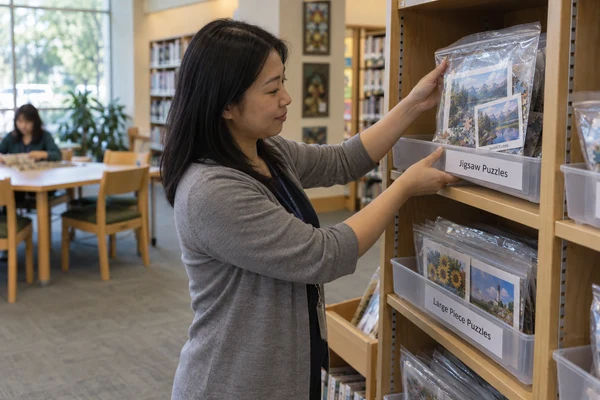
A lending configuration needs containment that supports repeated opening and return. Review how loose pieces, reference cards and guides go back into the box. Agree which components are library property and which instructions are supplied to borrowers. A pack suited to a one-time gift opening may need a different review before it serves as a repeatedly circulated resource.
Add a component record identifying the puzzle, reference material and other included items. Record the approved nominal piece count without suggesting that staff can verify every loose piece instantly. Decide which return checks are practical and how uncertainty is handled. A clear condition status is more useful than a completeness guarantee the library cannot support operationally.
Define the service policy before launch: return expectations, damaged components, reported missing pieces and when an item becomes unavailable. State who reviews a report and what remedy the library can provide. Individual replacement pieces should not be promised unless compatible inventory and an agreed service arrangement exist. Keep borrower communications consistent with the actual policy.
The missing-piece prevention guide covers product and service records in more detail. For libraries, add circulation context: when the item was received, its condition after review and whether it is cleared for the next loan. Maintain patron information only through the library's authorised privacy and circulation processes.
Plan shared-table setup and reset procedures
Set a simple opening procedure: confirm the correct puzzle, place the reference, arrange loose pieces and provide any relevant participation instructions. Identify the staff role responsible for the table and how patrons report an issue. The aim is a welcoming, usable activity, not a rigid rule for how every person must assemble a puzzle.
Plan the end of the day or session before the first opening. Decide how unfinished work is stored, what happens to loose pieces and when completed work is cleared. If the room has multiple uses, rehearse the changeover with the actual sample. A hypothetical setup can fit on a layout drawing while still proving awkward when components must be moved by staff.
For several simultaneous sets, keep containers and references distinct. Avoid mixing loose pieces from visually similar editions, and identify where each set returns. A written packing sequence can help volunteers or changing staff follow the same process. Do not assume that an image printed on the box lid is sufficient to distinguish every component after the room is cleared.
The West Linn programme account notes practical containment and sorting lessons from its own event. Use such reports to identify questions for your service, while recognising that an exchange event differs from a continuously shared table. Local staffing, room use and collection policies should govern the final procedure.
 PuzzleZa
Sample storage, handling and the complete programme kit
Give the manufacturer a brief describing the service model, intended users, quantity scenarios, image status and component list. State whether units are individually lent, stored together or distributed to branches. Specify any required labels or references early. These inputs let the supplier discuss a complete kit rather than quote a puzzle that library staff must later adapt without a plan.
Use the physical sample to review print appearance, piece separation, board edges, containment, box opening and the reference card. Repack it through the actual staff workflow. If the library has a cleaning or maintenance policy, review material suitability with the responsible team and supplier. Do not assume paperboard can be washed, disinfected or treated by an unverified method.
For installation preparation, this application normally means arranging the table, storage and reference materials rather than installing equipment. Confirm the physical space and setup method. Ask staff to record specific observations: the reference is hard to position, a lid is difficult to reopen, or pieces escape the intended containment. These observations can guide a revised sample.
The ALA accessibility toolkits provide a framework for considering varied needs during the review. Include relevant staff and user input where appropriate. A single approval should identify what was assessed and which questions remain open, rather than being described as an accessibility certification for every patron.
Connect shipment inspection with programme evaluation
Factory testing should compare selected units with the approved product and pack. Check artwork, pieces, containment, references and branch identifiers where specified. At shipment inspection, examine selected finished packs and cartons for component presence, count, visible condition and agreed marks. These checks establish conformity to the order; they do not demonstrate a programme's educational or health effect.
Give receiving staff the final kit record and allocation. Confirm how many sets go to each branch, which references match them and where spare components or service stock belong if purchased. Keep manufacture and receiving observations together. This makes it easier to trace a later report to the correct edition without treating every table issue as a factory defect.
Evaluate practical performance after the programme begins. Useful records may include setup effort, return concerns, storage problems and participant feedback. Interpret them in context and keep unsupported claims out of public descriptions. If staff identify repeated handling issues, translate them into a proposed product or procedure change and review the next sample against that specific concern.
PuzzleZa is an 8,000 m² custom puzzle factory in Shenzhen. Review the factory information and send your library programme requirements. Describe the service model and responsible staff review, so the discussion can address the actual resource, components and distribution plan.
Frequently asked questions
Should a library choose a shared table or a lending collection?
Choose around space, staffing and the service you want to provide. Shared tables need ongoing setup and unfinished-work storage; lending needs containment, circulation and return procedures. A pilot can reveal practical demands, but there is no universally superior model. Define the operating plan before selecting the product format and quantity.
Can libraries describe puzzles as cognitive therapy?
Avoid that description without appropriate clinical evidence and specialist oversight for the specific use. A voluntary puzzle activity can be presented as assembly, conversation or educational engagement. Participation records and positive feedback do not establish treatment outcomes, improved memory or prevention of cognitive decline, and should not be reported as such.
How can staff check returned puzzles efficiently?
Use an identified component list and a defined condition review. Check containment, references and visible damage, then record reported issues. Decide what completeness checks staff can actually perform and how uncertain items are handled. Do not promise that a brief visual check verifies every loose piece in a returned puzzle.
Are larger pieces automatically accessible to everyone?
No. Piece dimensions are only one part of access. Review image contrast, reference clarity, table position, reach, seating and individual preferences with the library's relevant users and staff. Larger pieces may suit some needs, while others require different support or an alternative activity. Avoid a universal accessibility claim.
Can one educational puzzle serve teachers and home borrowers?
Potentially, if the image and activity suit both settings, but packing and instructions may differ. Teachers may need multiple identified sets and a concise guide; borrowers need clear return and component information. Review each configuration and intended audience, including applicable children's-product requirements, rather than assuming one kit automatically meets every use.
Conclusion
A custom puzzle for libraries becomes useful through its operating plan as well as its artwork. Choose the service model, review access and space, specify manageable containment and define staff procedures. Sample the complete resource and evaluate participation and handling honestly, using observations to improve the programme without claiming unsupported health or educational outcomes.
Plan a reusable library puzzle resource
Contact info@PuzzleZa.com with your image direction, programme model and component needs. PuzzleZa can discuss the manufacturing scope and sample review for the intended application.
Sources and scope
Sources reviewed on 2026-09-28. Manufacturing examples and review checklists are planning guidance, not claims about completed customer projects or guaranteed results. AI-generated images illustrate the topic and do not document an actual inspection.
- American Library Association: accessibility toolkits — Considering communication, mobility, visual access and varied patron needs in library planning.
- Programming Librarian: West Linn Public Library jigsaw puzzle swap — A documented library example of puzzle intake, sorting, containment and event operations; not a PuzzleZa project.