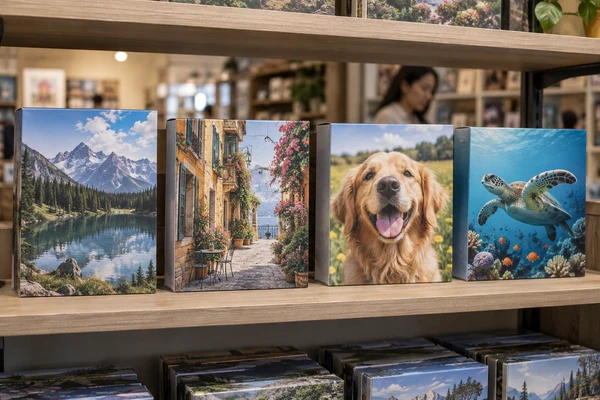
Custom puzzle shelf ready packaging should move a defined assortment from shipping carton to an accessible, identifiable retail display with predictable store work. Choose the shelf format and case pack together, then test the opening and replenishment sequence using real boxes. A transport carton is not automatically a display. This guide helps retail buyers, distributors and private-label teams specify shelf fit, assortment, identifiers and receiving information so the product arrives ready for the intended selling environment rather than leaving store staff to improvise a presentation.
Start custom puzzle merchandising from the real shelf
Custom puzzle merchandising begins with the place where customers encounter the product. A bookstore table, museum counter, specialty-gift shelf and larger retail fixture can require different orientations and presentation. Ask the retailer for the actual available width, depth and height, along with any fixture restrictions. A photograph of an attractive shelf cannot replace those measurements.
Decide whether customers will see the front face, the spine or several boxes arranged as a range. Put the most useful selection information on the visible panel: image, piece count and a clear product identifier where appropriate. Review it from the customer's expected position. A front-heavy design can become difficult to shop when the store displays boxes like books.
Distinguish the retail unit from its display and shipping protection. The unit carries the product story and stores the puzzle. A tray or fixture organises shopping. The shipping pack protects goods through the agreed distribution route. One component can sometimes serve more than one purpose, but the buyer should define those functions explicitly and test the proposed combination.
Compare the 500-piece retail puzzle format with your shelf and audience needs. Confirm the project-specific finished box dimensions before calculating facings. Approximate catalogue imagery is useful for discussing a concept, while the actual sampled box establishes the space your store will need.
What should shelf-ready puzzle packaging do?
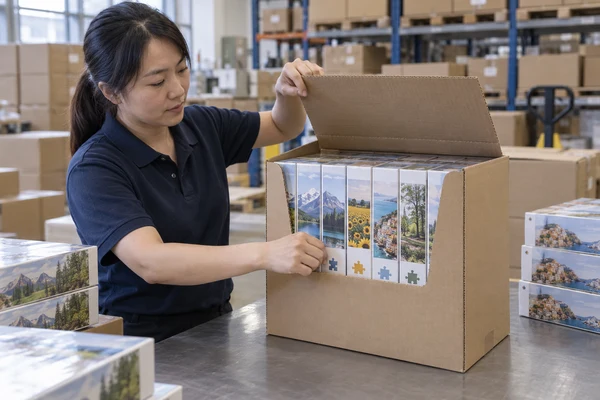
A shelf-ready pack should be recognisable at receiving, open in an understandable way, present the product coherently and allow practical replenishment. Ask the retailer which of these functions its preferred format must meet. Some stores may want loose retail units rather than an integrated tray. Shelf ready is a workflow requirement, not a reason to force every product into the same carton style.
Mondi's shelf-ready packaging description highlights identification, opening and replenishment. Apply those functions to the puzzle pack through sampling. This does not imply that a generic tray design or any PuzzleZa pack automatically provides the same results; the actual unit and store environment must be reviewed.
Evaluate visibility after the transport cover is removed. The tray front should not hide information customers need to choose a puzzle, and its remaining edges should not make removal awkward. Check that the boxes sit as intended without excessive leaning or binding. Those observations depend on the sampled geometry, not merely on the tray's printed design.
Review disposal and replacement handling as part of the store task. Ask how staff remove the cover, collapse the empty pack and place a replacement case. Any environmental wording needs its own evidence, but the practical opening sequence can be tested directly. A display that looks appealing at setup can still create avoidable work if the next replenishment is unclear.
| Component | Main job | Sample question |
|---|---|---|
| Retail box | Identify, present and store the puzzle | Can customers choose and remove it easily? |
| Display tray | Organise a shoppable assortment | Does it remain usable as stock decreases? |
| Transport cover | Protect and enclose the display | Can staff remove it without damaging product? |
| Master carton | Support shipment and receiving | Are count, identity and packing instructions clear? |
Choose case packs around assortment and replenishment
A case pack connects factory packing, warehouse allocation and store stock. Decide whether it contains one artwork or a defined mixed assortment. Mixed cases can provide a ready range, while single-SKU cases can make selective replenishment clearer. Neither format is universally preferable. Ask how the retailer orders, receives and tops up the display before choosing the configuration.
For an illustrative calculation, a case with eight boxes split evenly across four designs contains two units of each design. That is a planning example, not a recommended order quantity. If one design sells faster, the store may need a way to replenish it without repeatedly receiving the slower items. Build that scenario into the assortment discussion.
Avoid designing only for a full tray. Remove selected boxes and check whether the remaining products stay upright, accessible and visually coherent. An attractive launch display may perform differently when half its stock is sold. Ask staff to simulate normal customer removal and replenishment using the sample rather than judging a perfectly arranged photograph.
Record the case contents, unit count and arrangement in the purchase order. Include which artwork belongs in each position if placement is important. Review whether the case itself needs distinct identification. GS1's pack/case quantity rule explains when a quantity change requires a new higher-level identifier. Consult the applicable requirements instead of reusing case data without review.
Plan the shelf before the carton
Send your fixture dimensions, preferred box orientation, first assortment and replenishment model. We can discuss which retail and packing samples would test the handover.
Review a custom puzzle point of sale display in use
A custom puzzle point of sale display can be a small counter tray, shelf organiser or another agreed fixture. Specify where it will be used and who assembles it. Include the intended product boxes in the prototype. Empty-display dimensions alone do not show clearance, stability or the way a customer removes the final unit.
Keep assembly instructions proportionate to the product. A simple tray may need only a clear opening diagram; a more involved fixture may need an illustrated sequence and a component count. Review the instructions with someone who has not designed the pack. If the steps require verbal explanation, improve the instruction rather than assuming store staff will know what to do.
Test access, stability and visible information
Place the filled sample on the intended surface and check ordinary customer pickup. Inspect the visible artwork, price-label area and any shelf-edge interaction. Where stability or load testing is required, agree a suitable method with the responsible provider. An informal demonstration should not be described as a certified fixture assessment.
Keep display claims realistic. A fixture can make a range easier to organise, but it does not guarantee sales or a particular conversion improvement. Use store observations to improve layout and access, and reserve commercial performance conclusions for actual measured results from the retailer.
Plan installation preparation for store staff
For puzzle retail, installation preparation means confirming the fixture location, unpacking sequence, component checklist and replenishment method. State who provides the display, who places it and what tools or store approvals are required, if any. Do not introduce mechanical installation language where a simple shelf placement is the actual task.
Define a custom retailer exclusive puzzle clearly
A custom retailer exclusive puzzle can differ by artwork, box design, included material or another agreed product feature. Record what is exclusive and for which channel or territory, with commercial terms handled in the relevant agreement. An exclusive label should not be used simply because a store orders a private-label box. The meaning must be understood by the parties.
Coordinate the exclusive SKU with the standard range. Similar-looking products need clear records so warehouse and store staff can distinguish them. Use consistent identifiers, product images and descriptions across purchase orders and retailer data. The factory should not be asked to infer channel ownership from a slightly different logo on an otherwise similar box.
Shopify's SKU guidance describes the role of stock keeping units in inventory tracking. The operational principle is useful beyond that platform: give each physical item a controlled reference. Follow the actual retailer's requirements for its systems, rather than assuming one platform's conventions resolve every receiving need.
Keep the exclusivity story accurate in customer copy. If only the pack differs, do not imply the puzzle image or format is available nowhere else without evidence. Review artwork rights and channel terms separately from manufacturing approval. The artwork licensing guide discusses another important ownership question that should be resolved before an exclusive edition is released.
Connect the custom puzzle retail price with pack decisions
The custom puzzle retail price is a brand and retailer decision, not a number the box construction alone can determine. Consider product positioning, landed costs, channel terms, handling and the complete customer offer. Ask for manufacturing quotations on defined pack options, then use your actual commercial data to evaluate them. Avoid borrowing a competitor's price as proof that your proposed product will support the same result.
A display or decorative pack adds work and material that should be visible in the quotation. Compare the same quantity scenarios, assortment, included components and shipping basis. Ask which costs are recurring and which are development charges. A lower unit quote may exclude the display or require the retailer to perform extra work, so compare the whole handover.
Review how packaging dimensions affect the store and receiving plan. Larger presentation may use more shelf space and alter carton arrangements, while a compact pack may need clearer spine information. These are dependencies to assess with actual dimensions and costs, not fixed savings rules. Label early freight or retail estimates clearly and update them after the sampled configuration is measured.
Use a decision worksheet with pack option, supplier scope, retailer handling, expected selling presentation and unresolved assumptions. The aim is to make trade-offs explicit before launch. A shelf-ready concept should earn its place through operational suitability and brand presentation, not an unsupported promise that more packaging automatically creates a premium price or faster sell-through.
 PuzzleZa
Prepare the receiving record for custom puzzles for retailers
Custom puzzles for retailers need a handover record that connects the sellable unit to its shipping configuration. Include SKU, artwork version, identifiers, unit dimensions, case contents, carton dimensions and measured packing data when available. Mark estimates as estimates until the actual packed sample or production carton has been checked. Receiving teams need the final configuration, not a development sketch.
Provide the retailer's own instructions to the responsible factory and logistics contacts. Confirm labels, shipment references, appointment or allocation requirements and any destination-specific packing arrangement. Do not invent retailer acceptance rules or assume a previous customer's carton labels apply. The buyer should supply the current trading-partner requirements and consolidate conflicting instructions.
Approve opening instructions and retail placement with the product sample. Retain a photograph of the intended filled display and the exact assortment list. This lets store staff compare what arrives with what should be presented. If stores receive loose units separately from a fixture, record both deliveries so a missing display is not mistaken for a missing product component.
Use the PuzzleZa project process to identify where final retail and carton data are released. Discuss the packing scope through the factory enquiry. A controlled handover is especially useful when a distributor receives goods first and then splits cases across stores, because that extra operation can otherwise obscure the original assortment.
- The displayed orientation and actual shelf dimensions are confirmed.
- Single-SKU or mixed-case contents are recorded.
- Full and partly depleted samples have been reviewed.
- Codes and retailer records identify every packing level correctly.
- Store opening and replenishment instructions match the released pack.
Inspect the retail configuration and learn from store use
Factory testing can compare selected units, trays and packed cases with the approved configuration. Shipment inspection should examine selected saleable packs for correct artwork, count, display components, labels and visible condition. If the store opening sequence is part of the agreed scope, include it explicitly. A transport pack that remains closed cannot demonstrate how cleanly the display cover will be removed.
After receiving, collect practical observations from store staff: unclear opening, hidden product information, awkward removal or difficult selective replenishment. Treat these as improvement inputs and connect them to a specific configuration. They are more useful than an unsupported statement that the range performs well. If actual sales data is available, assess it separately from pack usability observations.
Before reordering, confirm assortment, case quantity, identifiers and fixture requirements again. A change in retail allocation can alter the best packing arrangement even if the puzzle itself is unchanged. Send PuzzleZa your shelf and receiving brief to discuss a sample and quotation that reflects how the goods will actually be sold.
Frequently asked questions
Is shelf-ready packaging the same as a shipping carton?
Not necessarily. A shipping carton protects and identifies goods in transit. Shelf-ready packaging also needs an agreed store-opening and presentation function. Sometimes one construction can do both, but approve that through a filled sample and the retailer's workflow rather than assuming any opened carton is a suitable display.
Should puzzle cases contain one artwork or a mixed range?
Choose around ordering and replenishment. A mixed case can provide a ready assortment, while single-SKU cases can support selective restocking. Review expected store allocation and the possibility of uneven demand. Record the exact contents and identification of the chosen case so receiving and packing teams follow the same arrangement.
How should a puzzle display be sampled?
Use the actual retail boxes, intended assortment and representative fixture location. Check opening, product visibility, removal and replenishment with a full display and reduced stock. If formal stability or load evidence is required, define that separately. A polished empty fixture or launch photograph does not establish everyday store usability.
Does a retailer-exclusive puzzle need a distinct product record?
It needs a controlled record that identifies the actual exclusive configuration and the applicable channel arrangement. Review SKU and trade-item identification requirements with the retailer. If artwork, pack contents or other product features differ, make those differences clear across purchase orders, warehouse data and customer-facing descriptions before production.
What should be confirmed before a retail puzzle reorder?
Recheck assortment, case quantities, artwork, identifiers, shelf dimensions and current receiving instructions. Review store feedback and any proposed display change. Update affected packing records and product data deliberately, because a changed retail allocation or case pack can require a new handover even when the puzzle image remains unchanged.
Conclusion
Custom puzzle shelf ready packaging succeeds operationally when the shelf, assortment and case pack are designed together. Sample ordinary opening, customer access and replenishment, then release clear receiving records. Those decisions make the range easier to handle and understand while leaving price and sales expectations grounded in the buyer's actual commercial evidence.
Build a retail-ready puzzle brief
Share your retailer instructions, assortment and quantity scenarios with PuzzleZa through the enquiry page or info@PuzzleZa.com. Ask for a quotation covering the complete display and packing scope.
Sources and scope
Sources reviewed on 2026-09-28. Manufacturing examples and review checklists are planning guidance, not claims about completed customer projects or guaranteed results. AI-generated images illustrate the topic and do not document an actual inspection.
- Mondi: shelf-ready packaging functions — Identification, opening, presentation and replenishment as shelf-ready design functions.
- GS1: pack/case quantity rule — Identification review when case or defined pallet quantities change.
- Shopify: stock keeping units — Using controlled SKU references for inventory tracking.