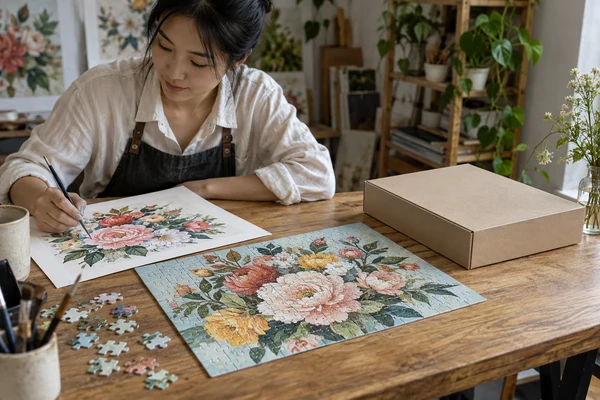
How do artists sell custom puzzles? Start with a small, coherent range of artwork that works at puzzle scale, choose a complete product format, sample it and prepare the sales, inventory and fulfilment records before launch. An established audience can help a collection find buyers, but a beautiful image alone does not explain its channel economics or stock requirements. This guide helps independent artists, studios and gallery-shop teams translate creative work into a manageable physical range. It covers image selection, product differentiation, quotation inputs and retail preparation without inventing sales forecasts, customer results or manufacturing promises.
Build a range that customers can understand
Begin with the customer moment. Is the puzzle an accessible entry to your art, a gift from a gallery visit or a longer assembly project for an existing collector? Choose one leading proposition for the first collection. A range can eventually serve several audiences, but a launch becomes harder to explain when every artwork comes in numerous sizes and packaging treatments.
Select a small set of images with a clear relationship. They might share a subject, palette, series or narrative, while offering visibly different scenes. Customers should recognise the collection and still understand why they might choose one image over another. Avoid treating every existing print as a necessary SKU; each additional option creates sampling, photography, stocking and replenishment work.
Assign each proposed SKU a job. One may be the welcoming gift option; another may serve customers seeking a more detailed project. Record the audience and channel beside each choice. If two products solve the same customer need with only a minor difference, ask whether both are necessary before committing stock. This is an assortment decision, not a judgment on the quality of the artwork.
Compare the 500-piece retail format with the 1,000-piece art format as development options. Neither count guarantees a particular difficulty or selling price. Finished dimensions, image structure and cutting affect the experience, and your actual pack should be reviewed before you describe the finished product to customers.
| Product role | Creative decision | Operational question |
|---|---|---|
| Gift entry | Recognisable, inviting image | Does the pack suit the intended shelf and parcel? |
| Art-led project | Detailed image with useful landmarks | Can the source support the finished print size? |
| Venue edition | Clear connection to the exhibition or place | Who owns stock and replenishment? |
| Future addition | Meaningful difference from current SKUs | What evidence justifies another stocked variant? |
Choose artwork for a custom art puzzle
A custom art puzzle should remain engaging when viewed piece by piece. Examine where the image provides recognisable features, colour variation, directional lines and local details. Broad repeated areas can create a deliberate challenge, but they should be a choice rather than an overlooked consequence of reproducing a print. Consider the intended audience's expectations when deciding how much repetition to retain.
Review the actual source asset, not a social-media download. A photograph of a painting may include glare, perspective distortion or uneven lighting; a digital illustration may have a crop optimised for a different medium. Ask what needs correction before the puzzle template is applied. Preserve a record of authorised changes so the manufactured image remains consistent with your creative intent.
A custom illustration puzzle can use strong visual storytelling, but tiny labels or fine decorative details need review at the finished scale. Move necessary instructions and artist information to the box or supporting card where appropriate. Use the puzzle image-selection guide to examine composition before requesting technical output work.
If artwork is supplied through Illustrator, Adobe explains packaging linked graphics, fonts and a report for handover. Follow the factory's actual file instructions and relevant font permissions. A packaged working document can support the workflow, but only the agreed, approved production output should authorise printing.
Compare direct sales, art stores and gallery shops
Direct sales let the artist control the product story and customer relationship, while also requiring order processing, parcel protection and after-sales decisions. Wholesale can place stock in established shops but requires a different revenue and fulfilment model. Consignment may create another set of responsibilities. Identify the arrangement actually being considered rather than applying one channel's assumptions to every opportunity.
For custom puzzles for art stores, ask the buyer what information supports its decision. It may need a sample, product images, dimensions, case quantity and reorder contact. Confirm the expected ordering and receiving process. Do not assume a retailer will stock every image or accept your standard parcel pack as its trade shipment; its requirements belong in the product brief.
A custom gallery shop puzzle can be tied to an exhibition or kept as an ongoing artist item. Clarify which party owns inventory, handles damaged stock and supplies sales data. If the exhibition ends, decide what happens to remaining units and whether replenishment remains appropriate. These questions affect the launch quantity more usefully than a general statement that art merchandise sells well.
Prepare channel-specific product information without changing the facts. The direct website may tell a longer artist story; a wholesale sheet may prioritise identifiers and ordering details. Both should use the same approved piece count, dimensions and component list. If a shop sells a special configuration, identify it explicitly so customers and fulfilment teams can distinguish it from your main edition.
Turn your art series into a product brief
Send a shortlist of images, the audience and the intended sales channels. Include format ideas and quantity scenarios so the collection can be discussed as a complete range.
Use a cost worksheet before committing to stock
Compare channels using current, product-specific costs. The manufacturing quotation is one input alongside freight, receiving, storage, transaction fees, parcel materials, fulfilment and expected service costs. Some expenses occur per unit; others belong to development or launch. Identify which costs apply to your own business and leave unknowns visible until the responsible supplier or partner confirms them.
The U.S. Small Business Administration explains unit break-even as fixed costs divided by selling price less variable cost per unit. Apply that planning relationship only with a consistent channel and complete assumptions. It is an estimate for decision-making, not a forecast of demand or a substitute for your accounting records.
For a hypothetical comparison, label direct-store and wholesale scenarios separately. The artist's revenue per sold unit differs between the arrangements, and fulfilment responsibilities may differ too. Use the revenue your business actually receives, not a retailer's shelf price, when assessing your own contribution. Avoid inserting a universal wholesale discount or margin target unsupported by your specific agreement.
Check how slower sales would affect cash and storage. Stock does not become an expense-free asset simply because production is complete. Decide what quantity scenarios to request and which assumptions most influence the choice. A focused launch can make those variables easier to monitor, but it does not guarantee profitability. Seek relevant financial advice when the commitment is material to your business.
Keep estimates distinct from confirmed amounts
Mark each worksheet input as quoted, measured, calculated or estimated, and include its date. For example, a packed-carton weight measured after sampling is different from a freight estimate made before the pack exists. Updating one input should trigger a review of the relevant scenario. This prevents an early planning number from becoming an unexamined launch assumption.
Brief the manufacturer around the complete range
When selecting a custom puzzle manufacturer for artists, bring the collection concept and operational requirements together. Identify the intended audience, artwork status, format, quantity scenarios and channels. State which components are shared and which vary. A common box structure with several printed wraps is a different brief from several entirely different formats, even when all images come from one artist.
Include the complete packaging direction: inner containment, retail box, reference image and artist card. Explain what the story card must do and what the retailer needs on the pack. Ask for the current template before final layout. A box that looks attractive in a studio render may be unsuitable for the selected component volume or display orientation.
Request a quotation that identifies its assumptions, exclusions and development charges. Ask whether the proposed sample represents the production board, print, finish and cut. A visual mock-up can establish a concept without approving the physical product. Know what each sample answers so your team does not authorise manufacturing after reviewing only an image preview.
Keep creative and technical approvals distinct but connected. The artist controls how the work is represented; product and operations reviewers assess component fit, identification and packing. Consolidate their comments into a single release instruction. Tell the supplier who can approve an adjustment and how any revised file should be returned for review before production proceeds.
Approve the sample and create accurate sales assets
Sample the complete customer experience. Open the box, inspect the image and pieces, locate the reference material and return the components to storage. Assemble selected areas to review print detail and piece handling. The purpose is to evaluate the intended product, not to declare universal material performance from a single sample or to promise every future unit will be identical.
Review the retail-box copy alongside the object. Confirm artwork title, artist credit, stated format and included components. If the puzzle is an adaptation, make sure descriptions and images represent the approved crop. Any environmental or certification language requires supporting evidence specific to the claim; the artistic story should not be padded with manufacturing credentials the supplier has not established.
Photograph the approved product for listings and buyer materials. Show the actual box, representative pieces and included reference materials where useful. Digital artwork alone may make the listing resemble an art print instead of a physical puzzle. Keep props from implying that accessories are included when they are not, and state any optional component accurately.
Create a concise wholesale information sheet with identifiers, product dimensions, pack details and ordering contact. Pair it with the longer artist story if retailers want that context. Keep unconfirmed delivery dates visibly provisional until the production and logistics plan is agreed. A clear sales asset helps a buyer evaluate the product without relying on an exaggerated claim about popularity or demand.
 PuzzleZa
Make stock and customer service ready for launch
Give each stocked product a unique internal identifier and a defined location record. Shopify's SKU guidance explains why products and variants need distinguishable identifiers. The principle is useful with any sales system: the artwork a customer selects must correspond to the physical box that fulfilment picks, especially when several designs share similar packaging.
Decide which units are available for sale and which are reserved for photography, samples, exhibitions or service. Track those uses rather than treating every manufactured unit as customer stock. Shopify's inventory guidance describes stock levels and adjustment histories. Use your platform's actual controls and reconcile them with physical counts when receiving the launch shipment.
Prepare an after-sales process before selling. Define how a customer reports a damaged box or suspected missing piece, what product information you need and who reviews the report. Confirm any remedy against available stock and agreements. Do not promise individual replacement pieces or factory-held service inventory unless the arrangement has actually been established for your product.
Test the fulfilment workflow with the approved retail pack and intended outer mailer. Confirm identification, protective materials, included inserts and the packing sequence. A gallery handover and a mailed order are different routes. If another partner ships your orders, send it a documented pack instruction and accurate product data rather than expecting it to infer your intended presentation.
Launch, review and replenish deliberately
Use factory testing and shipment inspection to compare selected units and cartons with the approved specification. Check artwork version, component presence, containment, visible pack condition and agreed assortment. Keep observations and approved exceptions with the release record. This provides traceability for the first collection without implying that inspection predicts every customer's experience.
After launch, review your own evidence by product and channel. Record sales, stock remaining, retailer feedback and service observations using consistent periods. A sold-out design may reflect a small allocation as much as strong demand, while a slow item may lack visibility. Interpret the context before adding variants or making a public claim about performance.
Plan replenishment around current demand, available stock and the next production and delivery decisions. Shopify's inventory records can support that review when used consistently. Retain the approved artwork, sample reference and carton data. If you change the crop, box or insert, create a controlled revision rather than silently replacing the earlier configuration.
PuzzleZa operates an 8,000 m² custom puzzle factory in Shenzhen. Review the factory information and send your artist-range brief with the images, intended channels and quantity scenarios. A manageable range gives both the creative team and manufacturer a concrete starting point for sampling and quotation.
Frequently asked questions
Should artists start with one image or a whole collection?
Choose the smallest assortment that communicates the intended proposition and gives buyers a meaningful choice. Each extra SKU adds sampling, photography and inventory work. Use your audience and retailer evidence to decide the range; there is no universal launch quantity or number of artworks that guarantees success for every artist.
Can a popular art print be used as a puzzle without changes?
Possibly, but review the source asset, crop and assembly experience. A print may contain repetitive areas, small details or framing that behaves differently when divided into pieces. Evaluate the image at the finished puzzle size and approve any adaptation, rather than assuming popularity in one medium predicts performance in another.
How should artists compare direct and wholesale sales?
Use separate scenarios with the revenue your business receives and the costs it bears in each channel. Include manufacturing, logistics, fulfilment and relevant fees. Distinguish variable costs from launch expenses and label estimates. A retailer's shelf price does not represent the artist's wholesale revenue or establish the artist's margin.
What should be ready before opening online orders?
Prepare approved product photographs, accurate dimensions and components, inventory identifiers, parcel instructions and an after-sales process. Confirm what stock is available and how availability will be communicated. If production is not complete, ensure your customer-facing order model and dates reflect the actual status instead of presenting estimated stock as received inventory.
Can the same puzzle be sold through galleries and the artist's website?
Often the physical product can serve several channels, subject to applicable agreements, but receiving and fulfilment needs may differ. Confirm stock ownership, product identifiers, assortment and parcel protection. If a gallery receives an exclusive configuration, document it separately so the website listing and warehouse do not confuse the editions.
Conclusion
Artists sell custom puzzles through a coordinated product, sales and fulfilment plan. Select suitable images, give each SKU a clear role and plan costs and stock around actual channels. Approve the complete pack, create accurate sales assets and prepare fulfilment and service before launch. Use your own sales evidence to decide when the range should expand or replenish.
Discuss your first artist puzzle range
Contact info@PuzzleZa.com with your artwork status and packaging needs. PuzzleZa can discuss a manufacturing quotation and the sample decisions your launch will require.
Sources and scope
Sources reviewed on 2026-09-28. Manufacturing examples and review checklists are planning guidance, not claims about completed customer projects or guaranteed results. AI-generated images illustrate the topic and do not document an actual inspection.
- Adobe: package Illustrator files — Handover of linked graphics, fonts and document information.
- U.S. Small Business Administration: planning and break-even — A unit break-even relationship based on fixed costs, price and variable costs.
- Shopify: using SKUs — Distinguishable identifiers for stocked products and variants.
- Shopify: managing inventory — Stock-level tracking and inventory adjustment records.