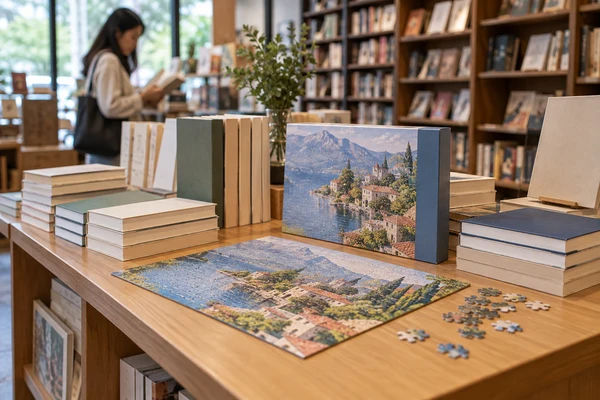
A custom bookstore puzzle works best as a complete companion product: a compelling image, an appropriate assembly experience, clear packaging and a sales record the book retailer can receive and replenish. Publishers should choose whether the puzzle extends a particular title, an illustrated world or an evergreen house collection, then assign editorial, rights and operational ownership before requesting samples. This guide covers that decision for publishing teams, independent bookstores and game companies. It explains how to coordinate a collection without assuming that a book's artwork permissions, identifier or launch schedule automatically carry over to a manufactured puzzle.
Give each custom bookstore puzzle a clear role
Decide what the puzzle adds to the retail range. A title companion may let readers explore a setting after finishing a book. A house collection may feature several illustrators under a consistent publisher brand. A store-exclusive image may connect the product to a local community. These directions have different approval paths and sales lifetimes, even when their physical formats are similar.
Write a short customer proposition before designing the box. Identify the intended purchaser, why the image belongs in the collection and what customers receive. Avoid making the customer decode a complex publishing partnership to understand the product. The front panel should communicate the image and puzzle format; fuller editorial context can sit on another panel or supporting card.
Compare a title-led range with an evergreen range. A title companion can benefit from coordinated launch attention but depends on the book's schedule and relevant permissions. An evergreen collection may be replenished independently but needs a durable brand story. Neither route guarantees demand. Use retailer feedback and your own sales evidence to choose a manageable initial assortment.
The 500-piece retail puzzle and 1,000-piece art puzzle provide different development starting points. Select a format around the audience, image and store space rather than automatically reproducing the dimensions of a book cover. The specific finished size and pack still require project-level sampling.
Adapt editorial artwork for an assembly experience
A successful cover image is not automatically a successful puzzle image. Covers are designed to communicate quickly at a small display size; puzzles are examined over a larger surface and divided into pieces. Review the crop, visual landmarks, repeated textures and broad empty areas. Decide whether the original composition supports the intended challenge or requires an approved adaptation.
Keep essential text outside the puzzle surface when it needs to remain legible before assembly. A title, creator credit or explanatory passage may work better on the box or card than across cut lines. If typography is part of the artwork, review it at the actual finished scale. Do not enlarge a low-resolution cover preview and treat it as a production-ready asset.
Separate editorial accuracy from print preparation. The publisher should approve names, quotations, character details and correspondence with the relevant edition. Prepress should check output files, crop and technical suitability. A manufacturing supplier can flag an ambiguous file or template issue, but should not decide whether a character design is canonical or whether a quotation matches the authorised text.
Review the puzzle as an independent activity. A hypothetical illustrated-town collection might use one scene with distinct buildings and routes instead of a cover dominated by a large title block. This is a planning example, not a reported project. Ask reviewers to explain which features help orientation and where the image becomes repetitive, then translate observations into controlled design decisions.
Use the support card for context
A concise card can identify the artist, explain the scene's relationship to the publication and provide an assembly reference. Keep promotional copy proportionate to the product. If the card points to a book or game online, confirm the destination and maintenance owner. A discontinued campaign page should not be the only way customers can understand the item they bought.
Assign editorial, licensing and co-branding ownership
A custom puzzle licensing program needs a documented path from creative approval to permitted manufacturing and sale. Identify the parties responsible for the artwork, characters, text and trademarks. Confirm territory, duration, sales channels and promotional use through the relevant agreements. Product planning should make these decisions visible before the factory receives artwork, rather than treating them as paperwork to resolve after sampling.
The World Intellectual Property Organization explains that protected work generally requires authorisation for use. Book publication rights and merchandise rights can involve different scopes. Check the actual permissions with the rights holder and appropriate advisers; the existence of a published cover or an artist invoice does not settle every planned puzzle use.
Custom puzzle co branding also needs a practical approval map. Decide whose logo leads, where other identities appear and who signs off on each component. A bookstore, publisher and illustrator may all have legitimate review interests, but the factory needs one consolidated instruction. Assign a coordinator to reconcile comments and issue the final approved output rather than forwarding conflicting mark-ups.
Record what happens when a licence or collaboration ends. Ask which inventory may still be sold, whether reorders remain permitted and how online assets should be handled. These are agreement-specific questions requiring relevant advice. Operationally, link the approved permissions to the product record so a routine replenishment request does not accidentally create an unauthorised new run.
| Decision | Suggested responsible role | Release evidence |
|---|---|---|
| Editorial content | Publisher or appointed editor | Approved scene and copy |
| Permitted use | Rights owner and licensing lead | Documented scope for the product |
| Brand hierarchy | Collection coordinator | Consolidated packaging approval |
| Retail records | Sales operations and retailer | Identifiers and product data |
| Manufacturing release | Authorised product owner | Complete specification and sample record |
Plan your companion collection
Share the book or game relationship, audience, artwork status and co-branding requirements. Include the planned channels and quantity scenarios for a focused discussion.
Define what a game companion includes
A custom puzzle for board game company can extend world-building, illustrations or a recognised setting. Decide whether it is a separate puzzle, a promotional gift or a component in a game bundle. Those propositions create different expectations. A standalone item should explain its own assembly format; a bundled item should be listed accurately in the bundle's component inventory.
Avoid implying gameplay that the puzzle does not provide. If customers expect clues, rules or compatibility with an existing game, make the actual relationship explicit. When the puzzle is simply an image-led companion, describe it that way. The box should not leave buyers wondering whether they need another product to use it or whether completing it changes game play.
Review visual spoilers and editorial timing. A setting revealed late in a book or campaign may require a different launch plan from a familiar cover scene. Ask the editorial or game-design owner to approve what can be shown on store shelves and online listings. Treat this as a content decision rather than asking the manufacturer to infer release sensitivities.
If a game bundle shares a master carton, sample the bundle's actual packing sequence. Check whether the puzzle box, rulebook and other components fit without pressure or confusion. Give the factory a complete packing brief. A puzzle sample approves only the puzzle configuration; it does not automatically validate a larger kit assembled elsewhere by a distributor or fulfilment partner.
Prepare the identifiers and product data bookstores need
Treat the puzzle as its own inventory item even when it sits beside a book. Agree the retailer's product-data fields, ordering process and identification requirements before artwork release. Useful fields include title, creator credit, piece count, finished dimensions, included components, retail-pack dimensions and case quantity. Do not copy the book's record without checking which fields describe the new physical product.
The International ISBN Agency excludes games from ISBN eligibility and explains that book-related toys use other identification systems. Do not reuse a book's ISBN on a puzzle simply because the artwork is shared. Ask the applicable agency and trading partner about identification when a combined publication or educational kit raises a specific scope question.
For separately sold puzzles, coordinate the required trade-item identifier with the responsible brand owner. The GS1 GTIN Management Standard provides rules for new products and relevant changes. Confirm the correct product hierarchy and pack quantities. A code assigned to a retail unit should not be applied indiscriminately to every carton or assortment.
Create the sales sheet from approved product data, not an early mock-up. Mark estimated dimensions or readiness dates until confirmed. Include a clear product image and ordering contact. Retail staff need to explain the item quickly, and receiving teams need to match the delivered unit to the record. Accurate information supports both functions without making unsupported claims about sales potential.
Sample the collection and its retail presentation
When choosing a custom puzzle manufacturer for publishers, evaluate how the supplier translates a coordinated creative brief into a complete pack. Review the puzzle face, board, cut, reference image, creator credit, box and inserts together. A matching digital colour palette does not guarantee matching physical appearance across different papers and finishes; compare representative outputs under agreed review conditions.
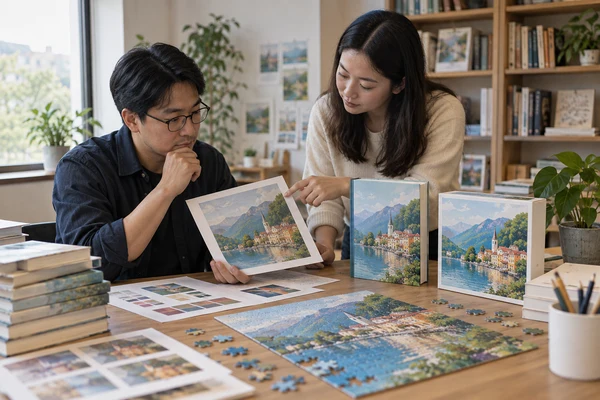
Invite the people responsible for editorial, retail and operations to the sample review. Editorial checks image and copy; retail considers display and customer understanding; operations examines identification and packing. Consolidate their decisions into one approval record. Otherwise an attractive puzzle can reach production while a required logo, insert or receiving label remains unresolved in another team's file.
Compare the puzzle box with the book or game it accompanies without requiring every surface to look identical. The materials and viewing conditions differ. Identify the colour relationships that actually matter, such as a shared brand colour or illustration character, and define the reference. Broader print preparation is covered in our puzzle artwork requirements guide.
Physically open, repack and display the sample. Check whether the chosen shelf orientation exposes the title and image, whether a reference card is easy to locate and whether staff can return everything to the box. If a display copy will remain open, plan how loose pieces and other stock stay distinguishable. Record practical observations instead of approving presentation from a render alone.
 PuzzleZa
Coordinate channel ownership and the launch calendar
Define who sells the collection and through which channels. A publisher website, bookstore chain, independent retailer and game distributor may use different assortment and receiving arrangements. If an edition is exclusive, specify what the exclusivity actually covers with the responsible parties. Avoid relying on a marketing phrase when the factory needs to know which artwork and carton allocation to produce.
Private label puzzles for sale need a commercial plan beyond the product sample. Decide who owns stock, who handles customer service and how retailers reorder. Compare your own expected channel revenue with landed and fulfilment costs; do not infer profitability from a factory unit quotation. Keep financial assumptions separate from published product claims and refresh them when current quotes or distribution arrangements change.
Work backwards from the required receiving date, leaving distinct decisions for editorial release, rights approval, sampling, production release, inspection and freight handover. Book and puzzle schedules may diverge. If a title launch moves, decide whether the puzzle follows it or remains available independently. Confirm revised dates with relevant partners before updating customer-facing availability information.
Prepare photography, sales copy and staff information from the approved product. State what is included and how the puzzle relates to the companion title. A licensed logo or co-brand does not by itself explain the product. Accurate launch assets reduce the chance that retail staff promise a poster, bonus content or book bundle absent from the actual manufactured configuration.
Control inspection, replenishment and collection changes
Factory testing should compare selected units with the released puzzle and pack references. Include the correct artwork edition, component presence, box copy and any co-brand approvals. At shipment inspection, check selected finished packs and cartons for version, assortment, visible condition and agreed marks. Provide the inspector with the relevant approval record rather than only a general publishing-season catalogue.
Send the receiving team the final SKU list, quantities and carton configuration. If different stores receive different selections, record allocation before packing. A central distribution centre may want a standard case; an independent store may want a mixed assortment. Confirm what the supplier is actually expected to pack and what another partner will assemble later.
Before replenishment, check stock performance alongside current rights and editorial status. A revised cover or new book edition may not require changing the puzzle, but that should be a deliberate decision. Record which components remain unchanged and which require approval. The GS1 rules can help review identification when the sellable item changes.
PuzzleZa operates an 8,000 m² custom puzzle factory in Shenzhen. Review the factory information and send a companion-collection brief with the intended audience, approved imagery, format and channels. A clearly owned product programme gives the manufacturer usable instructions and lets the publisher retain control over editorial and commercial decisions.
Frequently asked questions
Can a book cover be printed directly as a puzzle?
Sometimes, but review the composition, source quality and permissions first. A cover may contain large title text or broad empty areas that change the assembly experience. Approve the crop and any adaptation at the intended size, and confirm that the relevant rights cover manufacturing and selling the puzzle.
Can we use the book's ISBN for the companion puzzle?
Do not assume so. The International ISBN Agency excludes games and describes separate identification for book-related toys. A separately sold puzzle needs the identification required by its trading partners. For a combined educational publication or kit, ask the applicable agency about the specific product rather than borrowing the book's code.
Who should approve a co-branded puzzle collection?
Assign a coordinator to collect editorial, rights, brand and operational approvals. Each owner should review the components relevant to its responsibility, then the coordinator should issue one consolidated release. The factory needs a single authorised instruction set, especially when publisher, bookstore and illustrator comments affect different panels or inserts.
Should the puzzle and book launch on the same date?
Only if the commercial plan requires it and both schedules can support that receiving date. Track artwork, rights, sampling, production and delivery dependencies separately. If a publication moves, decide whether the puzzle follows or launches independently. Confirm the revised plan before communicating stock availability to retailers or customers.
What should a publisher send for an initial quotation?
Send the collection role, intended audience, artwork status, format direction, quantity scenarios, component list, sales markets and delivery requirements. Identify editorial and rights approval owners. Include co-branding and retailer data requirements where known, so the quotation covers the actual product system rather than only a printed puzzle sheet.
Conclusion
Build a custom bookstore puzzle collection around a clear relationship to the book, game or publisher brand. Adapt imagery for assembly, document permissions, assign approvals and prepare separate retail records. Sample the complete product and coordinate its launch and replenishment as a manufactured collection with its own practical requirements.
Request a publisher puzzle quotation
Contact PuzzleZa at info@PuzzleZa.com with the product brief, approved creative direction and required components. We can discuss a suitable manufacturing scope and sample review.
Sources and scope
Sources reviewed on 2026-09-28. Manufacturing examples and review checklists are planning guidance, not claims about completed customer projects or guaranteed results. AI-generated images illustrate the topic and do not document an actual inspection.
- World Intellectual Property Organization: copyright FAQ — Confirming authorisation for protected artwork and other creative material.
- International ISBN Agency: scope and assignment — Games are outside ISBN eligibility and book-related toys use other identification systems.
- GS1: GTIN Management Standard — Trade-item identification for new products and relevant collection changes.