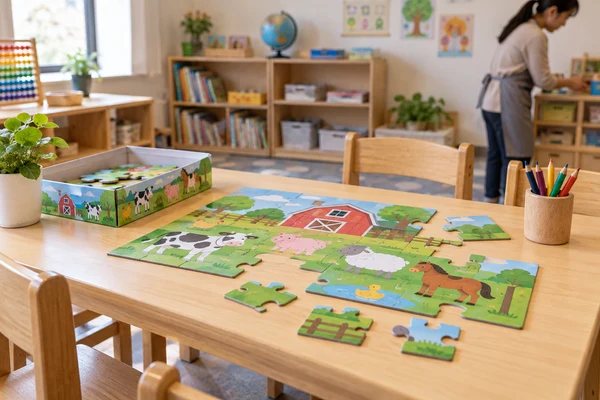
A custom preschool puzzle should be developed from the intended users, activity and destination-market requirements, then reviewed as a complete physical product. Piece count alone cannot establish age suitability, safety or educational value. Education buyers should coordinate an educator's image and activity review with qualified assessment of the materials, pieces, components and labelling before release. This guide explains that development process for brands and supervised early-learning settings. It offers practical questions for sampling and observation without prescribing a universal age-to-piece formula, claiming therapeutic effects or presenting an educational illustration as evidence that a product has passed safety testing.
Define a custom puzzle early learning brief
Begin with the activity you want to offer. Learners might identify a familiar scene, match visual features or discuss objects with an adult. Choose a primary purpose and explain how the educator will introduce it. The product brief should describe a meaningful invitation to play rather than a list of developmental benefits that has not been demonstrated for the proposed puzzle.
Record the intended users, setting, language and any relevant individual needs. A custom kindergarten puzzle may be used differently from a product proposed for a younger group, even if both share an illustrated theme. Do not treat setting names as complete age classifications. Confirm the actual audience and how the product will be marketed with the responsible product-development and compliance teams.
The National Association for the Education of Young Children's developmentally appropriate practice statement emphasises considering children and their contexts. Use that framework to ask useful activity questions; it does not certify a particular puzzle design or provide a universal manufacturing specification. Educator judgment and physical-product assessment remain distinct responsibilities.
Choose a development starting point such as the children's custom puzzle format, then document the actual requirements. Include the image direction, intended components, quantity scenarios and destination. A category name is helpful for discussion, but it cannot replace the approved specification needed for sampling, testing or manufacture.
| Input | Question | Responsible review |
|---|---|---|
| Users | Who is the product actually intended for? | Product owner and qualified age review |
| Activity | What will the adult invite learners to do? | Education lead |
| Physical format | Which pieces, materials and components are proposed? | Product and compliance specialists |
| Environment | How will it be set up, stored and supervised? | Setting staff |
| Market | Which requirements and documentation apply? | Responsible importer or brand and specialists |
Review pieces beyond a simple count
Piece count is one design variable alongside finished dimensions, shape, image layout and handling. Two puzzles with the same count can differ substantially in the size and form of individual pieces. Ask the manufacturer for the proposed cut reference, then review the physical sample. Avoid recommending a count as automatically safe or developmentally appropriate for every child of a given age.
For a custom toddler puzzle proposal, bring the full physical configuration to a qualified review early. Materials, separable components and foreseeable handling need consideration for the actual product and intended audience. A large appearance in a photograph does not establish a component's safety. Neither a supervision statement nor a supplier's generic description should substitute for the required assessment.
The U.S. Consumer Product Safety Commission's children's-product guidance explains age determination and the factors used to assess intended users. Review the current guidance for U.S. projects with the responsible specialists. Requirements in other markets need their own assessment; a conclusion about one jurisdiction should not be applied automatically to another.
During development, ask whether educators can handle the proposed pieces comfortably in the intended activity and whether the image remains recognisable across them. Record observations with the sample identifier and relevant context. This supports a design discussion, but informal handling feedback does not demonstrate compliance or justify a claim that the puzzle is suitable for every learner.
Create an image that supports the intended invitation
Keep the visual hierarchy clear. A familiar theme can contain distinct objects and useful contrasts without crowding every area with small detail. Decide which features matter to the activity and which are decorative. Review the image at the finished puzzle size, because a large digital preview can conceal how a small object or fine outline will look in print.
Choose imagery with the audience and setting in mind. Ask educators to review whether the scene is understandable and whether the portrayal is appropriate to the intended users. A farm, neighbourhood or everyday routine is a possible theme, not a universally recommended curriculum choice. Review cultural and language context rather than assuming one scene represents every child's experience.
Keep essential adult instructions on a guide or box panel. Learners may not need printed labels on the puzzle itself, while educators may need a reference picture and a short introduction. If words are part of the intended activity, qualified language review should cover spelling, translation and legibility. Avoid claiming that the mere presence of words establishes language-learning effectiveness.
The educational puzzle format can include a guide or answer reference where useful. Define these as components of the proposed product, then review their content and packing together. A reference card that uses an earlier crop can confuse the activity even when the puzzle print itself matches the approved artwork.
Use a visual-content checklist
Ask reviewers to identify the main scene, the features required for the activity and any element that needs explanation. Check whether important details remain visible at the intended scale and whether the reference matches the puzzle. Record specific changes rather than an overall instruction to make the artwork more educational, which gives designers little direction and no reviewable outcome.
Define your early-learning product
Send the intended users, activity, image theme and destination market. Include staff storage needs and the planned product assessment so the sample brief is complete.
Plan adult guidance and observe actual use
Write a short introduction for the adult facilitating the activity. Explain the intended invitation, how the reference may be used and what optional prompts can support discussion. The guide should allow educators to adapt their approach to the learners. Avoid prescribing a fixed completion speed or presenting a child's need for assistance as a product failure or developmental judgment.
The NAEYC statement on observing, documenting and assessing learning describes purposeful, responsive observation. Apply that principle to review the activity in its context. An educator can note what information or support was useful, then adapt the invitation. This is different from claiming that the puzzle itself has produced a measured developmental benefit.
If an appropriate product and programme review allows supervised observation, document the conditions and scope. Record which approved sample was used, what adults asked and the practical issues noticed. Do not test an unassessed prototype with children merely to obtain feedback. The responsible setting and product specialists should determine when and how observation is appropriate.
Use observations to ask concrete design questions. Was the reference difficult to see? Did a printed feature need explanation? Was the pack awkward for staff to clear? Revise the relevant component and review again. Keep personal information through the setting's authorised processes, and do not turn an informal session into a marketing case study or health claim without a proper basis.
Plan daycare and nursery setup, storage and maintenance
A custom puzzle for daycare needs an operational plan for staff as well as a visual concept. Identify who sets up the activity, controls access and collects components afterward. Keep different sets distinguishable and provide the reference where adults need it. A puzzle specified for an individual retail pack may require a different storage review when several sets are used in one setting.
For a custom puzzle for nursery, confirm the intended users rather than relying on the term nursery alone. Review where the resource will be stored and how staff prevent loose components from entering other activities. Follow the setting's actual supervision and access procedures. These are operating decisions that complement qualified product assessment; they cannot make an unsuitable physical component acceptable.
Ask about maintenance expectations before selecting material and finish. Paperboard should not be assumed to tolerate washing, soaking or a particular cleaning treatment. Review compatibility with the supplier and responsible setting staff using appropriate evidence. If the required maintenance process does not suit the proposed material, consider a different product configuration rather than publishing an unsupported easy-clean claim.
Rehearse setup and repacking with the actual sample. Confirm which guide belongs to each set, how components are contained and how staff identify a damaged or incomplete item. Use a simple status process for items awaiting review. Avoid a service promise such as guaranteed complete after every activity unless the organisation has an actual method capable of supporting it.
Coordinate market-specific safety and documentation review
Define the market, product configuration and responsible economic operators before commissioning assessment. Requirements can depend on intended users, materials, components and how the product is supplied or marketed. Give the qualified reviewer the complete pack, including inserts and containment. A report for a different puzzle or material should not be assumed to establish the status of this product.
The CPSC toy safety guidance explains that firms must identify which requirements apply to their specific toy and describes related testing and certification duties. Use the current guidance for the actual U.S. programme. This article does not determine your product's compliance or claim that PuzzleZa holds a certification for the proposed configuration.
Ask the responsible specialists to identify applicable standards, assessment methods, documentation and labelling for each destination. Record the product and material references connected to any resulting evidence. A statement that a sample passed a test is incomplete without knowing the tested configuration and scope. Resolve requirements before production release, rather than adding a market label after the retail box has been printed.
Our children's-puzzle testing and documentation guide provides further sourcing questions. Keep educator review and compliance review connected, but do not merge them into one approval. A product can be appealing for an activity and still need changes for the applicable requirements; it can meet specified requirements without proving a particular educational outcome.
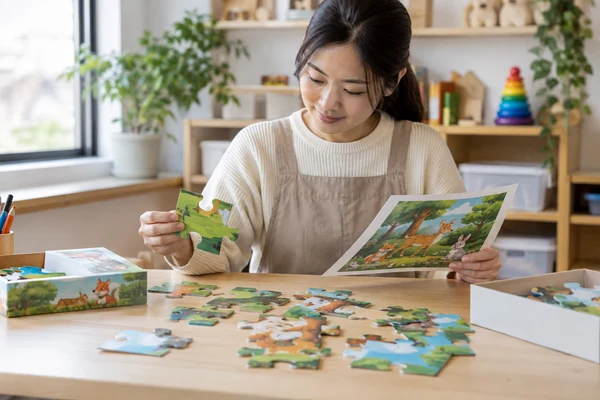
 PuzzleZa
Approve the complete preschool puzzle sample
Create a sample record identifying artwork, cut, finished dimensions, board, surface treatment, box, containment and printed support materials. State which components the sample represents and what remains provisional. A visual mock-up may show the intended scene but not the proposed materials or piece behaviour. The approval should match the evidence reviewed rather than the supplier's broad product category.
Give each reviewer a clear remit. Educators review image understanding, activity instructions and practical use. Product reviewers examine print, piece separation and component fit. Qualified compliance reviewers handle applicable product requirements. A coordinator should consolidate comments and record the final disposition. This reduces the chance that one team's approval is incorrectly treated as covering every unresolved aspect.
Use the NAEYC practice framework to keep attention on the intended learners and context during educational review. Record actual observations and limits. Do not describe educator feedback as an independent certification or a demonstration of improved concentration, motor skills or other outcomes that were not appropriately assessed.
Once approved, freeze the file and component versions used for release. Identify who can authorise substitutions and when a new review is needed. The children's versus adult puzzle guide offers broader product-selection questions, but the preschool programme needs its own exact specification. Similar artwork does not make two physical configurations interchangeable.
Maintain the approved configuration through delivery and use
Factory testing should check selected production units against the approved product and packing record. Relevant checks may include correct artwork, cut, component presence, visible board condition and pack fit. State which checks are agreed and what evidence is retained. Routine factory checks should not be described as laboratory compliance testing unless the relevant assessment was actually performed and documented.
At shipment inspection, provide the released specification and any approved exceptions. Examine selected finished packs and cartons for version, components, quantity, visible condition and agreed marks before handover. Match the product identifiers to the assessment and release records where required. Inspection observations support a manufacturing decision; they do not supply proof of developmental effectiveness.
Prepare receiving staff with the set count, references and storage instructions. Keep a process for reports about damaged components, confusing images or difficult packing. Review observations in context and refer safety concerns through the responsible product and setting procedures. When changing a material, cut or component, ask the relevant specialists whether the existing evidence remains applicable to the revised configuration.
PuzzleZa operates an 8,000 m² custom puzzle factory in Shenzhen. Review the factory information and send a preschool product-development brief. Include intended users, markets, educator requirements and the planned assessment route so the manufacturer can discuss the correct scope and sample decisions.
Frequently asked questions
How many pieces should a preschool puzzle have?
There is no universal count that establishes suitability or safety. Review the intended users, finished dimensions, individual piece shapes, image complexity and activity with educators and qualified product specialists. Evaluate the actual configuration and destination requirements. A number used by another brand is not evidence that your proposed design is appropriate.
Are large cardboard pieces automatically suitable for toddlers?
No. Appearance and nominal size do not settle the complete assessment. Review the materials, separable components, foreseeable handling, intended users and market-specific requirements with qualified specialists. A large-piece description or supervision statement cannot replace the applicable review, and a photograph cannot establish the safety status of a physical product.
Can educators assess a puzzle's safety during a play session?
Educators can identify practical concerns, but informal observation is not a substitute for the qualified assessment required for the product and market. Determine that assessment route before use. Any supervised observation should follow the setting's authorised procedures and an appropriate review of the sample, with clear limits on what feedback establishes.
Can the product promise improved concentration or motor development?
Do not make a specific developmental claim without appropriate evidence for the product and use. Describe the activity and educator guidance accurately. An engaging image, positive feedback or a successful assembly does not by itself demonstrate a measured outcome. Keep educational planning, usability observations and substantiated claims distinct in public copy.
What should a daycare buyer include in the first enquiry?
Send intended users, activity, destination market, quantity scenarios, artwork status and component needs. Describe setup, storage and maintenance requirements, and identify the responsible educator and compliance review. Include the planned assessment and documentation route where known, so the discussion covers the complete product rather than only the printed image.
Conclusion
Develop a custom preschool puzzle through coordinated activity, physical-product and market reviews. Define the intended users, sample the complete configuration and record what each approval establishes. Keep educator observations useful and claims proportionate to the evidence, then maintain the approved materials, pieces and components through production, receiving and later changes.
Discuss a preschool puzzle development brief
Contact info@PuzzleZa.com with the educator and product requirements for your programme. PuzzleZa can discuss the manufacturing scope and the decisions needed before sampling and release.
Sources and scope
Sources reviewed on 2026-09-28. Manufacturing examples and review checklists are planning guidance, not claims about completed customer projects or guaranteed results. AI-generated images illustrate the topic and do not document an actual inspection.
- National Association for the Education of Young Children: DAP position statement — Considering learners and context in educational planning, without certifying a puzzle product.
- NAEYC: observing, documenting and assessing learning — Purposeful, responsive observation and its use in adjusting educational activities.
- U.S. Consumer Product Safety Commission: children's products — Intended-user and age-determination review for U.S. children's products.
- U.S. Consumer Product Safety Commission: toy safety business guidance — Product-specific identification of applicable requirements and related assessment duties.