An FSC custom puzzle claim needs evidence connecting the relevant certified supply chain, product scope and transaction to the item being sold. Recycled-content and plastic-free claims require their own component-specific support. Buyers should verify those claims separately before approving artwork or retail listings. This article explains a practical documentation review for importers, publishers and private-label brands. It does not state that PuzzleZa holds FSC certification or that any particular PuzzleZa product qualifies for an FSC label; those facts require current project-specific verification before a claim is used.
Define the exact environmental claim before sourcing
Start with the statement your customer or retailer expects to see. Does the requirement concern responsible fibre sourcing, recycled board content, reduced plastic components or disposal instructions? These are different procurement objectives. A broad request for a sustainable custom puzzle leaves the manufacturer guessing which material and documentation decisions the buyer actually needs.
Describe the scope in physical terms. A paperboard puzzle can include face paper, core board, adhesive, coating, inner bag, poster, insert, retail box and outer packaging. A claim about the core should not silently become a claim about every component. Map the product first, then decide which components the statement covers and what evidence is needed for each.
Separate buyer preferences from release requirements. A preference for less packaging can be explored through samples, while a retailer's documented certification requirement may need a particular evidence path. State whether the requirement is essential, optional or still being evaluated. This prevents a quotation for a material option from being mistaken for confirmation that a retail claim is authorised.
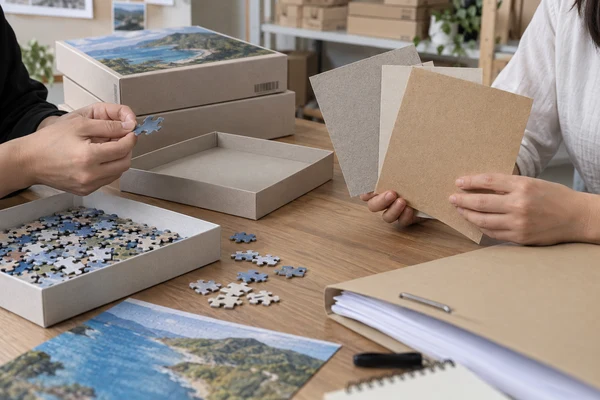
The retail puzzle format is a starting point for the component discussion. Confirm the actual construction and pack for your order before making any environmental statement. A product-category page, green-looking packaging or an AI-generated illustration cannot establish the sourcing history or composition of the item you will receive.
Understand FSC labels without treating them as interchangeable
The Forest Stewardship Council explains three label categories: FSC 100%, FSC Recycled and FSC Mix. They communicate different sourcing bases for the covered forest-based material. A buyer should identify the applicable category rather than adding whichever mark looks most familiar to its box design.
FSC 100% indicates material from FSC-certified forests. FSC Recycled concerns recycled material. FSC Mix can involve certified, recycled and/or controlled sources under the scheme's rules. These concise distinctions help frame the sourcing request, but they do not determine whether a specific puzzle or packaging component qualifies. The relevant certificate holder and certification process must establish that.
Do not interpret an FSC label as a statement about every environmental property. It is not automatically evidence of carbon neutrality, plastic-free construction or acceptance in local recycling systems. Likewise, a recycled core does not by itself authorise an FSC Recycled label. Keep the claims separate so sourcing evidence is not stretched beyond the matter it actually addresses.
Ask which product or component the proposed label covers and how that scope will be clear on the pack. If the box and puzzle use different materials, the buyer needs to avoid an ambiguous whole-product impression. Review the final label artwork with the party responsible for authorised trademark use before release, rather than treating a stock logo file as permission.
| Proposed statement | Evidence to request | Avoid assuming |
|---|---|---|
| FSC-labelled component | Applicable certificate scope and transaction claim | Every component is covered |
| Recycled board content | Material declaration and calculation basis | The complete pack has that percentage |
| Plastic-free pack | Defined component scope and material review | Paper appearance proves absence of polymers |
| Recyclable packaging | Construction and relevant destination guidance | Recycled content means recyclable everywhere |
How to verify an FSC certified puzzle manufacturer claim
When a supplier describes itself as an FSC certified puzzle manufacturer, ask for its legal entity name, certificate code, current status and applicable scope. Compare those details with the organisation taking your order and the site or activity involved. A certificate held by another business should not be assumed to cover your supplier's finished-product transaction.
Use the official FSC certificate search to review the record. Save a dated copy of the result for the purchasing file. Ask questions when names, sites or product groups do not match the proposed supply arrangement. A database match is an important check, but the buyer also needs to establish that the order itself is covered.
Request the relevant sales and delivery documentation requirements before placing the order. Ask which FSC claim will appear on the applicable transaction record and which items it identifies. Do not accept a photograph of certified raw paper as a substitute for connecting the claim to the finished goods. The evidence needs to follow the actual supply chain and commercial transaction.
FSC's chain-of-custody guidance explains the purpose of tracking certified material through the supply chain. Use it to understand why more than a mill certificate can be relevant. If the proposed arrangement is unclear, ask the applicable certification body or FSC contact to clarify it before approving a label. This article provides a review framework, not a certification determination.
Define your material and documentation requirements
Send the exact environmental claim, covered components, destination markets and retailer requirements. Ask for evidence to be reviewed before label artwork is approved.
Document a custom recycled cardboard puzzle by component
For a custom recycled cardboard puzzle, ask which layer contains recycled material and what declaration supports that statement. Core board, printed face paper and the retail box may have different compositions. A percentage should identify its denominator: a specified component, the paper-based content or another clearly defined basis. Without that scope, the figure can create a misleading impression.
Ask whether the declaration distinguishes pre-consumer and post-consumer material where that distinction is required by the intended claim. Retain the supplier document and its date. If composition varies by grade or supply batch, agree how current evidence will be supplied. A generic brochure describing recycled options does not identify the material actually purchased for your order.
Use a material-claim worksheet
List each covered component, material reference, claimed recycled content, evidence issuer and evidence date. Add the proposed customer-facing sentence beside it. Review whether the sentence can be supported without borrowing evidence from another component. Leave an unresolved claim out of artwork until the documentation gap is closed.
For the United States, the Federal Trade Commission's Green Guides summary advises qualifying recycled-content statements for products or packages made only partly from recycled material. Treat this as a reason for precise wording and destination-specific review, not a universal approved phrase for every market.
Keep environmental and performance reviews connected
A documented composition claim does not establish assembly quality. Sample the proposed board, face paper and pack for handling, print, cut and protection as well. If changing a material alters the finished construction, review both the claim evidence and the physical product before accepting the revision.
Set a clear scope for a plastic free custom puzzle claim
A plastic free custom puzzle request needs a defined boundary. Does the buyer mean no plastic inner bag, no shrink film around the box, no plastic insert or no plastic within any component? These choices are not equivalent. Write the intended scope before asking a supplier to confirm feasibility, and specify whether transport packaging is included.
Review surface treatments and containment rather than judging by appearance. Some papers have coatings or laminated structures that cannot be identified reliably from a photograph. Ask for the material description of the relevant layers and components. If the claim requires more detailed substantiation, involve the material supplier or a qualified testing adviser instead of guessing from a smooth surface.
Alternative containment needs a product application review. A paper-based bag, sealed paper wrap or other proposed option should be sampled for piece containment, opening and repacking. Replacing a familiar component may affect usability and protection. Document the observation rather than claiming that the alternative automatically improves the entire product's environmental impact.
Keep the final customer wording within the verified boundary. If only the inner packaging changes, say what changed clearly. Avoid a whole-product claim when evidence covers a narrower part. Our surface finish selection guide can help identify the finishing questions to discuss alongside packaging materials, but it does not certify the composition of your order.
Replace broad eco-friendly wording with supported information
A buyer searching for an eco friendly custom puzzle usually wants a credible product choice, but the phrase is too broad to serve as a specification. Decide which supported attribute matters to the audience and explain it directly. Specific information about a covered component is easier for a customer to understand than an undefined environmental promise.
The FTC guidance cautions against broad, unqualified environmental-benefit claims. Its principles are particularly relevant when writing United States retail copy, while other destinations may apply their own rules. Review the current requirements for each sales market before publication. Do not present this general procurement article as legal approval of a label or listing.
Separate recycled content from recyclability. The first concerns material origin; the second concerns whether the finished construction can enter a relevant collection and processing route. Laminates, coatings and local infrastructure can matter to the disposal question. Ask the responsible packaging and market specialists for appropriate instructions instead of promising that every customer can recycle the complete pack.
Avoid carbon, biodegradability or compostability language unless those exact statements have suitable evidence and a defined scope. Removing a plastic bag does not calculate a carbon reduction, and paper appearance does not establish a composting claim. A credible article or product page explains what has been documented and gives practical disposal guidance where supported without filling evidence gaps with marketing adjectives.

 PuzzleZa
Build a claim approval record before artwork release
Create a record linking every proposed claim to the component, evidence, approver and approved wording. Include where the statement will appear: box, insert, website or retailer data sheet. A claim can become misleading when a qualified sentence is shortened for a label or a retailer copies only its headline. Give sales partners the complete approved text.
Use a version-controlled artwork file. Identify the final certification label, applicable licence details, material wording and any qualification. Ask the responsible parties to review the complete layout, not only a cropped mark. Clear proximity matters when a claim covers the box rather than the puzzle inside; placement should not suggest broader coverage than the evidence supports.
Keep documentation beside the purchase order and sample approval. The physical sample helps verify construction, while certificate and material records support the claim. These evidence types complement each other. A good-looking sample cannot prove a chain-of-custody transaction, and a certificate cannot demonstrate how the pack opens or protects the puzzle.
Discuss documentation responsibility through the project approval process before production. Name who checks current evidence and who authorises printed wording. Review the PuzzleZa factory information for the supplier discussion, then request the specific evidence your programme requires. Do not infer certification from a factory's size, location or general cardboard specialisation.
- Claim scope identifies the covered components.
- Certificate and transaction details match the order where relevant.
- Material declarations support the exact recycled-content wording.
- Plastic-free wording has a defined physical boundary.
- The final layout and partner copy have named approval owners.
Check claim evidence again at shipment and reorder
Before shipment, check that delivered goods and documents use the released product identifiers and claim wording. Shipment inspection can compare selected packaging with the approved artwork and components. Documentation review should confirm the agreed transaction evidence. Do not treat either activity as a substitute for the other, because a visual inspection cannot establish the full sourcing history.
For reorders, recheck current certificate status and ask whether materials, suppliers or pack components have changed. Retained wording may no longer fit a changed construction. Require notification before substitutions and review affected claims alongside the sample. A previous valid claim is not permission to reuse the same statement indefinitely on every later order.
If a gap appears, resolve it through documentation or revise the claim to what can be supported. Keep a record of the decision and update the related web copy and retailer files. Send PuzzleZa your environmental requirements and evidence checklist so the conversation begins with a precise scope and a clear understanding of what still needs verification.
Frequently asked questions
Does this article confirm that PuzzleZa is FSC certified?
No. This is a buyer verification guide and does not establish PuzzleZa's certification status or the eligibility of any specific product. Request current legal-entity, certificate, scope and order documentation before relying on an FSC statement. Any label proposal needs review through the applicable authorised process.
Is a paper mill's FSC certificate enough for a finished puzzle claim?
Do not assume it is. The finished-product claim depends on the applicable supply arrangement, certificate scope and transaction evidence. Identify the parties handling the material and the item being sold, then verify the required chain-of-custody path with the relevant certificate holder or certification body before printing a label.
Can recycled cardboard automatically carry an FSC Recycled label?
No. Recycled composition and eligibility for an FSC label are separate matters. Obtain the material evidence for the recycled-content statement and follow the FSC requirements for the proposed labelled item. A supplier's description of recycled board does not by itself authorise trademark use on your packaging.
What does plastic-free mean for a custom puzzle pack?
It means only what the clearly defined, substantiated claim covers. State whether the boundary includes inner containment, shrink film, inserts, surface layers and transport packaging. Review component descriptions before approving the wording. Removing one plastic item does not establish that every part of the complete product is plastic-free.
What should be checked when an environmental puzzle programme reorders?
Check current certificate details where relevant, material declarations, component references, transaction requirements and approved artwork. Ask about substitutions or supply changes. Reassess the claim if any covered component changes, and update retailer or website wording with the physical product so an old description does not outlive its evidence.
Conclusion
An FSC custom puzzle or recycled-material programme starts with a precise claim and evidence that fits its scope. Verify certificates and transactions where required, document component composition and approve accurate wording before production. A sustainable custom puzzle discussion becomes useful when it identifies specific supported choices and the decisions that still need verification.
Begin with an evidence-based sourcing brief
Contact PuzzleZa at info@PuzzleZa.com or use the enquiry page. Share your material priorities and documentation checklist so project-specific availability and claim support can be discussed.
Sources and scope
Sources reviewed on 2026-09-28. Manufacturing examples and review checklists are planning guidance, not claims about completed customer projects or guaranteed results. AI-generated images illustrate the topic and do not document an actual inspection.
- Forest Stewardship Council: label categories — Distinguishing FSC 100%, FSC Recycled and FSC Mix.
- FSC: official certificate search — Checking current certificate identity, status and scope.
- FSC: chain-of-custody certification — Why supply-chain and transaction evidence matter to a finished-product claim.
- Federal Trade Commission: Green Guides summary — Qualifying environmental and recycled-content claims and avoiding broad unsupported benefits.