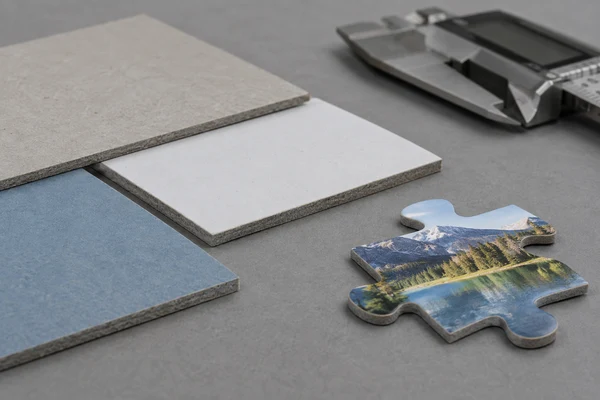
Custom puzzle cardboard thickness is one material parameter, not a complete quality standard. Buyers should specify the finished construction, distinguish core board from mounted face paper and compare rigidity, flatness, cut edges and handling through physical samples. A thicker board can behave differently without automatically being the better choice. For retail brands and product developers, the useful specification connects a measurable thickness to an approved material reference and practical assembly experience. This guide explains the terms, sample checks and procurement records needed to choose cardboard puzzle materials without relying on colour names or unsupported premium claims.
Understand the layers before specifying board thickness
A cardboard jigsaw puzzle may combine core board, printed face paper, adhesive and a surface treatment, with backing paper where the construction requires it. Ask the manufacturer to identify each layer. Two samples with similar finished thickness can have different cores and face papers, which makes a single caliper number an incomplete description of how the product will handle.
Distinguish raw board thickness from finished puzzle thickness. Mounting adds material, and the location or method of measurement can affect the reading. If a quote only says thick board, ask what is being measured and at which stage. State units explicitly so a value in millimetres is not confused with paper grammage or another supplier's naming convention.
A material name should lead to a specification sheet, supplier reference or retained sample. It should not replace those records. Ask how the board is identified during ordering and whether proposed substitutions require approval. This matters when several artworks share one construction: a material change can affect the entire range, even though the printed images remain unchanged.
Start the discussion from the intended format and user. The 1,000-piece art puzzle and a compact gift puzzle can place different demands on handling and packaging. Confirm the actual finished size and piece geometry before selecting a construction. The buyer should describe the experience it needs; the factory should propose a sample that can be reviewed against that brief.
Custom puzzle board thickness is different from stiffness
Custom puzzle board thickness describes the distance between surfaces under the selected measurement method. Stiffness describes resistance to bending in a defined test or handling situation. Material density, fibre structure, layer bonding and geometry contribute to the result. A buyer therefore needs a thickness reference and a handling review rather than assuming one reliably predicts every aspect of the other.
ISO 534 covers thickness measurement for paper and board. Its public scope distinguishes single-sheet measurement from bulking measurement and states that the bulking method is unsuitable for board. This is a reason to agree an appropriate method with a testing provider, not a claim that a hand-held caliper reading constitutes a standard test.
For a simple comparative review, use samples of equal dimensions and the same handling sequence. Observe whether pieces bend unusually during ordinary pickup and whether assembled sections remain manageable. Keep the result as an observation unless a defined mechanical test is commissioned. Do not translate an informal bend comparison into a certified strength rating.
If numerical acceptance limits are necessary, define the method, conditioning, sample selection and tolerance before production. A specification that gives only a nominal value can create disputes when different tools or conditions produce different readings. The appropriate limit should come from product development and supplier capability, not from copying an unrelated retail product's marketing description.
| Term | What it describes | What it does not prove |
|---|---|---|
| Thickness | Measured distance between surfaces | Rigidity or assembly performance |
| Grammage | Mass per unit area of a paper or board | Finished puzzle thickness |
| Core colour | Visible appearance of the core | Composition, certification or durability |
| Finished construction | Combined layers and finish | Performance without an appropriate sample review |
Compare blue core, greyboard and chipboard through evidence
Custom puzzle blue core board describes a visually identifiable core in many sourcing conversations, but the name alone does not establish a universal grade. Ask for the actual material reference, thickness and construction proposal. If a buyer prefers blue core for its product positioning, approve the colour and performance separately; visible colour is not a substitute for material evidence.
A custom greyboard puzzle can also be suitable when its construction meets the intended requirements. Greyboard is a broad commercial term, and specifications vary. Compare the proposed sample's edge, cut separation, flatness and handling. Do not reject or approve a board solely because its exposed core looks grey in a photograph.
The phrase custom chipboard puzzle is similarly dependent on the supplier's terminology. In paperboard conversations, chipboard can refer to a paper-based board; in other industries the same word can mean a different material. Confirm that both parties are discussing cardboard jigsaw construction and request a layer description to remove that ambiguity before quotation.
Use neutral language in your own retail copy. If composition or recycled content has not been documented, avoid inferring it from appearance. If a particular board grade matters to a buyer contract, place the verified grade or retained reference in the specification. The useful commercial promise is the approved construction, not an unsupported hierarchy in which one core colour always ranks above another.
Compare the right board constructions
Share your finished format, piece count, customer requirements and material concerns. Ask for a sample scope that compares board, paper and cutting together.
Select custom puzzle paper stock around image and process
Custom puzzle paper stock affects the print surface and its interaction with mounting and finishing. Ask whether the quoted stock refers to face paper, backing paper or board. Record the paper reference and any coating. A supplier can then explain why it is proposed for the image and printing route instead of leaving the buyer to compare vague terms such as high-quality art paper.
Assess important image details on the proposed stock. Fine illustration lines, broad colour areas and shadow transitions can reveal different concerns. Review the puzzle at its finished scale. An enlarged digital image may look sharp even when small details are hard to distinguish on the physical face paper. Sample the actual artwork where that distinction matters.
Separate print appearance from paper naming
A paper's marketing name cannot establish whether the complete puzzle will reproduce your artwork acceptably. Use a relevant physical print and define the features that must remain clear. The puzzle finish guide explains why surface treatment should also be reviewed on the image rather than selected in isolation.
TAPPI's paper-properties programme distinguishes multiple physical tests for paper and board. Use that distinction when commissioning evidence: request the property relevant to your decision rather than a general paper-quality test.
Check the mounted surface
Inspect the finished surface for visible lifting, wrinkles and local texture differences. Photograph observations beside a sample identifier and explain where they occur. The cause may involve material, mounting or finish, so request investigation rather than assigning the issue to paper grammage from appearance alone.
Review piece edges, separation and fit on cut samples
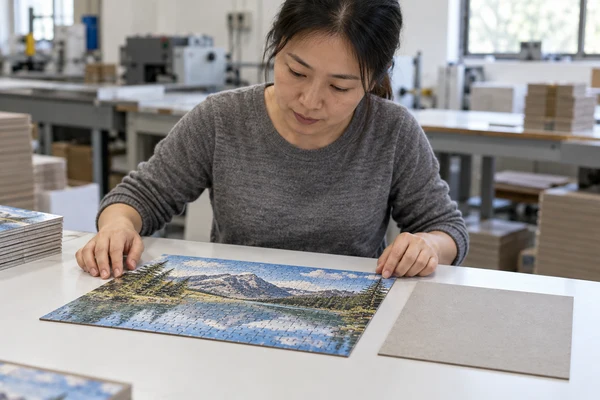
Board selection and cutting need to be reviewed together. A loose uncut board sample may feel convincing but cannot show how small tabs and narrow necks behave after cutting. Request a representative cut sample with the proposed geometry. Inspect straight edges, curves and fine areas rather than only the easiest broad pieces.
Look for observable conditions such as poorly separated pieces, lifted face paper, crushed edges or excessive loose fibres. Define the concern through photographs and examples. A small amount of loose paper dust and a piece with damaged image paper are different observations; do not group them under one subjective quality complaint without explaining their effect on the user.
Assemble and disassemble selected sections normally. Check whether the pieces enter their intended positions without unreasonable force, whether adjacent images align and whether ordinary separation damages the printed surface. This is an experience review for the specific sample. It does not establish an endurance guarantee or a universal fit metric for every puzzle format.
Compare samples with the same artwork and cut where possible. Otherwise, a different piece shape can influence handling and obscure the material comparison. Ask the factory to identify what changed between alternatives. This lets the buyer decide whether it is approving a board substitution, a new cutting pattern or a complete new construction that deserves its own review.
 PuzzleZa
Consider flatness, moisture and storage during development
Flatness should be reviewed under stated conditions. Place an assembled sample on a known flat surface and describe any visible lift or distortion. Record when it was unpacked and where it was stored. An observation made immediately after exposure to unusual conditions should not automatically be treated as the same evidence as a controlled laboratory assessment.
Paperboard behaviour is affected by moisture, which is why comparison and testing conditions matter. ISO 187 addresses conditioning and testing atmospheres for paper and board. It is not a completed-product flatness specification. If moisture or conditioning needs formal assessment, ask the provider to identify the applicable method and report the conditions used.
Avoid inventing a humidity range or storage life for the product. Ask the supplier what storage guidance is supported for the approved pack, and coordinate warehouse conditions with the responsible logistics team. Review the retail box and inner containment because materials travel as a pack, not as isolated board coupons. Packaging changes may need additional review if they alter protection.
For a hypothetical retail application, a puzzle kept on a communal table may encounter more handling and environmental variation than a boxed gift awaiting sale. Describe that application during development. The factory can propose a construction to sample, while the buyer can set practical use and storage guidance without implying resistance to conditions that have not been tested.
Build a material specification and comparison worksheet
Use one row for each candidate construction. Include board reference, core appearance, nominal core thickness, finished thickness basis, face paper, backing paper, adhesive description where supplied, finish and cut reference. Mark unknown fields rather than guessing. This reveals whether alternatives differ in one layer or several and keeps the buyer's comparison honest.
Add a short observation sheet for print detail, piece edge condition, separation, fit, flatness and pack experience. Use sample identifiers instead of labels such as good and better. Ask the same reviewers to follow the same sequence where feasible. A consistent process produces more useful feedback than several departments handling different samples and sending unrelated impressions.
For thickness records, include units, tool or test method, measurement stage and locations agreed with the supplier. Do not report a calculated average as if it were the nominal board grade. Separate measured readings from manufacturer declarations and buyer preferences. That distinction makes a later discrepancy easier to investigate because the evidence types are clear.
Review the manufacturing and approval process before finalising the worksheet. Identify when each property can be observed meaningfully: raw material on receipt, mounted sheets before cutting, finished pieces or packed saleable units. A specification is useful when it supports actual checks at the relevant stage, not only when it contains more technical words.
- Material identity and layer description are recorded.
- Core and finished-thickness references are distinguished.
- Comparable cut samples have been reviewed.
- Print, fit, flatness and pack observations have owners.
- Substitutions require documented review before production.
Retain material references for factory checks and reorders
Approve a retained material and product reference that can be located later. A material sheet supports board identity; a finished puzzle supports the complete handling experience. Keep both when they serve different checks. Record the approval date and who can authorise a substitution, especially when a range is expected to continue across several purchase orders.
Factory testing should compare selected construction and finished attributes with the agreed reference. Shipment inspection can examine selected packs for correct product version and visible material or cutting concerns. Neither activity proves that every unit has been mechanically tested. Ask what is actually checked and retain the report with the material record.
When a proposed board changes, evaluate affected print, mounting, cut and pack attributes before accepting it. A substitute that appears close in thickness may differ in other important properties. Discuss the available evidence through the Shenzhen factory enquiry and update the specification deliberately. For a new programme, send your construction brief with its customer requirements and unresolved material questions.
Frequently asked questions
What thickness should a custom cardboard puzzle use?
There is no single thickness that suits every format and customer. Confirm finished size, piece geometry, intended handling and packaging, then compare representative constructions. Specify whether the quoted value refers to core board or the complete mounted puzzle and agree the measurement method before setting acceptance limits.
Is blue core board always better than greyboard?
No universal conclusion follows from core colour alone. Compare the actual grade, construction, cut edges, handling and flatness. A blue or grey core can be part of a suitable product, but colour does not prove composition, durability, recycled content or certification without the relevant supporting evidence.
Is paper grammage the same as puzzle thickness?
No. Grammage describes mass per unit area, while thickness describes distance between surfaces using a stated method. Face paper and core board also serve different functions. Record the property and layer clearly so quotation comparisons do not confuse a paper weight with a finished puzzle-thickness specification.
Why should material alternatives use the same cutting pattern?
Piece geometry influences bending, separation and assembly. If both board and cut change, it is harder to identify why the samples feel different. A controlled comparison using the same geometry makes material differences clearer, while a new complete construction should be reviewed as its own product proposal.
What evidence should be kept for a puzzle material reorder?
Keep the released layer specification, material identifiers, agreed measurement basis, retained raw-material reference and finished approved sample. Add inspection observations and substitution decisions. Before reordering, confirm whether any material or process has changed and review affected attributes instead of relying only on an old board-colour description.
Conclusion
A useful custom puzzle cardboard thickness specification describes the layer being measured and the construction it belongs to. Combine that measurement with evidence of print, cut, fit and flatness. Retained samples and documented substitution rules give purchasing teams a stronger basis for product selection and repeat orders than thickness or core colour alone.
Turn material preferences into a clear brief
Contact PuzzleZa at info@PuzzleZa.com or use the enquiry page with your format, artwork and proposed pack. We can discuss the construction details that need confirmation.
Sources and scope
Sources reviewed on 2026-09-28. Manufacturing examples and review checklists are planning guidance, not claims about completed customer projects or guaranteed results. AI-generated images illustrate the topic and do not document an actual inspection.
- ISO 534: paper and board thickness — Distinguishing appropriate paper and board thickness measurement methods.
- TAPPI: paper properties and testing — Paper and board properties require distinct physical tests.
- ISO 187: paper and board conditioning — Using stated conditioning and testing atmospheres for paperboard assessment.