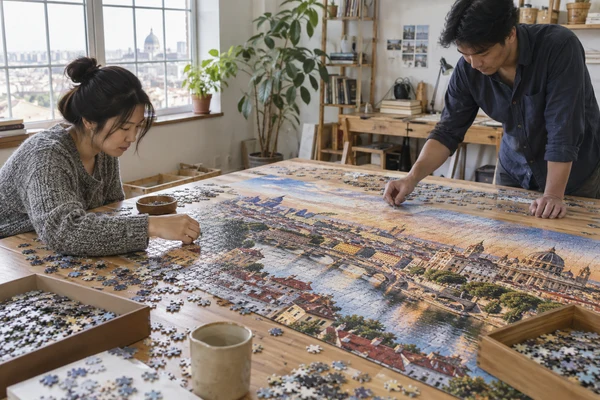
Source a 1,500 to 3,000-piece edition by confirming the production platform, completed dimensions and full packing system before promising the format to customers. Large counts can appeal to specialist adult buyers, but count alone does not establish difficulty, piece size or required table space. This guide helps retailers evaluate feasibility, artwork, references and approval evidence for an ambitious edition without assuming every requested format is available.
Confirm the physical platform before planning an ambitious edition
Begin a large piece-count project with a feasibility question rather than a finished promise. Ask whether the supplier can provide the intended count, dimensions, cut pattern and board construction for the proposed artwork and quantity. A custom 1500 piece puzzle, custom 2000 piece puzzle and custom 3000 piece puzzle may require different production and packing arrangements. Their availability should be confirmed for the specific project; a familiar count in another brand's catalog is not evidence that your supplier offers the same platform.
Give the supplier the intended audience and product application. A specialist retailer, art publisher and general gift shop may have different expectations for challenge, assembly space and retail presentation. Define what the edition adds to the range: a panoramic image, a more detailed composition or a long-term hobby project. A larger count alone is a weak brief because it does not explain the customer's reason to purchase or the constraints the production team must consider.
Use the confirmed art-puzzle product discussion as a starting point, then ask explicitly about a higher-count development. Do not present larger formats as a standard extension before feasibility is established. Request a proposal identifying what is existing, what needs development and which sample decisions are required. This makes a specialist range more credible and prevents unsupported dimensions or delivery assumptions from becoming printed product information.
Specify completed dimensions and realistic working space
Piece count does not tell a customer whether the puzzle will fit their table. Obtain the proposed completed width and height, orientation and measurement convention. A panorama can use table space differently from a conventional rectangle even when its area is similar. Include the finished dimensions in the product brief and customer information. Keep packaging size separate: a compact retail box can hold a puzzle that requires a much larger assembly surface after opening.
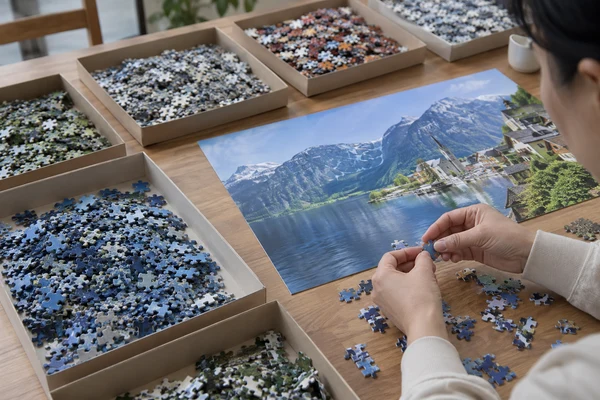
Customers also need space for loose pieces, sorting trays and a reference image. An empty tabletop exactly matching the completed puzzle leaves little room for those tasks. Describe this practical issue without prescribing a universal table size. Ask sample reviewers to assemble a representative section in the intended setting and note where they place unassembled pieces. The result should inform customer guidance rather than become an unsupported assurance that the project will fit every dining table.
An original research paper on puzzle table area examines the additional area needed for loose pieces under a particular model. It supports considering working space beyond the completed rectangle, not a guaranteed footprint for every assembly method. Avoid applying its model as a fixed product requirement. A shopper using stacked trays, separate sorting surfaces or a shared table may organize the project differently.
| Measurement | Purpose | Confirmation needed |
|---|---|---|
| Completed dimensions | Customer table planning | Approved format and orientation |
| Piece scale | Handling and visual detail | Representative cut sample |
| Retail pack size | Shelf and fulfillment | Complete filled pack |
| Master carton | Receiving and freight | Confirmed case arrangement |
Choose artwork that supports prolonged assembly
Review the image for both detail and navigable regions. A detailed cityscape, varied landscape or illustrated scene can offer useful visual landmarks, but repeated windows, broad skies or similar textures can create demanding sections. An ambitious edition should have a deliberate balance between challenge and information. Do not add complexity merely by selecting an image with large indistinct areas. The intended buyer may welcome difficulty, yet still expect an image that reproduces clearly and rewards careful observation.
Assess print quality at the proposed final size and inspect critical details on a proof. A source that works for a smaller retail edition may need a different crop or may reveal weaknesses when enlarged. Keep fine labels, faces and strong landmarks visible after cutting where feasible. If the image contains rights-controlled artwork, obtain permission for the specific reproduction and marketing uses before committing to production. The supplier should not be expected to infer rights from the fact that the buyer supplied a file.
Avoid marketing a hard custom jigsaw puzzle solely through a numeric count. Explain the image features, confirmed dimensions and intended audience in clear language. If a sample trial identifies a particularly demanding region, describe the observation cautiously rather than promising a fixed difficulty level. Difficulty depends on image, piece geometry, scale and the assembler's experience. Customer guidance should help shoppers understand the project, without inventing completion times or describing a staged assembly as a verified customer result.
Review piece scale, cut geometry and actual count together
A higher count can result from a larger finished area, smaller average piece area or both. Ask for the proposed cut layout and approximate piece scale rather than assuming the pieces become progressively smaller. Individual tabs and blanks also make bounding dimensions vary. A sample should show the relationship between the cut and the printed detail. Review handling and visual recognition with the intended adult audience, particularly where small features are important to the product experience.
Clarify whether the number on the proposed box is a category label or an exact piece count. Ravensburger explains its own count conventions, illustrating why buyers should ask this question explicitly. Its counts and dimensions are not universal specifications. Record the agreed count terminology with the supplier and approve the customer-facing wording so the product does not appear inconsistent when an assembler counts a different number of pieces.
The piece-fit guide covers the broader physical review. For a large edition, add representative sections from visually similar areas and inspect whether adjacent pieces produce misleading fits. Compare the whole outline and assembled dimensions, not only a satisfying connection between two pieces. Ask which sample construction represents the proposed final product. A smaller demonstration cut may be useful, but it cannot prove the entire large-format layout has been evaluated.
Do not confuse platform feasibility with artwork approval
Approve both decisions explicitly. A supplier may confirm a workable count and size while the image still needs a crop or resolution review. Conversely, a strong image proof does not establish that the desired cut platform is available. Keep the two decisions connected but separately traceable in the release record.
Check high-count project feasibility
Share the proposed artwork, count, completed-size target and quantity scenarios to discuss a feasible development route.
Make the reference and product information usable for the task
A large edition can benefit from a reference image that is easier to inspect than the box face. Compare the actual useful image area of a poster or card, preserving the approved crop and orientation. A larger sheet does not automatically reveal more detail if most of it is used for margins or promotional copy. Check fine features at print size, and place folds so they do not unnecessarily obscure important visual landmarks. Confirm the proposed paper and folding arrangement with the supplier.
The reference must fit the pack and work at the customer's assembly table. Ask how it can be positioned while sorting, whether the box image remains useful and whether the instructions accurately identify all supplied components. Consider including completed dimensions and a clear note about allowing space for sorting. Avoid a long generic instruction sheet that distracts from the reference. Give each component a defined role and verify that it improves the project rather than simply makes the pack appear more substantial.
Use the poster and insert guide for component planning. For high-count editions, coordinate the reference file with the exact large-format crop rather than reusing a smaller edition's poster without checking it. A missing edge region or changed aspect ratio can make the guide frustrating during assembly. Keep separate versions when editions differ, and provide thumbnails or codes so packing staff can distinguish the correct reference without examining subtle artwork details.
Plan containment and retail packing around loose-piece volume
The bag and box need to hold the actual loose pieces plus all inserts. Ask for a representative filled pack and confirm the interior dimensions. Large counts can create a different packed profile even when the box image looks similar to a lower-count edition. A generous empty box may still be awkward if its opening or lid overlap interferes with the filled bag. Remove and repack every component during review rather than approving the arrangement only as photographed.
If a supplier proposes more than one bag, clarify the purpose and customer information. Do the bags contain random portions or defined sections, and how would the customer know? Do not imply a pre-sorted or sectioned system unless it is explicitly specified and confirmed. Count the supplied components in the packing record and include the required opening instructions. A multiple-bag proposal adds identification and packing questions; it is not automatically a solution for every large format.
Check the external pack and carton data before ordering. Retailers need shelf measurements, warehouse teams need case quantities and logistics partners need the confirmed packed configuration. Avoid estimating freight from the assembled puzzle dimensions or assuming a larger piece count requires a particular retail box. The physical loose-piece stack, inserts and approved protective arrangement determine the package. Review any proposed change to bag or box construction alongside the sample, commercial quotation and customer-facing product information.
 PuzzleZa
Build a sample review that covers the complete edition
An ambitious edition deserves a defined approval scope. Identify which decisions can be made from artwork proofs, which require representative cut sections and which require a complete finished sample. A printed sheet can demonstrate image appearance but not loose-piece handling; a cut section can demonstrate local fit but not whole-layout assembly. Record the limitation of each reference. The buyer should know what has actually been reviewed before releasing a product description or committing to a larger order.
Through the factory review, agree practical factory testing and the final component-control method. Check that the approved files, dimensions, cut reference and packing version are linked to one edition identifier. For shipment inspection, compare selected complete packs with that record and inspect representative pieces or assembly sections as agreed. Document the scope and exceptions. Selected inspection does not support a claim that every large puzzle has been fully assembled or individually counted by hand.
Create a change log for any revised material, dimensions, reference insert or packing arrangement. High-count projects can make late changes expensive to coordinate because several components depend on the same approved format. Ask the supplier to identify consequences before accepting a substitution. On reorders, retain the original reference and review differences rather than relying on the product title. The purpose is to preserve the approved experience while allowing practical changes through a clear, documented decision.
Prepare a specialist range brief and useful customer expectations
For the question how many puzzle pieces for adults, a specialist retail answer begins with the intended customer and space available. Some adults prefer a compact project; others actively seek a large-format challenge. Plan the edition around that audience rather than treating 1,500, 2,000 or 3,000 pieces as a universal progression. Describe the art, confirmed dimensions and component system clearly, and let shoppers assess whether the project suits their time, table and preferred style of assembly.
Send quantities, destination market, proposed artwork, target count and desired completed dimensions in the initial brief. Mark any dimension as a target until confirmed. Ask for the feasible platform, development scope and physical reference needed before approval. Include packaging, poster, barcode and warehouse requirements so they are not added after the puzzle is specified. A complete brief gives the supplier enough context to propose a coherent edition instead of quoting an isolated count with unknown accessories.
Submit the project through PuzzleZa's enquiry page and identify a fallback format if the requested high-count construction is not feasible. The appropriate result may be a confirmed larger edition, a revised size or a different range position. Good specialist sourcing does not force an ambitious numeral onto an unverified product. It matches the intended assembly experience with a producible specification, usable customer information and an approved packing system that can be repeated.
Frequently asked questions
Can every supplier produce a 3,000-piece puzzle?
No assumption should be made from another brand's catalog or a general manufacturing description. Ask the supplier to confirm the actual platform, dimensions, quantity and development requirements. A larger count may need a different production and packing approach. Keep availability provisional until the proposal is confirmed.
Does higher count always mean smaller pieces?
No. The finished area can increase, the average piece area can decrease, or both can change. Ask for the cut reference and representative physical pieces. Individual shapes also vary around an average scale. Confirm the proposed product rather than deriving piece size from the marketed count.
How much table space should customers allow?
Provide confirmed completed dimensions and explain that loose pieces, sorting and references need additional room. The exact working footprint depends on assembly habits and accessories. Avoid a universal table-size guarantee. A representative review can inform practical guidance for the intended edition.
Should large puzzles include several bags?
Only if the confirmed containment system calls for them. Specify whether the bags contain random portions or defined sections and explain the actual arrangement accurately. Multiple bags introduce component and packing controls. Do not advertise sectioned assembly or pre-sorting unless those features have been explicitly approved.
What is the best artwork for a large edition?
Choose a source that prints clearly at final size and offers the intended balance of landmarks and demanding regions. Detailed scenes can help navigation, while repeated textures can create challenge. Review the actual crop and print proof. Do not rely on count alone to establish suitability or difficulty.
Conclusion
An ambitious puzzle edition needs more than a large count on its lid. Confirm the platform, review the artwork at final size and give customers usable information about the completed format. Coordinate references, containment and approval records so the specialist product remains clear to buyers and repeatable for production.
Prepare a specialist puzzle brief
Send the destination, reference-image needs and packing requirements for a project-specific feasibility and quotation discussion.
Sources and scope
Sources reviewed on 2026-10-09. Manufacturing examples and review checklists are planning guidance, not claims about completed customer projects or guaranteed results. AI-generated images illustrate the topic and do not document an actual inspection.
- Research: jigsaw puzzle assembly table area — Original model considering working area beyond completed puzzle dimensions.
- Ravensburger puzzle FAQ — Manufacturer-specific examples showing why count and dimensions need confirmation.