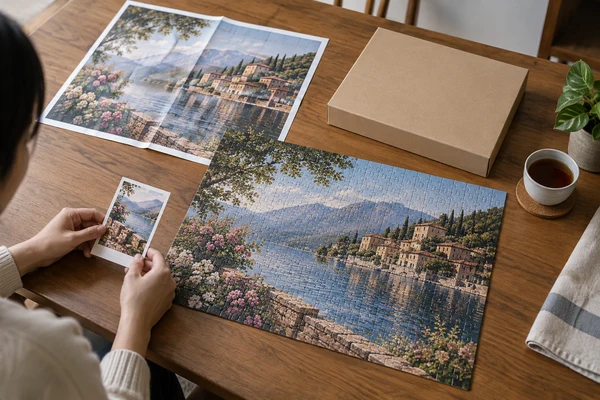
A custom puzzle poster insert is useful when the box image is too small, awkward to position or insufficiently detailed for assembly. It is not automatically necessary for every product. Choose a poster, reference card, instruction sheet or story card according to what the customer needs after opening the pack. Then specify image scale, paper, fold, copy and packing as deliberately as the puzzle itself. This guide helps retail brands and publishers compare the options and approve a supporting component that customers can actually use. Examples of dimensions are illustrative design scenarios, not standard PuzzleZa specifications or confirmed production capabilities.
When does a custom puzzle poster insert improve the experience?
Start by asking how the customer will use the image while assembling. A box lid can work if the picture is readable, the lid can stand conveniently and important regions remain visible. A larger reference can help when a detailed image becomes too small on the box or the customer wants to keep the packaging elsewhere. Inspect the actual box image rather than assuming that every adult puzzle needs another printed component.
For buyers asking 'should custom puzzles include a poster?', the answer depends on image complexity, box presentation and user context. A panoramic photograph may benefit from a reference that preserves its proportions. A simple compact illustration may work with a card or the box alone. Extra paper should have a defined purpose; including several components with no distinct role can make the opening sequence less clear.
The art-puzzle format can include a reference poster where useful. Confirm the option and construction for the actual project. A poster is not evidence that the image is easy to assemble, and a larger print cannot correct a poorly chosen source. Check that the proposed reference supports the approved artwork and intended audience before adding it to the quotation.
Compare posters, reference cards, instructions and story cards
A reference poster shows the image at a useful scale. A custom puzzle insert card can provide a smaller reference, a message or product information. A custom puzzle instruction sheet explains actions or handling, while a story card adds context about the artwork or collection. Write a one-line purpose for every proposed component. If two lines describe the same job, consider combining them or removing the less useful piece.
A custom puzzle with reference card can be practical when portability matters or the image remains clear at a smaller scale. Keep the reference face visually clean. Dense artist biographies and promotional offers can go on the reverse or a separate component where justified. If the reverse is used, check whether reading it interrupts the main activity and whether both sides are correctly oriented in the printed sample.
Custom puzzle leaflet printing is most useful when the information genuinely needs more room. Multiple folds can organise instructions, but they also create handling and layout decisions. Do not add a leaflet merely to give the pack a more elaborate appearance. Use the packaging guide to review the complete component system, then decide which printed material has a clear job after the customer opens the box.
| Component | Main purpose | Trade-off to review |
|---|---|---|
| Folded poster | Larger assembly reference | Creases, table space and refolding |
| Flat reference card | Compact image reference | Small detail and usable image area |
| Instruction sheet | Explain an activity or handling sequence | Text clarity and actual necessity |
| Story card | Artwork context, credits or message | Length, accuracy and component duplication |
| Folded leaflet | Organise several useful topics | Panel order, folds and packing thickness |
Specify useful image area and preserve the approved crop
Distinguish sheet size from image size. A poster with broad margins, a heading and a large story block may show the image only slightly larger than the box lid. State the usable image dimensions in the brief and compare them with the actual pack image. Preserve the puzzle's approved crop and orientation. A beautiful alternative crop can still mislead the assembler if important edge regions are missing.
Consider a hypothetical 400 × 300 mm sheet carrying the reference image. A single fold can reduce the outer footprint to 200 × 300 mm; another arrangement might produce a 200 × 150 mm folded piece. Those dimensions describe a layout example only. Confirm the actual fold direction, panel design and box interior before using them. The printer should provide the relevant template and feasibility advice for the proposed paper.
A hypothetical 150 × 100 mm card has a different role from a large folded poster. It may show the full composition clearly while losing subtle brushwork or map labels. Check representative details at actual print scale. The artwork-requirements guide covers source quality and file preparation; the insert review should add the useful image area and its relationship to the completed puzzle, not simply copy the puzzle file into a smaller page.
Keep puzzle, box and reference versions coordinated
Identify the source image and crop used by each component. If the puzzle crop changes, review the poster and card even when their filenames have not changed. A new border, reversed orientation or removed artwork detail can affect the reference. Keep a thumbnail in the component list so a packing reviewer can identify the intended image without opening editable design files.
Choose paper through handling, glare and fold behaviour
Ask the supplier to propose paper appropriate to the insert's job. A reference needs readable print and convenient handling; a story card may need stiffness; a folded leaflet needs a workable folding structure. Record the proposed paper grade, basis weight, finish and sample reference. Basis weight describes mass per area, not every aspect of thickness, rigidity or folding behaviour. Compare physical samples rather than treating one number as a complete material specification.
Review glare under normal table lighting. A glossy reference can make some image details difficult to view at a particular angle, while a different surface may reproduce the artwork differently. Neither is universally superior. Ask which finish is available for the actual paper and process, then examine the reference beside the puzzle. The customer needs a useful image, not an unsupported promise that every component will look identical across different surfaces.
Sappi's folding and creasing guidance explains that paper and production factors influence folding performance. Use that as a reason to review grain direction, scoring and surface behaviour with the printer. Do not prescribe a universal paper weight or fold treatment without the proposed construction. A stiffer sheet may feel substantial but can become awkward to fold, use and return to a compact box.
Compare your insert options
Share the artwork, box direction and what the supporting component should do. We can discuss poster, card and leaflet options for the proposed pack.
Plan fold placement and panel order before printing
Keep folds away from the most important fine detail where feasible. A crease through a face, small label or essential instruction can interrupt the user's reference. Check the unfolded view and every folded panel. For a leaflet, build a plain paper dummy with the intended opening sequence and mark the front, back and reading order. The print layout should follow that approved structure rather than assume a standard fold arrangement.
Discuss scoring or creasing with the supplier when the paper and design require it. Sappi's fold-endurance technical note identifies contributors to cracking, including paper characteristics, process conditions and heavy coverage across folds. Those factors explain why a dark image crossing a fold deserves a physical check. They do not establish that every folded reference must use one prescribed treatment.
Define the folded outer dimensions and orientation in the component record. Confirm that the result fits the box without forcing a final extra fold at the packing station. Open and refold a representative sample several times as an informal handling review, recording visible observations rather than calling it a standardised durability test. If the paper cracks or the reference becomes difficult to flatten, discuss the stock, finish, fold direction or design before production release.
Keep instructions accurate and prepare the actual insert file
Write instructions only for actions the product needs. Explain what is included and any special orientation, learning activity or message component. Avoid universal storage or care claims that have not been supported for the chosen construction. A story card should identify the artwork and approved credits accurately, without inventing artist biographies, provenance or environmental certifications to make the pack feel more authoritative.
Prepare separate controlled files for the insert faces and fold structure where required. Adobe's printer-mark guidance explains crop, bleed and registration marks and recommends confirming the print provider's requirements. Use the printer's actual template for margins, bleed and technical marks. Marks used during production should not be mistaken for visible decorative content on the customer component.
Check the exported file for missing fonts, assets, overset text and unintended layer content. Adobe's preflight documentation supports those technical checks. It cannot confirm that an artist credit or instruction is factually correct. Have the responsible content owner approve the copy and review special characters in the actual printed sample, especially when several language versions share a leaflet structure.
Specify insert quantity, position and packing sequence
Write the component count for every retail unit. For example, a hypothetical pack might contain one reference poster and one story card, with no separate instruction sheet. That count is a planning example, not a standard inclusion. State whether each component sits above the bag, beneath it or in a separate compartment. Review the opening sequence and check that the lid closes normally with the intended stack.
A 100 × 70 mm story card in an illustrative pack can disappear beneath a larger folded sheet or become bent beside the bag. The physical sample should show where it is placed and how the customer finds it. Avoid assuming that a packing worker can recognise every artwork or language. Use component codes and thumbnails, especially when similar puzzle editions share the same box construction.
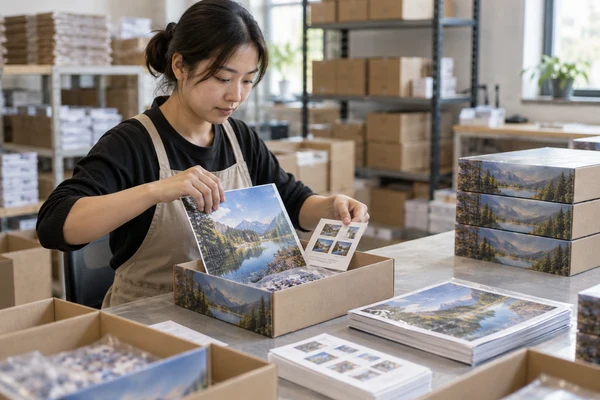
During factory testing, compare selected packs with the released component list, folded dimensions and physical reference. At shipment inspection, check selected completed units for correct insert, count, orientation and visible condition. A poster present in the box may still be the wrong crop or edition. Keep the check scope and exceptions in the order record. These observations support control; they are not a claim that every insert has been individually examined.
- Each insert has a defined purpose, code and released artwork version.
- Unfolded and folded dimensions match the approved construction.
- The image, instructions and credits match the intended puzzle edition.
- Packing quantity and position are shown in the physical reference.
 PuzzleZa
Quote the insert as a component and review changes on reorders
Send the insert purpose, proposed dimensions, paper direction, printed sides, fold and quantity scenarios with the puzzle brief. Ask whether the proposal includes layout work, proofing, folding and packing. A poster should not be added after the box and quotation have been approved without reviewing fit and scope. Additional components can change the physical stack and packing work even when the puzzle face remains unchanged.
Use the factory discussion to confirm what the representative sample will demonstrate. A flat print approves appearance but cannot confirm the final fold and box fit; a plain folded dummy confirms structure but not print. Combine the evidence needed for the actual decision. Keep accepted paper and fold references with the order so a repeat request does not rely only on a descriptive phrase such as premium poster.
Submit the component brief through PuzzleZa's contact page and identify outstanding copy or artwork approvals. On reorders, review material proposals, updated credits, language changes and the crop relationship again. If a component changes, give it a traceable revision and confirm the packing instructions. The best insert is the one that helps the customer assemble, understand or enjoy the approved puzzle while remaining practical to manufacture and pack.
Frequently asked questions
Should custom puzzles include a poster?
Include one when a separate image meaningfully helps the intended user. Compare its usable image area with the box picture and test both at a realistic assembly table. Detailed or panoramic artwork may benefit, while a simple compact design may work with a reference card or the box alone.
What is the difference between a reference card and a story card?
A reference card primarily supports assembly by showing the approved image. A story card provides context, credits or a message. They can share a component when the layout remains useful, but give each face a clear role. Avoid crowding the reference with copy that makes the image harder to see.
Which paper weight is best for a puzzle poster?
There is no universal best weight. Choose a proposed stock through print readability, handling, glare, folding and box fit. Basis weight does not fully describe stiffness or fold behaviour. Ask the supplier for suitable options and approve the physical folded sample rather than selecting a paper solely from its weight.
How can we reduce visible cracking at poster folds?
Review the proposed paper, grain direction, coating, ink coverage and folding process with the printer. Scoring or creasing may be appropriate for the specific construction. Keep critical details away from folds where feasible and examine a representative printed, folded sample. Do not assume one stock or treatment prevents every possible fold issue.
What should shipment inspection check for puzzle inserts?
Compare selected completed packs with the released component record for correct image, crop, language, count, fold, orientation and visible condition. Verify the insert against the puzzle edition, not only the box. Record the observations and any exception, and avoid implying that selected checks establish individual inspection of every unit.
Conclusion
A custom puzzle poster insert should solve a customer need and work physically with the pack. Compare it with a reference card or box image, then approve useful image area, paper, folds and supporting copy together. Control the insert's version, count and placement so the final product contains the reference and information the buyer intended.
Specify a useful puzzle insert
Contact PuzzleZa at info@PuzzleZa.com with component dimensions, paper and fold ideas, quantity scenarios and approved content, or use the enquiry page.
Sources and scope
Sources reviewed on 2026-09-28. Manufacturing examples and review checklists are planning guidance, not claims about completed customer projects or guaranteed results. AI-generated images illustrate the topic and do not document an actual inspection.
- Sappi: folding and creasing technical brochure — Paper and production factors relevant to folded supporting components.
- Sappi: fold-endurance printer technical note — Factors contributing to fold cracking and the need to review stock and process together.
- Adobe: setting printer's marks — Printer marks, bleed and print-provider-specific file requirements.
- Adobe: configure and use the preflight panel — Technical insert-file review before print release.