
Choose a puzzle packaging structure by component fit, opening experience and distribution needs. A rigid box, tuck carton, tin and tube each introduces different closure and storage decisions; no structure wins every application. Begin with the intended channel and a representative packed sample, then confirm feasibility, materials, dimensions and costs with the supplier. This guide helps product teams compare structural concepts rather than decorative finishes or unsupported claims about durability.
Choose the structure from the retail and storage job
Choose puzzle packaging by the way the product will be sold, opened and put away. A rigid box can suit a shelf presentation where a substantial lid and repeat storage matter. A tuck carton may be appropriate when compact presentation and efficient packing take priority. Tin and tube concepts introduce different closures, shapes and component arrangements. None of these structures is automatically the strongest or lowest-cost solution. Construction, size, contents and handling must be evaluated together, and every proposed format remains subject to supplier confirmation.
Write a channel brief before asking for quotations. Identify whether the puzzle will be sold from an upright shelf, displayed on a flat table, posted individually, included in a gift kit or carried during travel. Note the space available in the store and the customer's likely storage routine. A beautiful cylinder may occupy a different shelf footprint from a rectangular box, while an oversized lid can be inconvenient on a small assembly table. Those practical differences belong in the selection process.
Use the complete puzzle packaging guide to understand the full pack system. This article narrows the decision to structure, closure and usable space. Keep decorative finishes out of the first comparison so a foil treatment or dramatic mockup does not conceal an awkward opening method. Begin with plain structural samples where feasible, then ask which approved structures can carry the desired artwork and finish without changing the component fit.
Compare rigid boxes, tuck cartons, tins and tubes
A custom puzzle rigid box usually means a relatively firm board construction with a separate lid or another defined opening arrangement. Ask which exact construction is proposed. A wrapped two-piece box and a hinged presentation box behave differently during opening, packing and storage. Record the lid overlap, closure method and internal dimensions. The word rigid does not establish transit protection, corner durability or resistance to crushing. Those are separate questions for the actual packed design.
A custom puzzle tuck box uses a folding-carton arrangement with flaps that close the pack. It can be convenient for some compact products, but review the flap access, repeated opening and the space required to insert the bag. A custom puzzle tin box has a metal container and a specific lid fit; request the material and finish details rather than assuming food-contact suitability or water resistance. Inspect seams, edges and closure behavior on the proposed sample. A tin's outward appearance does not establish its protective performance.
Custom puzzle tube packaging requires careful attention to opening diameter, cap retention and how the bag or reference sheet passes through the opening. A narrow neck can frustrate users even when the cylinder has enough total volume. Confirm whether the structure stands securely, how it is packed into cartons and whether the customer can return every component without folding it differently. These concepts are options to investigate, not a statement that all formats, dimensions and finishes are available for every PuzzleZa order.
| Structure | Possible role | Approval priority |
|---|---|---|
| Rigid box | Shelf presentation and storage | Usable depth, lid fit, repacking |
| Tuck carton | Compact retail pack | Flap access and bag insertion |
| Tin | Travel or gift concept | Seams, closure, actual construction |
| Tube | Distinctive tall presentation | Opening diameter and carton arrangement |
Specify usable interior space separately from outer dimensions
Compare actual component fit, not only package volume. Two boxes with similar outer measurements can have different usable interiors because of walls, liners, lid overlap or a shaped insert. Record internal length, width and usable depth in the agreed orientation. Record external measurements separately for shelves, master cartons and warehouse data. State whether a measurement describes the closed pack or an open base. This prevents an attractive drawing from becoming the wrong reference for packing staff.
Use a representative bag filled with the intended puzzle pieces, along with the actual folded poster and cards. Empty pieces occupy space differently from a neatly assembled sheet. A sample arranged by a designer may look tidy but become difficult to reproduce during packing. Ask the reviewer to remove all components and replace them without special positioning. Note whether the lid closes normally, whether a card catches on a wall and whether the customer can find the reference image immediately.
FEFCO's code provides a shared description system for corrugated packaging designs. It is useful for discussing the outer shipping container, rather than treating a sketch as a complete specification. Keep retail-container terminology separate from master-carton terminology. A shipping carton that fits a rigid box cannot be assumed to fit a tin or tube with the same advertised capacity. Obtain the proposed complete packing arrangement for each shortlisted structure.
Review opening, reclosure and repeated household storage
The first opening should make the contents easy to reach without scattering loose pieces. Review where a customer grips the lid, how the closure releases and what is visible immediately afterward. Check this with the intended inner containment in place. A loose-fitting lid, a deeply recessed bag or a flap blocked by a poster can undermine an otherwise attractive product. Document the observation using the sample version rather than describing an entire packaging category as difficult or effortless.
For a custom puzzle reusable box, define what reuse means in the product brief. It might mean storing the pieces between sessions, returning them after completion or holding the puzzle on a household shelf. Each use asks something different from the closure and interior. Run an informal opening and repacking review with the proposed sample and record what happens. Do not call that exercise a certified durability test or publish a guaranteed number of reuse cycles without an appropriate basis.
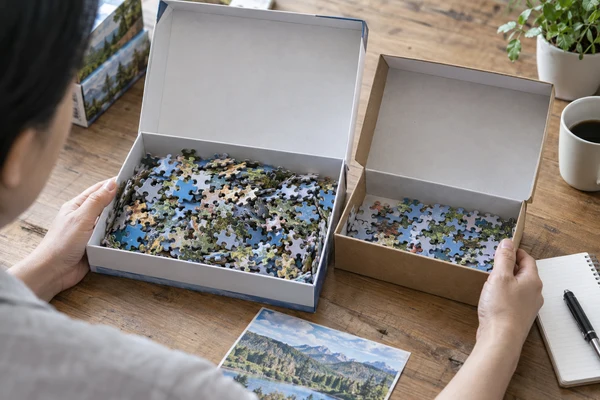
Include realistic opening conditions: seated at a table, with the box facing the user and the reference sheet nearby. Ask someone who has not seen the packing sequence to open and repack the sample. Observe whether they recognize the lid orientation, struggle to return the bag or accidentally bend the insert. If the solution requires instructions, decide whether those instructions are reasonable for the intended product. A structural revision may be more helpful than adding another warning to the pack.
Separate informal handling from validated performance
A buyer opening exercise helps identify friction and clarify requirements. If a retailer needs a formal transit or durability assessment, agree the method, packed sample and acceptance criteria separately. The exercise above does not establish compliance with a testing standard.
Compare two practical packaging routes
Share your puzzle format, components and selling channel to discuss feasible structural options and sample requirements.
Compare the complete cost and operational consequences
Ask for comparable quotations using the same piece count, artwork, quantity, component list and delivery basis. Separate the retail structure, inner containment, inserts and outer carton where possible. A cheaper empty container may require more packing labor, extra protective material or a less efficient carton arrangement. Conversely, a more substantial structure may add costs that the channel cannot recover. Use the whole pack as the unit of comparison and avoid assigning a universal price hierarchy to rigid, tuck, tin and tube formats.
Review storage and freight implications with proposed dimensions and carton quantities. Round packages can leave unused space in a rectangular carton unless the arrangement has been designed around them. A wider rigid box may consume more shelf frontage, while a taller compact container can change warehouse stacking and photography requirements. These are planning considerations, not measured outcomes for a particular structure. Ask the supplier and logistics partner to calculate the actual proposed configurations instead of estimating savings from a rendered image.
Also consider development effort. A new structure may need additional sampling, different component folds or revised packaging artwork. Request the approval steps and identify the items that cannot be finalized until a physical sample exists. If the launch is time-sensitive, compare an existing confirmed structure with a new concept rather than assuming both follow the same schedule. Preserve the commercial assumptions in the quote record so a later change in size or closure triggers a deliberate review of the full pack.
Describe materials and end-of-life choices accurately
Name each material and relevant component in the specification. A box may combine board, printed paper, adhesive, coating and an inner bag; a tin may include a paper sleeve or insert. A tube can have different materials in its body and caps. Asking for a material breakdown is more useful than labeling the whole pack natural or green. Establish what evidence the supplier can provide for the proposed construction and which claims the buyer is responsible for approving in the sales market.
The US EPA's recycling guidance emphasizes local acceptance. Apply that principle when developing disposal instructions. A familiar material name does not guarantee that every collection program accepts the assembled package. Check coatings, mixed components and separation steps with the relevant destination program. Avoid blanket statements that a tin, paper tube or rigid box is recyclable everywhere, and do not imply that visual simplicity proves environmental superiority.
Reuse claims need the same precision. If the box is intended to hold puzzle pieces after assembly, show that practical use through the approved sample. Do not extrapolate it into a life-cycle claim or an assertion that the pack has lower environmental impact than every alternative. A buyer may choose fewer components, a smaller footprint or a confirmed material route, but the packaging copy should explain the actual choice clearly. Keep the evidence and final claim wording alongside the released packaging files.
 PuzzleZa
Approve the complete structure with a repeatable checklist
Build an approval record for the final pack rather than signing off separate attractive parts. Include the structure drawing, dimensions, closure details, component list and photographs of the packed sample. Note whether the sample uses representative or final materials. A plain structural dummy can help approve fit and opening, while a printed mockup may demonstrate artwork placement without proving final construction. Record the limitation of each sample so the production team knows what still needs confirmation.
During factory testing, the relevant practical checks can include correct components, closure behavior, visible pack condition and agreement with the approved arrangement. The scope should be agreed for the order. At shipment inspection, review selected completed packs and the corresponding cartons against that record. A retail pack should not pass simply because the correct image appears on the lid; the wrong box depth or inner arrangement can still change the customer experience. Record observations and any accepted deviation before freight handover.
Discuss the evidence required through the factory review. Ask who controls the component revisions and how a substitute is proposed if the agreed structure becomes unavailable. Require a revised drawing or sample for a material change that affects fit or closure. Keep the old and new references identifiable. Clear change control is particularly important when a range shares artwork across multiple piece counts or when several packaging structures are photographed under one collection name.
Prepare a shortlisting brief that produces useful quotations
Limit the first comparison to two or three realistic structures. Give each a defined job and explain the trade-off you are investigating. For example, compare a shelf-oriented rigid box with a compact tuck carton for the same adult puzzle, or a confirmed rectangular travel pack with a proposed tin. Avoid requesting every possible combination of size, structure and finish at once. A focused brief lets the supplier explain feasibility and gives the buyer a comparison that can actually be reviewed.
Include destination market, order quantity scenarios, finished puzzle format, inner containment, reference insert and proposed retail positioning. Add shelf constraints and individual-posting requirements where relevant. State which dimensions are fixed and which are suggestions. If an existing travel puzzle tin concept is relevant, ask how its construction would need to change for your contents. A product page is a starting point for discussion, not confirmation that every requested configuration can be supplied.
Send the brief through PuzzleZa's enquiry page with the preferred structure and one fallback. Ask for a physical review that covers filling, opening, reclosure and complete carton arrangement. Keep the buying decision tied to the actual channel and customer requirements. The strongest selection is usually the structure with a clear purpose, approved component fit and manageable operational consequences, rather than the container that looks most impressive in an isolated concept photograph.
Frequently asked questions
Which puzzle box structure is best for retail?
Choose the structure that fits the channel, shelf space and desired opening experience. Compare the full component stack and carton arrangement on samples. A rigid presentation may be useful for one range while a compact folding carton suits another. The final decision should use comparable quotations and confirmed construction details.
Can a puzzle tin replace the inner bag?
Do not assume it can. Discuss piece containment, closure, handling and the packing sequence for the actual tin. The supplier should confirm the proposed arrangement and provide a sample. A metal container alone does not establish secure containment under every storage or transport condition.
Are puzzle tubes easy for customers to use?
They can work when the opening diameter, cap and component shape are compatible. Test removing and replacing the filled bag and reference insert without forcing them. Review stability and storage orientation as well as appearance. Total volume alone does not show whether customers can use the pack comfortably.
Does a rigid box always protect a puzzle better?
No. Protection depends on construction, size, inner packing, loading and shipping arrangements. The rigid category describes a structural approach rather than a verified performance level. Agree the assessment needed for the channel and inspect the complete packed sample against the intended requirements.
What should a structural packaging quotation include?
Provide puzzle format, quantities, destination, material preferences, component list and shelf constraints. Ask for dimensions, closure details, inner packing, outer carton arrangement and sample scope. Confirm which elements are available and which require development. Keep the same underlying puzzle brief across shortlisted structures.
Conclusion
Choose structural packaging as a complete working system. Confirm the customer's opening and storage routine, review usable space, and compare quotations with the same contents and delivery assumptions. A physical packed reference makes the decision repeatable and helps protect the approved arrangement when production or reorders introduce changes.
Build a confirmed packaging specification
Send quantities, destination, shelf constraints and your preferred structure through the enquiry page for a project-specific quotation discussion.
Sources and scope
Sources reviewed on 2026-10-09. Manufacturing examples and review checklists are planning guidance, not claims about completed customer projects or guaranteed results. AI-generated images illustrate the topic and do not document an actual inspection.
- FEFCO packaging design code — Shared terminology for corrugated outer shipping container designs.
- US EPA recycling questions — Destination-specific material acceptance and disposal guidance.