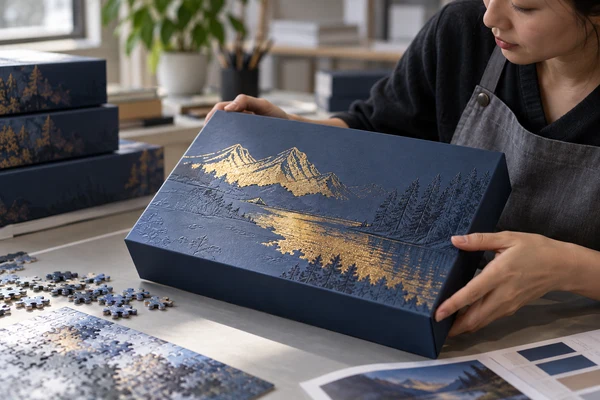
Custom puzzle foil stamping, embossing, debossing and spot UV serve different visual and tactile purposes. Choose the effect that supports the artwork and gift experience, then approve it on the actual box construction. A loose decorative swatch cannot demonstrate registration, corners, opening or transit protection. For premium retail and gifting teams, the most useful brief defines where the effect belongs, how it interacts with printing and what the finished pack must withstand during ordinary handling. This guide explains those decisions without assuming that every finish is available for every project.
Choose premium box effects around the product story
Start with the role of the box. An art edition may need a quiet presentation that gives the image priority, while a ceremonial gift may use a tactile title or reflective accent to mark the occasion. Define the customer's first view and opening sequence. The effect should reinforce that moment rather than compete with the puzzle artwork or make important information difficult to read.
Select one clear focal area before adding secondary effects. A small foil title can create contrast without covering the complete lid. A relief pattern can give a plain image-free panel physical interest. These are design examples, not recommended dimensions or claims about available tooling. Ask the supplier to assess your actual drawing, paper and box structure.
Distinguish the puzzle surface from the retail-box finish. A tactile box wrap does not need to be repeated on the puzzle face, where reflection and image detail have different implications. Review the complete presentation as related components with separate functions. The customer should understand what is decorative packaging and what is part of the assembly experience.
The premium custom puzzle gift set provides a starting format for this discussion. Confirm the actual lid, base, insert and component arrangement before specifying embellishment. A decorative concept should be quoted with its construction and pack, because the same effect can behave differently on another paper or box geometry.
Compare foil, raised relief, recessed relief and selective gloss
Foil stamping applies a decorative transfer through a defined process. A custom puzzle embossed box has raised relief, while a custom puzzle debossed box has recessed relief. Spot UV applies a selective coating to chosen areas. The effects can be combined in suitable constructions, but each requires its own artwork and production assessment. The appearance of a combined concept cannot be approved from a flat printed PDF alone.
LEONHARD KURZ describes hot stamping and other transfer-finishing routes for packaging. That process range is a reason to identify the exact proposed method. A quotation that says metallic finish may refer to foil transfer, ink or another treatment, which can produce different appearances and development needs.
Decide whether the effect should align closely with a printed shape or sit as an independent element. Tight alignment creates a registration question that must be assessed on the actual process. A decorative shape with intentional space around it can be easier to judge consistently. Ask the supplier to recommend feasible artwork clearances rather than prescribing universal tolerances from another product.
Balance the effect with readability. Reflective titles can change appearance with viewing angle, and fine relief may be less obvious on some stocks. Review the intended text under ordinary room light and in the customer's likely handling position. The buyer's goal is a readable, coherent pack, not simply evidence that a decorative operation has been performed.
| Effect | Design role | Important sample check |
|---|---|---|
| Foil | Reflective or coloured accent | Coverage, adhesion and registration |
| Embossing | Raised tactile feature | Legibility, relief consistency and surrounding surface |
| Debossing | Recessed tactile feature | Clarity, depth appearance and wrap behaviour |
| Spot UV | Selective gloss or coating contrast | Alignment, cure and interaction with the base finish |
| Soft-touch surface | Tactile background finish | Handling marks, adhesion and compatibility with other effects |
Prepare custom puzzle foil stamping artwork for assessment
Provide the foil area as a separate identified artwork layer or file following the printer's workflow. Keep it aligned with the approved dieline and print artwork. Explain the intended appearance and supply a physical reference if a specific foil colour or visual character matters. A screen representation of gold does not define a supplier's actual decorative material.
Ask the factory to review fine lines, small text, large solids and narrow gaps. These features can place different demands on the selected paper, tool and transfer process. Do not treat a tiny logo that worked on a smooth cosmetic carton as automatic approval for a textured puzzle-box wrap. The complete combination needs assessment.
Review whether the foil crosses a fold, corner or wrapped edge. Changes in geometry can affect appearance and handling, so sample those areas where they are part of the design. Place functional barcodes and required copy in suitable areas and review them separately. A foil accent should not compromise the pack's identification or customer information.
At proof stage, inspect coverage and unwanted transfer with an agreed reference. Distinguish intentional texture from incomplete coverage and document the expected appearance. If rubbing or adhesion checks are needed, agree the method and acceptance basis in advance. An informal fingernail scratch is an observation, not a universal durability test or a basis for a lifetime performance claim.
Assess your premium box concept
Send the box style, artwork, component list and preferred foil or tactile effects. We can discuss feasible sample stages and the details that need physical approval.
Develop embossing and debossing with the box construction
Relief should be designed with the actual wrap paper and supporting structure. Ask whether the operation occurs before or after the relevant mounting or forming stage and what the sample represents. A relief swatch can show a tactile idea without demonstrating the finished lid. The buyer needs to understand that distinction before authorising a complete product.
Specify which areas rise or recess and how they relate to printed artwork. A vague request for an embossed logo can conceal differences in scale, shape and alignment. Provide an unambiguous layer and ask the supplier to confirm feasible detail. Avoid prescribing depth as a cosmetic preference without first assessing its impact on paper, structure and tooling.
Review texture and readability together
Handle the relief sample normally and inspect it in side light as well as direct view. Check whether the intended word or motif remains recognisable without relying on a studio photograph. A subtle tactile pattern can be appropriate, but it should be an approved choice rather than an unexpected difference between the rendering and the product.
Inspect the surrounding paper for visible distortion and review corner or edge areas. Record any crease, mark or surface break with its sample location. The supplier can then investigate the specific issue rather than being asked to make the embossing stronger without a clear description of what the buyer wants improved.
Check the assembled lid and base
Open, close and handle the complete box with its contents. Decoration should not be approved separately from normal fit and use. Include the intended insert and poster because the assembled pack may handle differently from an empty presentation sample. Keep functional and appearance comments in one consolidated review.
Assess a custom puzzle spot UV box and soft-touch background
A custom puzzle spot UV box uses selective coating to create contrast or another designed surface effect. Confirm the coating type, application area and intended base finish. A glossy patch over a matte background can make an illustration detail visible from a different angle, but it can also create reflections. Review the real box under ordinary lighting before approving the effect.
ACTEGA describes multiple UV-coating effects for paper and board. Its process information shows why UV does not name one appearance. Ask the supplier to identify the actual proposal and assess cure, compatibility and subsequent handling for the construction being developed. Do not borrow performance claims from an unrelated coating product.
Custom puzzle soft touch lamination should also be distinguished from a soft-touch coating. Both can be discussed as tactile options, but their construction and process are not automatically the same. Ask whether a film layer or coating is proposed and what implications it has for foil, printing, adhesion and the desired environmental wording.
Review handling marks and surface interaction on a filled sample. Dark backgrounds can make certain scuffs or fingerprints more visible, while textured effects can change the feel of the same artwork. Our puzzle finish selection guide covers the puzzle-face decision; for packaging, add checks of wrapped corners, repeated opening and protection within the shipping pack.
 PuzzleZa
Approve representative samples and itemise the development scope
Ask for a sampling proposal that states which effects, materials and structures will be represented. A plain box can answer fit questions; a decorative swatch can answer surface questions; a finished embellished box connects them. The right sequence depends on what remains uncertain. Do not assume the first paid sample will approve every later operation.
Separate one-time development or tool charges from recurring production charges. Confirm what is included, how artwork revisions are handled and whether additional effects require new assessment. A box with several independently registered treatments may have a different scope from a printed box with one isolated accent. Request an itemised quotation instead of trying to compare only the headline unit price.
Use a finish approval sheet with effect name, artwork version, material reference, sample identifier and expected appearance. Record limitations such as an unprinted structural sample or a decorative swatch on different stock. Assign an owner to resolve each limitation before release. This helps creative and purchasing teams understand what the sample fee has actually established.
Check layered artwork technically. Adobe Acrobat Output Preview supports separation and overprint review, which can help identify unintended file interactions. Follow the printer's actual layer-naming and output instructions. A correct technical file is necessary for the chosen workflow but does not replace the physical approval of foil, relief or coating.
Inspect decorated boxes for appearance and ordinary use
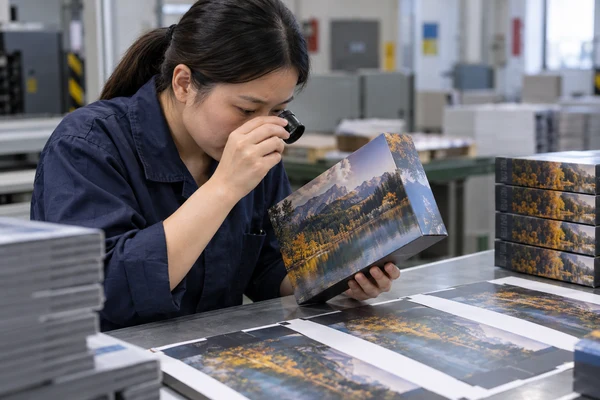
Define acceptance examples that inspectors can use. The checklist might distinguish a foil void, misaligned selective coating, marked corner, unreadable relief feature and damaged lid. Their commercial significance can differ. Discuss classification and review conditions before production so a dispute does not depend solely on whether one person thinks the box looks premium.
Agree appropriate handling checks without inventing a universal test. If abrasion, adhesion or transit evidence is required, identify the method, scope and responsible provider. The test needs to represent the finished pack and intended distribution route. A loose coated sheet cannot establish how a filled box will arrive after the actual shipping configuration is used.
Factory testing can compare selected decorated components and assembled packs with the retained reference. Shipment inspection can check selected saleable units for artwork, finish, component fit and visible condition. Keep observations with sample or carton identifiers. These checks are evidence about their defined scope, not proof that every box has been examined under every possible handling condition.
Review the approval and production stages and discuss access to the relevant checks through the factory enquiry. Confirm project-specific capability before assuming a finish is available. An illustrative image, a generic term or a reference supplied by another manufacturer does not establish the exact process that will be used for your order.
- Effects and supporting materials have clear identities.
- Print and decoration layers match the released dieline.
- A representative assembled pack has been opened and handled.
- Acceptance examples distinguish appearance and functional concerns.
- Protection and shipment checks reflect the finished decorated pack.
Control premium materials and finishing on repeat orders
Premium custom puzzle materials should be controlled through actual references, not a label that simply says luxury. Retain the wrap stock, decorative material, base finish and approved assembled sample. Record tool or layer identifiers where applicable and ask for notification before substitutions. A visually similar foil or paper can change the overall presentation enough to require buyer review.
When the artwork changes, review the affected finishing layers rather than reusing them by default. A new title position may alter foil registration, while a box-size change can alter wrap and relief geometry. Identify those dependencies in a revision request. Do not assume an unchanged colour palette means the existing decoration file is suitable for a new edition.
Before quoting, state the product application, box construction, component list, image direction and preferred effects. Include reference photographs as discussion aids and label them clearly as references. Send the premium-pack brief to PuzzleZa with the decisions that need assessment. The most useful result is a coherent sampled pack with defined approval evidence, rather than an unsupported promise of a more luxurious finish.
Frequently asked questions
What is the difference between embossing and debossing?
Embossing creates raised relief, while debossing creates recessed relief. Both depend on the selected material, tooling and construction. Supply a separate design layer and review the actual sample for clarity, surface condition and alignment. A flat digital rendering cannot establish the final tactile effect or the assembled box's performance.
Can foil and spot UV be used on the same puzzle box?
Potentially, if the actual materials and process support the combination. Ask the supplier to assess compatibility, operation sequence and registration before quoting. Approve a representative finished box rather than separate attractive swatches, because each effect can interact with the base surface and other decoration on the assembled pack.
Is soft-touch lamination the same as soft-touch coating?
No. Ask whether the proposed surface uses a film layer or an applied coating and record that construction. They may differ in appearance, tactile feel, finishing compatibility and environmental implications. Sample the specific combination with the print, foil or selective coating instead of treating soft touch as one universal material.
How should a brand inspect a foil-stamped puzzle box?
Compare coverage, unwanted transfer, registration and ordinary handling with the approved reference. Check the complete filled box, including corners and opening. If a formal adhesion or abrasion test is required, agree its method and acceptance basis in advance; an informal scratch observation does not establish a general durability rating.
What should be kept for reordering a premium puzzle box?
Retain the released dieline, print and effect layers, material references, tool identifiers where relevant, approval sheet and assembled sample. Record inspection observations and approved substitutions. Review affected decoration whenever size, title position, wrap stock or surface finish changes, because an old layer may no longer fit the new construction.
Conclusion
Custom puzzle foil stamping and other box effects work best when they have a clear design purpose and a representative approval path. Define separate artwork layers, sample the actual construction and inspect ordinary use alongside appearance. A controlled material and finish record helps the premium presentation remain coherent through production and reorders.
Request a finish-specific puzzle quotation
Contact PuzzleZa at info@PuzzleZa.com or use the enquiry page with your pack references, quantity scenarios and sales channel. Ask for a quotation that identifies the actual materials and finishing scope.
Sources and scope
Sources reviewed on 2026-09-28. Manufacturing examples and review checklists are planning guidance, not claims about completed customer projects or guaranteed results. AI-generated images illustrate the topic and do not document an actual inspection.
- LEONHARD KURZ: packaging transfer finishing — Distinguishing packaging transfer-finishing routes such as hot stamping.
- ACTEGA: UV coatings for paper and board — Multiple UV-coating effects and the need to identify the actual proposed coating.
- Adobe Acrobat: Output Preview — Technical separation and overprint review for layered decoration artwork.