
Custom puzzle AQL inspection is a defined acceptance-sampling approach for deciding whether a production lot meets agreed inspection criteria. It is not a guarantee that every puzzle is defect-free or evidence that all product-safety requirements have been met. Buyers should define the lot, sample selection, defect categories, applicable sampling plan and release authority before inspection begins. This guide explains how importers and private-label teams can commission a useful inspection, read its limitations and turn the report into a documented shipment decision.
What is a puzzle shipment inspection?
For buyers asking what is a puzzle shipment inspection, it is a documented examination of selected finished products and packing against an approved order reference before the agreed shipment release. The scope can cover identity, visible condition, components, specified measurements and packing. It should state which checks were performed and which were outside the assignment.
Inspection can be performed under different arrangements, so identify the responsible provider and independence expectations. A factory's internal check and a buyer-appointed inspection are not the same commercial arrangement even if they examine similar features. Confirm access, available goods, reference samples and reporting responsibility before booking. The buyer should know who will make observations and who can authorise shipment.
The National Institute of Standards and Technology describes acceptance sampling as a lot-disposition decision, rather than a method whose main purpose is to estimate lot quality. That distinction matters when reading a puzzle report. A favourable sample result does not calculate the exact number of defective units remaining in the shipment.
Connect inspection to the actual sellable construction. The retail puzzle product format can help discuss the pack, but the inspector needs your released specification, artwork and component list. A product-category description or a generic quality claim cannot tell the inspector which image, box version or insert belongs in this particular order.
Understand the limits of an AQL sampling system
AQL is associated with a defined acceptance-sampling system and its operating rules. Do not interpret it as permission to deliver a fixed percentage of defective puzzles or a promise that an accepted lot contains less than that percentage. The plan supports a decision under stated assumptions, with statistical risks that remain even when the procedure is followed.
The American Society for Quality describes ANSI/ASQ Z1.4 as an attributes-inspection system using switching rules on a continuing stream of lots. Its public description includes normal, tightened and reduced plans. Ask the inspection provider to specify the applicable edition and how the selected procedure fits your purchasing situation.
A single new order may require different consideration from a continuing sequence with established inspection history. Have the responsible quality professional select and document the appropriate plan. Do not take a popular table from a supplier blog and choose a sample count without understanding its basis. This article deliberately does not prescribe universal sample sizes or acceptance numbers for all puzzle shipments.
The NIST overview of sampling plans explains producer and consumer risks and operating-characteristic curves. Those concepts explain why an accepted lot can still contain nonconforming items. If the commercial consequence of a particular defect is severe, discuss appropriate prevention and evidence rather than expecting sampling alone to remove that risk.
Define the lot, inspection unit and product versions
State which goods form the inspection lot. Identify the purchase order, SKUs, quantities, production status and relevant manufacturing batches. If several artworks, pack formats or constructions are involved, ask the provider how they will be represented. Pooling unrelated products without review can hide a problem concentrated in one version and weaken the usefulness of the result.
Define the inspection unit. It might be one complete sellable puzzle pack for specified attributes, while cartons or individual components require separate checks. The choice affects how findings are recorded. A carton-count discrepancy is not the same observation as a damaged retail box, and a piece-edge issue should be linked to the finished unit in which it was found.
Keep version identity visible. Provide thumbnails, final file names, component references and the retained approved sample. Similar artwork editions can be difficult to distinguish from a name alone. If the inspection team uses an obsolete reference image, it can miss a wrong-version issue or reject correct goods against the wrong standard.
Require the report to state what was available. If goods were partly packed, blocked from access or not complete, the limitation affects the inspection claim. Do not label a partial review as examination of the entire completed shipment. Agree whether inspection can proceed, must be rescheduled or needs a revised scope, and retain that decision with the eventual release record.
Define the inspection before production
Send your SKU specification, destination market, defect examples and intended inspection arrangement. Discuss which checks need final-pack access and which require separate evidence.
Classify puzzle defects with agreed descriptions and examples
Defect categories should reflect safety, functionality, identification and commercial consequences. Critical, major and minor are useful labels only when the buyer and provider share definitions. Write observable descriptions and include photographs or retained examples for disputed appearance conditions. The category cannot be decided reliably from an instruction that says all defects are unacceptable.
A wrong artwork or mismatched reference image may prevent the pack from being the intended product. A damaged tab can affect assembly. A small superficial mark on the box may have a different consequence depending on the retail proposition. These examples illustrate the classification discussion; they do not impose universal categories on every puzzle contract.
Separate safety concerns from cosmetic observations
Agree an immediate escalation path for suspected safety or compliance issues. They should not be dismissed because an appearance-defect count remains within a sampling limit. The responsible compliance team needs to decide the relevant evidence and action. Do not use a cosmetic inspection table as a substitute for evaluating a potential hazard.
For products entering the United States as children's toys, CPSC toy-safety guidance explains that firms must identify applicable requirements. This is a separate compliance task; an AQL report does not establish testing or certification obligations for your specific product.
Agree how findings are counted
Specify whether the plan counts nonconforming units or individual nonconformities for the relevant assessment. One pack can have several observations. The provider should state how duplicate findings and multiple categories are handled under the chosen procedure so the buyer does not interpret the same report using a different counting basis.
| Observation | Potential consequence | Reference needed |
|---|---|---|
| Wrong image or box version | Incorrect sellable product | Released SKU and artwork |
| Damaged piece or poor separation | Assembly difficulty | Approved cut sample and defect examples |
| Missing included poster | Incomplete pack | Component list |
| Visible box scuff | Retail presentation concern | Agreed appearance reference |
| Suspected safety issue | Separate escalation required | Applicable compliance assessment |
Plan sample selection and the checks each sample receives
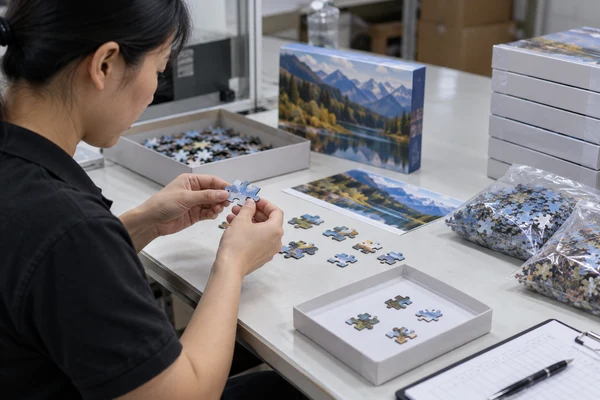
Custom puzzle quality inspection needs a sample-selection method that suits the defined plan. The provider should have access to the relevant lot and document how units were selected. Supplier-chosen showcase units are not equivalent to representative selection from the submitted goods. Record any access limitation or deviation rather than presenting a convenience sample as if it followed the intended method.
Specify the attribute checks and their individual scope. A visible pack review, component check, selected assembly review and measurement may require different time and handling. Do not assume every sampled unit will receive every possible test. The inspection brief should state which checks apply to which samples and how results will be reported.
Counting all pieces or assembling an entire puzzle can be a substantial task. If that evidence is important, discuss a suitable method, time allowance and sample scope before inspection. Our missing-piece prevention guide explains the broader control discussion. A quick visual review of a sealed bag cannot prove its complete piece count.
Arrange what happens to opened or altered units. Identify whether they can be repacked, need to be set aside or are excluded from shipment. Inspection should not create unrecorded incomplete stock. Retain sample identifiers and connect photographs to the relevant observation, especially where the buyer may need to review a borderline condition before deciding on release.
Connect custom puzzle factory testing with final inspection
Custom puzzle factory testing can provide checks during print, mounting, cutting and packing. It can identify issues while an operation is still in progress. Final shipment inspection instead examines submitted finished goods against the agreed scope. Both have useful roles, but a favourable final sample should not be treated as evidence that every process control was effective.
Custom puzzle factory quality control should be discussed as a set of actual activities. Ask what is checked, when, against which reference and what records are available for your order. Do not infer a certified quality system from the presence of a checklist or a factory photograph. Confirm the specific evidence the supplier can provide and what the buyer requires.
Build feedback from repeated findings into the next manufacturing brief. For example, if selected packs repeatedly show a mismatched insert, investigate version control and pack sequence rather than adding only a stricter final appearance check. This is a hypothetical improvement route, not a claim about PuzzleZa's production history. The cause needs evidence from the actual order.
Use the production-stage overview to identify practical check points and the factory enquiry to confirm project arrangements. If independent laboratory evidence or destination-market documents are needed, coordinate their timing separately. A lot acceptance decision cannot create missing compliance documentation or correct an unapproved product specification.
 PuzzleZa
Read a custom puzzle pre shipment inspection report carefully
A custom puzzle pre shipment inspection report should identify the lot, provider, date, available quantity, references, plan, selected samples, checks, findings and limitations. Review those fields before focusing on a pass or fail headline. A report with unclear product scope can give the buyer less decision value than its conclusion suggests.
Compare observations with the agreed classification and counting rules. Ask for clarification when photos, category labels and totals do not align. Separate a clear nonconformity from an attribute that was never specified. Do not retroactively add an appearance limit simply because a production photo looks different on a screen; compare the actual evidence under the approved conditions.
Name the shipment-release authority. The inspection provider supplies findings and a result within its assigned scope; the buyer or authorised party makes the commercial disposition decision. Document whether goods are released, held, corrected or otherwise handled under the agreement. If an exception is accepted, state its scope and approval instead of quietly changing the original requirement.
When correction is required, record the affected goods, proposed action, evidence and reinspection arrangements. Repeatedly selecting a new convenient sample until one passes is not a substitute for a defined corrective and resubmission process. Ask the provider to apply the relevant procedure and ensure the next report identifies what changed. Keep the goods and release status clear throughout the review.
Build a decision-ready inspection brief before production
Use a concise brief that lists the product references, lot definition, planned procedure, defect examples, check scope, access requirements and reporting owner. Include the release contact and the route for urgent questions. Agree the brief early enough that sampling and production records can support it; a last-minute instruction may leave important checks impractical.
Coordinate inspection with packing and freight without allowing the booking to determine the quality decision. Share the expected goods-ready status and explain which conditions must be met before collection. If readiness changes, update the inspection arrangement and release record. A freight deadline does not establish that the lot meets the agreed criteria.
Keep the final report with the purchase order, approved sample, packing list and corrective-action record. Receiving and after-sales teams can then trace a concern to the product version and actual shipment. Send PuzzleZa your inspection requirements when planning a new order so access, references and responsibilities can be discussed before finished stock is waiting to ship.
- Lot, SKUs and inspection units are defined.
- The applicable sampling procedure and counting basis are recorded.
- Defect categories have observable examples.
- Each check has a stated method and sample scope.
- Limitations, escalation and shipment-release authority are clear.
Frequently asked questions
Does an accepted AQL result prove every puzzle is defect-free?
No. Acceptance sampling supports a lot decision under a defined plan and retains statistical risk. It does not inspect every unit or establish the exact defect rate remaining in the shipment. Review the references, checks, selection method and limitations before interpreting the report's result or using it in customer-facing claims.
Which AQL sample size should a puzzle buyer use?
There is no universal sample count for every shipment. The responsible quality professional should select the applicable plan using the lot, inspection arrangement and risk requirements, then document its basis. Avoid choosing a count from an isolated online table without confirming the procedure, edition and counting rules that make it meaningful.
Should missing pieces and box scuffs have the same defect category?
Not automatically. Their consequences can differ, and the category depends on the agreed product and customer requirements. Define each observable condition before inspection and establish how findings are counted. A piece-count check also needs a suitable scope; looking at a sealed bag does not verify all of its contents.
Can an AQL shipment inspection replace toy-safety testing?
No. A sampling inspection and product-safety evidence serve different purposes. The responsible parties must identify applicable destination-market requirements and arrange the relevant assessment or documentation. A favourable visual inspection report does not establish laboratory results, certification or conformity for a specific children's product, and suspected hazards need their own escalation.
What should happen when a puzzle lot fails inspection?
Hold the release decision and review the findings against the agreed criteria. Document the affected goods, correction or disposition, responsible owner and any reinspection arrangement. Follow the applicable resubmission procedure rather than repeatedly choosing fresh samples until one passes. Keep the buyer's release authority and current goods status explicit throughout the process.
Conclusion
Custom puzzle AQL inspection is useful when the lot, references, defect rules and release authority are clear. Its result should be read within the actual sampling and check scope. Connect it with documented factory controls, appropriate compliance evidence and a corrective-action path so the buyer can make a reasoned shipment decision without treating sampling as a guarantee.
Plan a controlled shipment release
Contact PuzzleZa at info@PuzzleZa.com or use the enquiry page with your product references and quality requirements. Ask to confirm inspection access, responsibilities and the evidence needed before freight handover.
Sources and scope
Sources reviewed on 2026-09-28. Manufacturing examples and review checklists are planning guidance, not claims about completed customer projects or guaranteed results. AI-generated images illustrate the topic and do not document an actual inspection.
- NIST: what acceptance sampling does — Acceptance sampling supports lot disposition rather than determining exact lot quality.
- American Society for Quality: Z1.4 and Z1.9 — Attributes sampling, continuing lots and switching rules in the described system.
- NIST: types and risks of lot acceptance plans — Sampling plans have producer and consumer risks and defined decision rules.
- CPSC: toy-safety business guidance — Applicable toy-safety requirements require a separate product-specific compliance review.