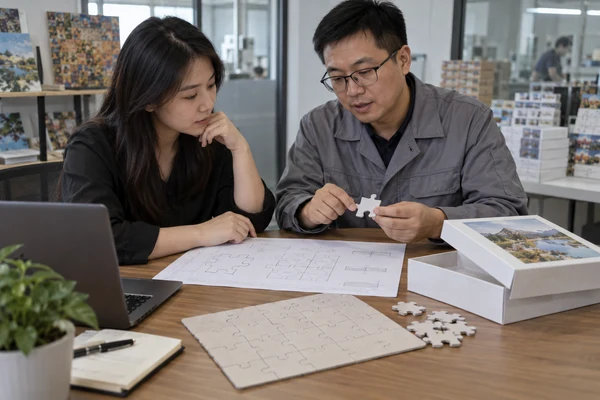
For custom puzzle OEM projects, a buyer usually supplies the product concept or specification and asks a manufacturer to produce it. For custom puzzle ODM projects, the manufacturer contributes an existing design platform or product-development work. The useful distinction is who controls the design, files, tooling, approvals and future changes—not which label appears in a quotation. Retail brands, publishers and importers should choose the arrangement that matches their internal resources, then document responsibilities before sampling. This guide explains how to compare the two routes, set a practical approval system and preserve a reliable reorder record. The terms are commercial shorthand, not a substitute for a project agreement; exact rights and responsibilities need to be confirmed with the parties and appropriate advisers.
When should buyers choose OEM or ODM?
An OEM puzzle manufacturer can be a suitable partner when your team already has a defined range, owns or licenses the artwork and can supply a coherent technical brief. That does not mean you must design every factory operation. A manufacturer can still advise on board, die cutting and packing feasibility while your brand retains responsibility for the intended product and commercial decisions. Describe the advice you need rather than assuming it is included in a general OEM label.
An ODM puzzle manufacturer may be useful when you need a starting format, a packaging concept or more development support. For example, a buyer might adapt an established box structure while supplying its own artwork and market positioning. This is a planning example, not a claim that any specific ready-made design is available or exclusive. Ask which elements are standard, which will be created for the project and which other customers may use.
Compare both routes against your actual staffing. A business with an experienced art director may want strong manufacturing support but little creative intervention. A new gift brand may benefit from fewer format decisions and a clearly bounded development service. Neither model automatically creates a better puzzle, lower price or faster launch. The quality of the specification and approval path matters more than the label.
Write a one-paragraph decision statement: our team will own these design inputs, the factory will develop these components, and the following people will approve the result. Use the available custom puzzle formats as discussion references, not as a substitute for confirming project-specific construction. This statement gives purchasing and creative teams a shared scope before quotations arrive.
A quick development-scope check
If the scope is still unclear, send a project brief to PuzzleZa with the decisions you want help reviewing before a quote.
- OEM: identify the finished design inputs your team will supply.
- ODM: identify the existing platform and the development work being offered.
- Both: name the final approver for every customer-facing component.
Build a responsibility map before development begins
The most useful tool for custom puzzle contract manufacturing is a responsibility map. List every decision that could stop the project, name the person who proposes it and identify who can approve it. Include artwork crop, printed copy, board construction, piece count, finished dimensions, cutting pattern, bag, reference image, retail box, labels and export packing. A decision that nobody owns is a likely source of late revisions.
Keep technical recommendation and final approval separate. The factory may recommend a board or identify a small-text problem; the buyer still needs to accept the commercial and customer-facing implications. Conversely, a buyer can approve a visual idea that remains technically unworkable. Record both feasibility confirmation and brand approval rather than treating either one as a complete release.
Use job roles rather than a long list of individual email addresses in the master document. Then name the current contact against each role. If your packaging designer or purchasing manager changes, the record still explains which function must review the issue. Assign one consolidator for comments so production receives one instruction set, not several competing revisions.
An approval matrix is not a legal allocation of every liability. It is an operational control that supports the agreement. Ask the responsible advisers to address legal obligations separately, especially where licensed images, regulated product claims or destination-market requirements are involved. Review the PuzzleZa production process to identify the practical handover points that need an owner.
| Decision | Typical buyer input | Factory contribution |
|---|---|---|
| Artwork and printed copy | Rights, concept, final text approval | Prepress feasibility review |
| Physical construction | Customer requirements and acceptance reference | Material and manufacturing proposal |
| Tooling | Ownership and reuse instructions | Tool specification and custody arrangement |
| Shipment release | Acceptance decision and freight owner | Agreed inspection and packing records |
Separate design rights from tooling and file custody
A paid development fee does not, by itself, explain ownership of every resulting asset. A puzzle programme may contain source illustration files, print-ready PDFs, cutting layouts, box dielines, tooling and manufacturing know-how. Ask for a component-by-component record of what exists, what the buyer can receive and what permission applies to each item. Do not reduce this discussion to the phrase 'all files included.'
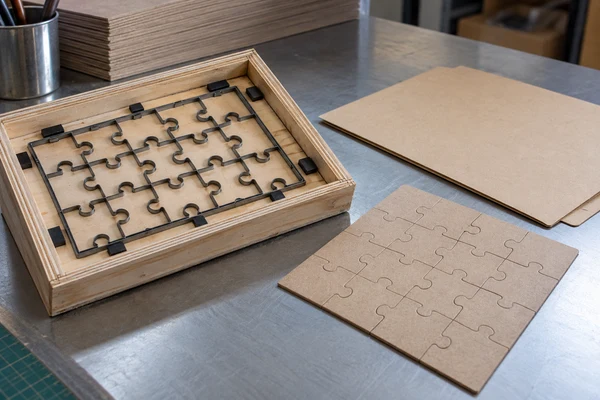
Tool ownership and physical custody are also different. A cutting die may remain at the production facility even if the commercial arrangement gives the buyer particular rights in it. Confirm identification, storage, maintenance, replacement, retrieval conditions and whether it may be used for another order. Check whether a standard tool is shared or whether a project-specific tool is actually being developed.
Artwork rights need their own review. The World Intellectual Property Organization explains that licence terms determine permitted uses. For a puzzle, the relevant permissions might cover manufacturing, retail sale, territory, duration and promotional images. This is a reason to define scope, not a determination of the rights in your particular files.
Ask what happens when the relationship ends. Can the buyer obtain the approved production files? Are editable source files included or only final outputs? Can another manufacturer use the design, and would the original tooling be transferable or suitable there? These questions are easier to resolve before the first deposit than after a successful launch creates urgent reorder demand. Obtain professional advice where the agreement's meaning or enforceability matters.
Compare quotations on one controlled scope
A puzzle contract manufacturer can only quote the scope it understands. Give competing suppliers the same quantity scenarios, artwork status, market, pack configuration and delivery basis. Require assumptions to be stated. If one quote includes design work and a physical box sample while another only includes manufacturing, the apparent price difference is not an equivalent comparison.
Separate recurring unit costs from development, sampling, tooling and other project-specific charges. Ask whether a change in finished size or box structure affects the quoted basis. Do not assume that a sample fee is credited, a tool is free on reorders or a development charge includes unlimited revisions. Record the arrangement in writing without requesting promises the supplier has not made.
Evaluate the economics around the intended range. A hypothetical launch with three artwork SKUs can involve shared packaging components and distinct printed puzzle faces. Explain which elements are common and which vary; do not assume that three images combine into one manufacturing quantity. The supplier can then identify how the actual process treats the variants.
Keep a quotation comparison worksheet with scope, exclusions, approval stages, validity and unresolved decisions. Use a blank field for unknown values rather than inserting an optimistic estimate. This is especially important where demand is unproven. The goal is to understand what each route includes and where your team will supply additional work, not to select a model solely because a headline unit price looks attractive.
Clarify your manufacturing scope
Send your artwork status, proposed format, quantity scenarios and the development support you need. We can discuss a practical scope before sampling.
Approve a sample that represents the intended production
Sampling should test the proposed manufacturing relationship as well as the object. Does the factory understand your comments? Can your team approve the right files promptly? Are changes recorded clearly? A sample that reveals communication gaps is useful before a full order repeats those gaps across many units. Keep the review focused on observable conditions rather than broad descriptions such as premium or professional.
Distinguish a visual mock-up, a construction sample, a printed proof and a representative finished pack. Each answers a different question. A mock-up can show layout but may not represent paper, finish or cutting. A plain box can verify dimensions without approving printed copy. Ask the supplier to state what each sample represents and what still requires confirmation.
Review the puzzle face, assembled sections, piece separation, board edges, bag closure, reference image and box together. Record customer requirements as observable checks: a reference card must match the final crop, the lid must reopen normally, or a printed label must remain readable. Agree any measurement method and tolerance rather than treating a single observation as a universal material benchmark.
Print files deserve a technical review before release. Adobe's separation guidance explains checks such as spot-colour handling and linked assets. Follow the factory's actual output workflow. Our sample approval guide covers the broader review; here, add a clear statement of which party must correct and approve every outstanding item.
Control changes between approval and production
Once a sample is approved, freeze a release record. Identify the artwork version, component list, material reference, dimensions, box layout and packing configuration. Include the approval date and authorised approver. A new file should not silently replace an approved file simply because it has a later timestamp. The version must be linked to a documented decision.
Use a change request that explains the requested alteration, its reason and possible effects. A revised logo may affect a box face only; a new size can affect layout, tooling, board yield and carton dimensions. Ask the factory to review the affected operations before accepting a revised schedule or cost. These are dependencies to evaluate, not automatic claims about how much time a change will add.
Mark older material as superseded while retaining it for traceability. If multiple market languages or artwork variants are planned, use identifiers that cannot easily be confused. Keep a thumbnail and written description with the code. A buyer and production worker may not recognise the same artwork name, but a visual reference can help both locate the correct version.
Product identification should be reviewed when a change affects the sellable item. GS1's GTIN Management Standard provides rules for new products and product changes. Consult the relevant rule and trading partner instead of assuming an existing identifier can be reused. Update listings and receiving records alongside physical artwork when required.
 PuzzleZa
Define factory testing, inspection and freight handover
Agree which checks occur during manufacturing and which occur on finished shipment units. Factory testing can address selected print, cut and packing attributes against the approved reference. Shipment inspection can examine selected finished packs and cartons before release. The order should state the scope and responsible parties; neither phrase is evidence of an unlimited guarantee.
Write practical defect descriptions and examples where needed. A wrong artwork version, a mismatched reference image and a scuffed box are different issues with different commercial implications. Tell the inspector what to compare, what evidence to retain and who decides on a disputed condition. If an independent inspection or laboratory assessment is needed, confirm access and timing before production is complete.
Freight responsibility needs equal clarity. Identify the delivery basis, named place, booking owner, required documents, carton information and point at which the approved goods will be handed over. Coordinate with the buyer's forwarder on the actual shipping arrangement. An OEM or ODM label does not determine these logistics responsibilities, and a unit quote does not necessarily include every destination cost.
Prepare the receiving team with the released SKU list, component references, carton count and any approved exceptions. For installation preparation in this product category, the relevant task is normally retail display or activity-table setup, not mechanical installation. Share the required shelf or table dimensions and opening sequence where they affect the application. This makes the product easier to receive and use without inventing installation obligations.
Create a reusable handover record for future orders
The first order should leave behind a usable product record. Keep the approved specification, final print files, retained sample references, tool identifiers, inspection results and carton data together. Record who holds each item and how the next order will reference it. A photograph of the sample alone cannot explain the complete material or component configuration.
Before reordering, ask whether anything has changed in raw materials, tooling condition, artwork, pack structure or shipping requirements. Request notification and review of substitutions. A product can look similar while differing in a detail that matters to your customer or retailer. Confirm the current quotation basis rather than assuming the first-order price and scope remain valid indefinitely.
Review observations from receiving and actual customer use. If a poster is difficult to refold or a box is awkward to display, translate that observation into a proposed change with a defined review step. Treat examples as improvement inputs, not proof of factory performance. Resolve issues through evidence and agreed action rather than adding stronger marketing claims.
Finally, assess the development model itself. Did your team need more design support than expected, or did an adapted standard format meet the brief well? The next project may use a different balance of OEM and ODM work. Review the Shenzhen factory capability and bring a clear scope to the next discussion. A documented relationship gives both parties a better foundation for reliable decisions.
Frequently asked questions
Is OEM always cheaper than ODM for custom puzzles?
No. Compare the complete scope, including design inputs, sampling, tooling, packaging and revisions. OEM can require more work from the buyer; ODM may include development or existing components. The economical route depends on the actual specification and responsibilities, not the label alone.
Does paying for tooling mean the buyer owns every design file?
Not automatically. Tool ownership, physical custody, design rights and access to editable files are separate questions. Define them explicitly in the project agreement and asset register. Get appropriate advice before relying on a particular legal interpretation or transferring protected designs to another producer.
Can we combine a standard box with our own puzzle artwork?
Potentially, subject to the manufacturer's capabilities and rights in the box structure. Identify which parts are standard and which are custom, then approve the complete configuration. Confirm that the reference image, labels, dimensions and component packing remain consistent with your product brief.
What should a manufacturing agreement cover operationally?
Include a controlled specification, responsibility map, approval process, tool and file arrangements, change notifications, inspection scope and delivery handover. Commercial and legal provisions also need review. The operational checklist supports an agreement but does not replace professional advice on the contract or destination-market obligations.
Should an ODM sample be inspected differently from an OEM sample?
Both should be reviewed against their intended production specification. For ODM, also confirm which features come from a shared platform and which are exclusive or newly developed. For OEM, check that supplied designs have been translated accurately. In either case, document what the sample does and does not represent.
Conclusion
Choose custom puzzle OEM or custom puzzle ODM by allocating design work and approval authority clearly. Neither model replaces evidence-based sampling, version control or a defined shipment release. Document the ownership, custody and permitted use of the assets your programme depends on, then retain that record for future orders.
Start with a decision-ready puzzle brief
Tell PuzzleZa which design inputs you control, what needs development and where the finished product will be sold. Contact info@PuzzleZa.com or use the enquiry page.
Sources and scope
Sources reviewed on 2026-09-28. Manufacturing examples and review checklists are planning guidance, not claims about completed customer projects or guaranteed results. AI-generated images illustrate the topic and do not document an actual inspection.
- World Intellectual Property Organization: technology-transfer agreements — Why permitted uses and rights must be defined in licence terms.
- Adobe: preparing documents for colour separation — Technical prepress checks and file handover.
- GS1: GTIN Management Standard — Identification review when products or packaging change.