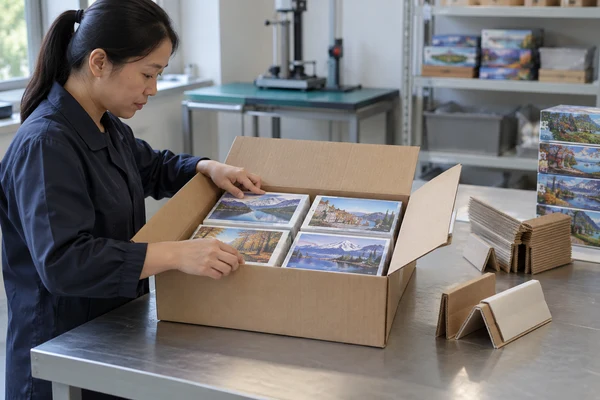
A custom puzzle drop test should assess the complete pack that will travel through the intended distribution system. Testing a retail box by itself cannot answer how the same product will behave inside a master carton, parcel mailer or pallet load. Buyers should first describe the route, identify likely handling hazards and agree product-specific acceptance criteria, then select an appropriate test with a qualified packaging laboratory or logistics partner. This guide helps importers and retail brands define that brief, review the resulting evidence and control later packing changes. It provides a planning method, not a claim that PuzzleZa has performed a particular laboratory test or certified a shipping configuration.
Map the journey before selecting a packaging test
Start with a sequence of handovers, not the word export. A shipment may move from the factory to a consolidator, enter a container, pass through a distribution centre and then travel as individual customer parcels. Each stage handles a different physical unit. The carton that reaches the importer may be opened before the retail box enters its most demanding final journey.
Record handling and packaging at each stage: floor-loaded or palletised cartons, intact or rebuilt pallets, mixed warehouse loads and customer mailers. Include the retailer routing guide. These details help the laboratory distinguish bulk handling from parcel delivery and identify configurations requiring separate review.
Identify likely damage mechanisms in concrete terms: retail-box corners pressed against carton walls, lids moving during repeated handling, inserts bending inside an underfilled box, or cartons shifting within a unit load. Treat these as risks to investigate rather than claims about a route you have not observed. Receiving photographs from previous shipments can improve the brief when the actual pack and conditions are known.
The International Safe Transit Association distinguishes screening tests from distribution simulations. That distinction matters because different procedures answer different questions. Give the laboratory your distribution map and ask it to explain the selected procedure's scope, edition and limitations. A familiar test name is insufficient if the packaged unit or transport mode falls outside its intended use.
Specify the complete custom puzzle shipping pack
Treat the packaging as a nested system: puzzle pieces, inner containment, reference material, retail box, master carton and any unit-load protection. Every layer influences what happens inside the next. A protective master carton cannot correct a retail box that crushes its own poster, while a sturdy presentation box may still arrive scuffed if neighbouring units rub against it during movement.
Create a packing bill of materials with component identifiers for containment, retail-box construction, inserts, separators, protection and carton material. Include dimensions and measurement methods. References should let the supplier and laboratory reproduce the pack; descriptions such as strong carton are insufficient.
Document custom puzzle carton packing with a diagram showing unit orientation, layer count, separators and closure. If the pack contains mixed artwork, state the assortment and position of each variant. A photograph is useful, but a photograph alone may conceal a divider or show a carton before final closure. Keep both the written configuration and visual record with the test request.
Choose the intended retail product before validating protection. A presentation-led puzzle gift set may have different cosmetic priorities from a standard stock box. Decide which included components must remain flat, clean and usable. Then ask whether the proposed outer pack protects those particular requirements, rather than treating every cardboard puzzle as an identical cargo item.
Define what a custom puzzle drop test must demonstrate
Acceptance criteria should describe observable condition after the agreed test. Separate carton integrity, retail presentation and product usability. A carton can show impact marks while its contents remain acceptable; a carton can also look tidy while an internal poster is creased or a puzzle bag has opened. The review needs to examine each relevant layer before assigning an overall result.
For the puzzle, consider component containment, visible piece damage, separation, board condition and correspondence with the reference image. For the box, consider opening and closing, split corners, denting, print abrasion and insert displacement. Agree how to classify a condition that affects appearance but not use. Do not leave a premium retailer's cosmetic expectation to be invented after the laboratory has completed its work.
Retain a photographed, untested reference pack. Assign responsibility for unpacking, photographs, disputed observations and the final commercial decision. Laboratory staff may assess package performance while your team evaluates presentation and assembly. State these complementary roles in the testing brief.
The FedEx testing instructions call for the exact customer shipping configuration, including its components. This supports using a complete representative pack rather than a substitute filled with arbitrary material. Confirm the laboratory's preparation instructions before dispatching the sample, including protection for its journey to the lab and how that transport protection will be removed.
Write criteria that two reviewers can apply
Replace an instruction such as box must look good with a shared example and decision rule. For instance, identify which printed faces are customer-facing and photograph a condition requiring review. Agree dimensional limits only where your team has justified them and can measure them consistently. Product expectations should be specific without borrowing unexplained tolerances from unrelated packaging.
Define your shipping configuration
Send the retail pack, carton count, destination and distribution route. Include any carrier or retailer test requirement so the packing brief addresses the correct handover.
Choose tests around the distribution hazards
A custom puzzle packaging test can involve more than a single impact event. Depending on the route and selected procedure, the evaluation may include sequences addressing handling, vibration, compression or atmospheric conditioning. Ask what the proposed sequence represents. A useful plan explains the risk being examined and the evidence required, while leaving procedure-specific loads and settings to the current protocol and qualified tester.
ISTA describes its 1-Series as integrity screening and its 3-Series as general simulation of distribution hazards. These categories are useful starting points, not a reason to automatically choose one procedure for every order. Check packaged weight, dimensions, shipment type and the receiving customer's requirements. The testing specialist should identify the relevant scope and any agreed departures in the final report.
Do not copy a drop height from an unrelated product or online checklist. Applicable impact conditions depend on the chosen method and packaged-product characteristics. An improvised factory check may be helpful for development if documented honestly, but it should not be presented as compliance with a named procedure unless that procedure was followed and the supporting evidence establishes the claim.
Distinguish a design comparison from qualification against a required programme. Comparisons need controlled inputs; qualification needs the correct procedure, representative specimens and specified reporting. A development comparison does not automatically supply the evidence a retailer or carrier requires for approval.
| Configuration | Questions to resolve | Evidence to retain |
|---|---|---|
| Individual parcel | What mailer reaches the customer? Is the retail box restrained? | Complete pack photos and parcel configuration |
| Master carton | How are units oriented, separated and closed? | Carton specification and packing diagram |
| Pallet load | What stack, restraint and handling route apply? | Unit-load diagram and material references |
| Multiple routes | Where is the product repacked or split? | Separate configuration records for each stage |
Measure carton size and shipping weight consistently
Custom puzzle shipping weight should describe a specific packaged unit and its measurement status. Distinguish puzzle weight, complete retail-pack weight, carton net weight and carton gross weight. State whether figures come from a prototype, a production sample or finished packed cartons. Estimated information can support early planning, but it must be updated before it becomes the basis for a laboratory or logistics decision.
Measure external carton dimensions after normal packing and closure using an agreed method. Record the units and avoid mixing an internal box dimension with the external shipping dimension. Include closure materials, dividers and protection in the gross weight. If several carton configurations exist, give each its own record; a single average may hide an important difference between a full carton and a partial final carton.
For a hypothetical packing comparison, six retail units and eight retail units are two configurations even if the box artwork is identical. The number changes the load inside the carton and may change void space or separators. Do not extrapolate a report from one configuration solely because the second uses the same carton brand. Ask the laboratory or responsible packaging reviewer whether further evaluation is needed.
Keep freight estimates separate from package approval. Carriers can calculate chargeable weight differently from the physical weight used in testing. Our international puzzle freight guide explains the broader handover questions. Here, the immediate goal is a reproducible test specimen and accurate packing data, not a promised freight rate or a universal weight threshold.
Review custom puzzle pallet packing as a load
Custom puzzle pallet packing needs a unit-load drawing as well as a carton specification. Record the pallet type, footprint, carton orientation, stacking pattern, height, restraint and any edge protection. Confirm receiving restrictions with the warehouse before finalising the plan. A pallet load is an interacting structure; a carton that performs adequately on its own may behave differently under a stack or during handling.
Check whether cartons overhang the pallet or leave unsupported areas, and ask the packaging specialist to evaluate the proposed arrangement. Review where straps, stretch wrap and corner boards contact printed cartons. Protection should support the actual load without preventing safe access or hiding identification. Avoid imposing a maximum stack height without knowing carton performance, handling equipment and the receiving site's approved limits.
Clarify whether the pallet is maintained through the whole route. A load assembled at the factory may be broken down at a consolidator or rebuilt at the destination. In that case, the factory drawing describes only one stage. Ask the forwarder and warehouse what happens later, and decide whether the test plan needs to address the cartons independently as well as the initial unit load.
ISTA's procedure descriptions distinguish unitised loads from other shipment types. Use that scope information to discuss an appropriate method with the lab. Record the exact tested stack and restraint. A successful result for one unit-load arrangement is not evidence for a taller, mixed or differently restrained load without review of the changes.

 PuzzleZa
Read the test report before accepting the packing plan
A useful report identifies the product, specimen configuration, procedure and edition, laboratory, test date and agreed acceptance criteria. It also records deviations, observations and the condition of components after unpacking. Request enough photographs to connect the specimen to the approved product. A pass label without a clear description of what was tested gives the buyer little support for a shipment decision.
Check that the custom puzzle export carton in the report matches the intended order. Compare material references, packing count, orientation, closure, dimensions and protection. Review whether specimens were production representative or specially prepared prototypes. The report can still be useful during development, but its relevance depends on those details. Flag unresolved differences rather than silently treating them as immaterial.
Connect observations to conclusions. Does a dent meet the agreed cosmetic criterion? Does a containment failure identify the affected component? Clarify ambiguous terminology and preserve photographs even when the commercial team accepts a condition, so later reports can be compared with the original decision.
When a pack needs revision, change a controlled component and record the reason. A stronger carton, different divider or tighter fit should be assessed as part of a revised configuration. Confirm the retest scope with the laboratory rather than assuming one isolated check is sufficient. Keep the superseded report alongside the new one so teams can understand which packing version received final approval.
Carry the validated configuration into production and receiving
Package validation only helps when production uses the approved configuration. Add the packing diagram, material references, closure method and relevant report to the release record. Factory testing can compare selected packed units with that record; shipment inspection can check selected finished cartons and visible unit-load details before handover. Neither activity should be described as a repeat of laboratory testing unless it actually is one.
Agree which changes require packaging review: carton substitution, different unit count, revised retail box, added insert, new pallet pattern or a new distribution route. Tell the supplier who can approve a change and what evidence is required. Procurement should not authorise a material substitution through an informal message while the warehouse continues using an older configuration drawing.
Send the receiving team a short record of expected carton condition, counts and product identifiers. Ask it to retain useful photographs when damage occurs, showing the outer pack and contents before disposal. Compare observations with the tested configuration and known handling route. A single damaged delivery does not by itself establish where the failure occurred, but complete records help target a corrective review.
PuzzleZa is a custom puzzle factory with an 8,000 m² facility in Shenzhen. Review the factory information and send your distribution and packing requirements to discuss a project brief. Identify any required independent testing explicitly. The resulting order should state what will be manufactured, what will be checked and which party will commission the evidence needed for approval.
Frequently asked questions
Does a custom puzzle drop test guarantee damage-free delivery?
No. A test evaluates defined specimens under a specified procedure and acceptance criteria. Actual distribution may differ, and later packing changes can alter performance. Use the report to understand the tested configuration and manage risks, then review receiving evidence and material changes rather than promising that every delivery will remain undamaged.
Should we test the retail box or the master carton?
Test the packaged unit relevant to the distribution stage. A retail box inside a customer mailer differs from several boxes inside a master carton. If your route includes both configurations, describe both to the laboratory and decide which evaluations are needed. Do not assume one automatically represents the other.
Which drop height should a buyer specify?
Do not select a universal height for custom puzzles. Ask a qualified laboratory to apply the current procedure suitable for the packaged product, weight and route. If you commission an informal development check, document its method and limitations accurately rather than describing it as a named standard test.
Can an old report support a new order?
Possibly, if the relevant product, pack and distribution conditions remain equivalent. Compare the current configuration with the report and ask the responsible packaging specialist to review differences. Changes in carton material, unit count, inserts, closure or pallet arrangement may require additional assessment before the old evidence is reused.
What should be included in a packaging test request?
Include product identifiers, complete components, material references, packing diagrams, external dimensions, gross weight, distribution route and required acceptance criteria. State whether specimens represent prototypes or production. Confirm the selected procedure, reporting scope and who evaluates retail presentation after testing, so the result answers your actual commercial question.
Conclusion
A useful custom puzzle drop test starts with the delivery route and ends with a controlled packing record. Define the complete specimen, observable acceptance criteria and responsible reviewers before commissioning the test. Carry the approved configuration into factory checks, shipment inspection and receiving records, then review changes before applying previous evidence to a new order.
Discuss a complete puzzle packing brief
Contact PuzzleZa at info@PuzzleZa.com with your product format and packing needs. Identify independent laboratory requirements when requesting a quotation.
Sources and scope
Sources reviewed on 2026-09-28. Manufacturing examples and review checklists are planning guidance, not claims about completed customer projects or guaranteed results. AI-generated images illustrate the topic and do not document an actual inspection.
- International Safe Transit Association: test procedures — Differences between screening, simulation and shipment-specific test scopes.
- FedEx: applying for testing and preparing the package — Testing the complete package in the exact customer shipping configuration.