
Choose puzzle inner packaging by the containment and opening job it must perform. A filled bag, paper pouch, outer wrap and retail box serve different purposes, so compare complete configurations with the actual puzzle and inserts. Confirm materials, closure and feasibility before adopting a new arrangement. This guide focuses on the customer's first opening and subsequent storage, with a practical approach to component control and accurate disposal information.
Separate inner containment, outer sealing and presentation
Inner containment keeps loose pieces together. An outer seal protects the opening or indicates that the retail pack has not been opened. The box carries the product and supports household storage. These roles can overlap, but they are not interchangeable. A custom puzzle polybag might contain the pieces inside an unwrapped box; a custom puzzle shrink wrap might surround the retail box while a separate bag holds the contents. Record exactly which layer performs each job before comparing materials or requesting a quotation.
Start with the moment the customer opens the box. They should understand where the pieces are, where the reference image sits and how to empty the contents without losing small components. A clear bag can make the pieces visible, while a paper pouch changes the opening method and what can be seen before opening. Neither choice automatically creates a better experience. Consider the audience, storage habits and any need to keep the pieces contained between assembly sessions.
Use the complete packaging guide for the broader retail and shipping system. Here, the focus is on bagging, wrapping and opening. Avoid selecting inner packaging solely from a photograph: an empty pouch and a neatly filled sample can behave differently. Ask to review the proposed material, closure and contents together, with the actual box and insert arrangement wherever possible.
Specify the bag as a controlled component
A bag specification should identify material, dimensions, closure and any printing. Ask the supplier what constructions are feasible for the piece count and packing process. A generic request for a clear bag leaves important choices undefined. Confirm whether the bag is intended for one opening or repeated containment, whether it needs a tear feature and how the filled bag sits inside the box. Keep the approval reference linked to the puzzle edition, particularly where several formats use visually similar bags.
Review filled dimensions rather than only flat bag measurements. Loose pieces create an uneven profile, and a seam can occupy space needed by the poster or lid. Check that the bag can be inserted and removed without snagging on the box, and that the closure is accessible. If the proposed design requires scissors, decide whether that is acceptable for the intended customer experience. Do not imply that one closure is universally safest or most convenient without reviewing the actual product and market.
Inspect the closure and visible condition on representative samples. Note open seams, trapped components or a tear feature that works differently from the approved reference. Ask what practical factory testing is appropriate to the proposed containment. Avoid promising that a bag prevents every missing-piece complaint; containment is only one part of a component-control system. Agree the packing sequence and the scope of shipment inspection so bag selection is connected to final pack verification rather than treated as an isolated material purchase.
Understand what outer shrink wrap contributes
Outer wrapping may hold a retail lid in place, reduce incidental handling marks or provide a visible opening step. Its suitability depends on the box construction, printing and sales route. Ask the supplier to explain the purpose of the proposed wrap and where seams or openings will appear. A customer who has to remove wrap, open a box and cut an inner bag encounters several actions before assembly. Each action should have a clear reason in the pack design.
Compare a wrapped sample with the same pack using the proposed alternative seal. Review the box corners, lid alignment and whether the customer can identify the intended opening point. Check the surface beneath the wrap as well as the wrap itself. A smooth rendered pack cannot demonstrate how the actual material behaves around corners. If a retailer requires a particular sealing approach, provide that requirement early and ask for confirmation before approving the artwork or inner packing arrangement.
Do not use outer wrap as evidence that the complete pack has passed a transit test, is moisture-proof or provides a verified tamper barrier. Those are separate performance claims requiring an appropriate basis. For ordinary product planning, describe the confirmed function plainly. If wrapping is omitted, review how the lid remains closed in the retail and shipping arrangement. Removing a layer should lead to a complete revised packing plan, not a gap that warehouse staff must solve informally.
| Layer | Question to answer | Sample check |
|---|---|---|
| Inner bag | How are pieces contained? | Filled fit and closure |
| Paper pouch | How does the customer open it? | Seam and emptying sequence |
| Outer wrap | Why is this layer needed? | Opening point and corner behavior |
| Retail box | Where do pieces live afterward? | Repacking and normal lid closure |
Review paper pouches and kraft presentation without shortcuts
A paper pouch may be proposed as an inner-containment alternative where the material, closure and process suit the project. Confirm its construction rather than assuming every paper option can hold loose puzzle pieces equally well. Ask how the seam closes, whether pieces can stress the corners, and how the customer opens and stores the pouch. A proposal that looks attractive on a design board still needs a filled sample and a feasible packing sequence.
A custom puzzle kraft box describes an appearance or material direction, not a complete environmental specification. The retail box can still contain a plastic bag, coated printed surfaces or mixed components. Request the material breakdown and identify which features are visible to customers. Review the puzzle image reproduction on the proposed substrate and confirm that copy remains readable. Keep branding preferences separate from verified material facts so a brown-paper aesthetic does not become an unsupported claim about the entire product.
Compare inner packaging options with the same puzzle contents and reference sheet. A paper pouch may need different dimensions from a clear bag, and its seam or fold can alter the stack inside the box. Ask whether any proposed change requires a revised box depth or a different packing method. These are feasibility questions for the particular order. Avoid declaring every paper construction available or automatically more protective, easier to open or environmentally preferable than every film option.
Review a clearer opening sequence
Share the puzzle format, inserts and current packaging concern to discuss feasible containment and sealing configurations.
Use destination-specific recycling instructions and claims
For recyclable puzzle packaging, define the components the claim covers and the sales market where it will appear. A claim about the retail box should not silently include the inner bag, wrap and insert. Request evidence for the actual material construction and consult the destination collection guidance before finalizing disposal copy. A recycling symbol by itself does not explain what the customer should separate or where the material is accepted. Clear instructions are more useful than broad imagery suggesting that every layer has one disposal route.
The US EPA advises checking local acceptance, including for bags and films. Use that principle when drafting market-specific guidance rather than treating all clear packaging as curbside recyclable. Where a collection route exists, describe it accurately and keep the source in the copy-approval record. Avoid suggesting a special collection route exists everywhere just because a similar material is accepted by a program in one region.
The FTC's environmental claims guidance explains the importance of qualifying claims appropriately. For a US-facing range, have the responsible reviewer consider the complete claim and its support. Do not replace a precise component statement with vague terms such as earth-friendly. A material substitution should trigger review of the printed disposal instructions as well as the physical sample, because the original copy may no longer describe the pack being supplied.
Run an opening and repacking observation session
Invite an adult reviewer who has not arranged the sample to open the pack at a normal table. Provide only the information that a customer would see. Observe where they start, whether they find the opening feature and how the pieces are emptied. The purpose is to reveal friction in the sequence, not to create a performance score. Record the sample revision and conditions, including whether the bag material and closure are final or merely representative.
Then ask the reviewer to return the pieces and reference material to the pack. Does the original containment still work? If not, does the retail box reliably contain the pieces in its intended storage orientation? A single-use tear bag may be entirely appropriate when the box is the storage container, but the product should not suggest a resealable pouch that has not been supplied. Review the instructions and photographs together so the customer promise matches the actual contents.
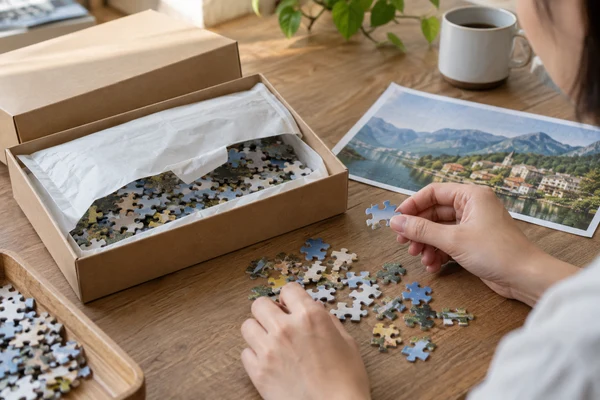
Check the edges and surfaces that touch during opening. A tight bag can scrape against a box corner; a poster under a bulky seam can become difficult to remove. Discuss observations with the supplier and revise the relevant component rather than adding unnecessary steps. Do not publish staged opening photographs as proof of actual customer testing. Any AI-generated image used to explain the arrangement should be labeled as an illustration and should depict the proposed concept without inventing real factory evidence.
Keep observations specific
Describe the action and the visible result: the reviewer needed scissors, a folded reference caught under the bag, or the lid closed only after rearranging pieces. Such records give designers a useful revision target. General labels such as premium opening experience are harder to translate into a reproducible packing instruction.
 PuzzleZa
Control materials, components and packing versions together
Create a bill of components for the retail unit: puzzle, inner bag or pouch, poster, story card, retail box and any outer seal. Give each item a code or clear reference and record the approved quantity. Include material and closure details for inner packaging. A bag that looks similar may have a different opening feature or size. Packing instructions should identify the correct component through a reference photograph or code rather than rely on a worker recognizing the intended customer experience.
Use the factory discussion to agree practical checking points. During packing preparation, confirm the proposed sequence and how inserts remain identifiable. During factory testing, compare representative filled packs with the approved arrangement. At shipment inspection, examine selected complete units for correct containment, closure, component presence and visible condition. Define the sample scope and record exceptions. These checks help control the pack but do not justify stating that every unit has been individually opened and inspected.
Review changes before release. If a film, pouch dimension or closure becomes unavailable, ask for the proposed alternative and assess its effect on fit, opening and claims. Keep the accepted revision alongside the old version, with a clear decision date. On a reorder, check whether the component list has changed even if the puzzle artwork has not. Inner packaging often attracts less attention than the lid, yet it can create a noticeably different first-use experience if substituted without review.
Build a quotation brief around the intended customer sequence
Request a small number of complete configurations rather than an open list of custom puzzle packaging options. For example, compare a confirmed clear-bag arrangement with a proposed paper-pouch arrangement, using the same retail box where feasible. Explain what you want to improve: fewer opening steps, easier repacking, reduced component count or a particular market-specific material direction. Give the supplier the finished puzzle format, quantities, destination and component list so feasibility and costs can be reviewed on consistent assumptions.
A 500-piece retail puzzle brief should include inner containment alongside the printed box and reference image. State whether the supplied bag must remain usable after opening and whether a retailer has sealing requirements. Ask what the sample will demonstrate and what still needs final material approval. Keep quotations explicit about wrapping, bagging and assembly so an apparent price difference is not caused by omitted components or different packing work.
Submit the preferred arrangement and fallback through PuzzleZa's contact page. Include photographs of any existing pack you want to improve, with notes describing the issue rather than asking the supplier to copy it blindly. A useful final specification tells the production team what to pack and tells the customer how the product works. Inner packaging succeeds when containment, opening, storage and truthful material information support the same product promise.
Frequently asked questions
Does a custom puzzle need both a bag and shrink wrap?
Not automatically. The bag contains pieces, while outer wrapping may provide a separate retail sealing function. Determine which functions the channel requires and compare complete samples. If a layer is removed, confirm how the remaining arrangement maintains containment and closure throughout the intended handling sequence.
Can we request a paper pouch instead of a polybag?
You can ask the supplier to evaluate it. Feasibility depends on material, seams, closure, dimensions, pieces and packing process. Review a representative filled sample and check the opening sequence. Do not treat a paper concept as confirmed availability or assume it fits the existing box without adjustment.
Does a kraft box make the entire pack recyclable?
No. Assess the actual construction and each component in the intended sales market. Coatings, bags, wrap and mixed materials may need different instructions. Confirm collection guidance and supporting material information before approving claims. The visible brown-paper appearance cannot establish the disposal route for the complete product.
Should a puzzle bag be resealable?
Only if repeated bag containment supports the intended use. Some packs rely on the retail box for storage after the first opening. If a resealable closure is specified, review it on the filled sample and confirm it in the component record. Avoid showing or promising a closure that is not supplied.
What should we inspect before approving inner packaging?
Check material reference, filled fit, closure, opening access, component position and repacking. Confirm the customer instructions match the arrangement. Record the sample version and any limitations. For production, agree selected pack checks against that reference rather than relying on an empty bag's appearance.
Conclusion
Good inner packaging connects piece containment with a clear opening and storage routine. Compare filled configurations, give every layer a defined purpose, and approve the material information with the actual pack. Control component revisions so a later change does not quietly alter the customer experience or invalidate the printed disposal guidance.
Specify your complete inner pack
Send quantity scenarios, destination market and preferred bag or pouch direction to prepare a project-specific packaging discussion.
Sources and scope
Sources reviewed on 2026-10-09. Manufacturing examples and review checklists are planning guidance, not claims about completed customer projects or guaranteed results. AI-generated images illustrate the topic and do not document an actual inspection.
- US EPA recycling questions — Destination-specific material acceptance and disposal guidance.
- FTC environmental claims guidance — Qualification and substantiation of environmental claims.