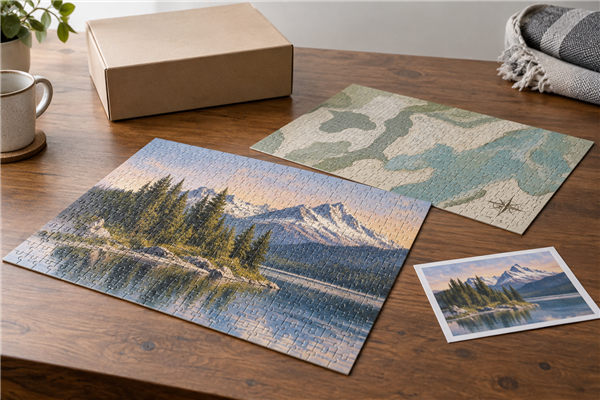
A custom double sided puzzle is not simply a standard puzzle with extra ink on the reverse. It asks the buyer to define two customer-facing surfaces, how they relate to the cut pattern, and how the completed product will be explained in the box. The most reliable route is to decide the role of each side early, prepare print-ready files and assess a physical sample before mass production. That lets a retailer or brand test the experience rather than relying on a screen proof alone.
Start with a decision-ready project brief
Start with a product brief that names the finished size, piece count, board, finish, cut style, front artwork, reverse artwork, artwork orientation, box, inner bag and intended reference material. State whether both sides are meant to be assembled, whether one side is a map, educational image or alternate scene, and how customers should identify the two sides. A custom double sided jigsaw puzzle can be engaging for a gift or museum range, but it needs a more deliberate briefing process than a one-sided product.
A practical brief also makes comparisons fair. Give potential suppliers the same core information and ask them to identify assumptions rather than silently filling gaps. This keeps commercial choices visible: which part of the specification creates customer value, which detail is driven by the sales channel, and which item needs a decision from your team. It also gives the factory a usable starting point for installation preparation, prepress review and packing planning.
What a buyer should define before requesting a quote
- Target customer, sales channel, destination market and launch milestone.
- Quantity scenario, finished size, proposed piece count and product application.
- Artwork status, ownership or licensing position, and every planned printed component.
- Packaging direction, inserts, barcode or label needs, and any retailer routing requirements.
- Sample approvers, required factory testing, shipment inspection and freight handover owner.
Buyer checkpoints for this decision
- The commercial role of the front and reverse sides is written into the brief.
- Artwork orientation, cut style and reference-card or poster version are approved together.
- A physical sample is reviewed on both sides before production release.
- Factory testing and shipment inspection use the approved two-sided pack as the reference.
A double-sided product needs version control for both printed faces. Record front and reverse file names, orientation, board, finish, cut and the components that show the finished image. A reverse-side print intended only as a brand identifier should not be described to customers as a second puzzle experience.
Choose the product around the customer experience
Decide whether the reverse side has a functional purpose. A custom puzzle back print may be a subtle identifier, a branded component detail or a full alternative image. Those are different products. If the reverse is part of the assembly experience, make the contrast between sides intentional and avoid artwork that creates unnecessary ambiguity. A custom puzzle with poster or a custom puzzle reference card can show both finished views, explain the concept and keep essential instructions off the interlocking surface.
When comparing options, ask what changes for the person who receives the product. A specification should have a visible reason: perhaps it protects detailed art, makes an educational activity clearer, supports a gift-worthy unboxing sequence or fits a retailer's shelf. This discipline prevents a common sourcing error in which individual choices look attractive on their own but do not form a coherent customer experience when packed together.
It is also useful to make trade-offs explicit. A more complex format may affect development work, component control or logistics. A simplified pack may improve fulfilment but leave less room for story content. Neither result is inherently right or wrong. The value of a B2B manufacturer conversation is that product, creative and operational implications can be reviewed together while the option is still affordable to change.
Common sourcing risk to avoid
Do not approve a two-sided layout from a reversed screen preview alone. A proof can confirm content, but a physical sample is the practical way to see how the board, cut, front/reverse relationship and reference materials work together.
Decide what the reverse side contributes
Begin with the customer journey. Some double-sided products offer two equally complete images; others put a learning map, an answer view or a quieter pattern on the reverse. Each choice changes how the product is described, photographed and packed. Write one sentence for each side: what it shows, who uses it and when. If the answer is unclear, the second side may be decorative back print rather than a reason to create a two-sided range.
Give both surfaces a visual role. Two images that are too similar can make loose pieces difficult to sort, while two unrelated visual systems can make the product feel accidental. A retailer may choose distinct palettes, borders or image subjects so the customer can recognize each side without printed assembly instructions across the pieces. Keep critical copy, age guidance and product identifiers on the pack or insert where they can remain legible.
Plan the sales asset at the same time. Product photography, ecommerce copy and a printed reference piece should accurately show whether buyers receive one puzzle with a functional reverse or two assembly choices. This prevents a customer expectation issue caused by an attractive online rendering that does not explain the physical product.
Prepare artwork and approve a sample that shows both faces
Ask for the current factory template for the finished size, bleed, safe areas and box components. Supply front and reverse artwork as separately named, controlled files and note their orientation in the approval sheet. If one side contains a map, small labels or fine illustrated detail, confirm that the intended physical size supports it. A high-quality source image is useful, but it does not replace a review on the selected board and finish.
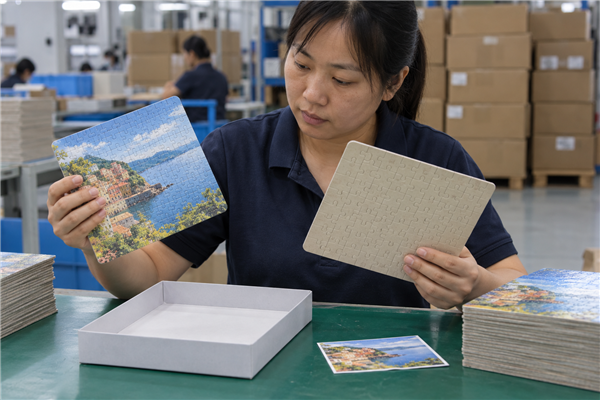
A pre-production sample should be opened and handled like a customer unit. Compare the front and reverse images with their references, assemble a small area or edge, examine cut registration and turn the assembled section over. Review the poster or reference card beside it. This is the point to correct an artwork direction, a component crop or a packaging sequence before the production run uses it repeatedly.
Keep the sample approval factual. Record what was reviewed, the file versions, board and finish, component list and any observations to carry into factory testing. Do not convert a sample observation into an unsupported durability, environmental or delivery claim. A precise release record is more useful to procurement and quality teams than a general statement that the product is premium.
Control components and packing at production release
Treat the finished product as a component set: puzzle pieces, inner bag, reference card or poster, tray where selected, retail box and master carton. A tray can make the pack orderly, but only if its depth and fit are tested with the actual contents. Confirm that the pack closes correctly and that inserts are not bent, omitted or substituted when the product moves from sample to production.
Factory testing can use selected units to check the approved prints, board, cut, component presence and packing sequence. At shipment inspection, compare selected finished packs and cartons with the signed release record. Check visible carton condition, count, protection and agreed outer marks before freight handover. These checks do not guarantee every future outcome, but they provide a practical traceable control point for the specific order.
For receiving preparation, retain the carton dimensions, pack count, final artwork references and inspection observations with the purchase-order record. If a distributor later needs a reorder or a replacement component, the team can identify the correct two-sided version without assuming that a visually similar file or old sample is the current product.
 PuzzleZa
Use the sample as evidence, not as a formality
A physical pre-production sample should show the actual relationship between front print, reverse print, board, cut and pack. Review both sides under consistent light; check image orientation, print coverage, cut registration, edge presentation, piece separation and the way the puzzle lies when turned over. During factory testing, compare production units to the approved two-sided reference. Shipment inspection should then check selected units, inserts, bags, tray and cartons against the documented release version before freight handover.
Bring the relevant teams into the review in the right order. Creative reviewers can confirm image, copy and visual hierarchy. Product and purchasing teams can check material, components and the commercial specification. Operations teams can review carton information, receiving limits and delivery readiness. Consolidate their feedback into one documented response so the factory receives a clear decision rather than conflicting comments from separate email threads.
The approved sample should answer a practical question for everyone involved: is this the product we are prepared to reproduce, pack, inspect and deliver?
Version control matters at this point. Reference the exact artwork, packaging and component versions in the sample-approval record. If a revision is needed, identify what changed, why it changed and whether another physical sample is necessary. This is not administrative overhead; it is the evidence quality and production teams use later when a project contains several files, SKUs or market versions.
Send Your Requirements
Share the product idea, quantity, artwork status and destination. We will help turn them into a practical custom puzzle brief.
Plan quality control, packing and delivery together
Packing needs an explicit component plan. A custom puzzle with tray can protect pieces and keep a reference card or poster together, but tray dimensions, inner bag, box depth and packing count must be sampled as one unit. Confirm the approved pack order, carton quantity, outer marks and delivery requirements before release. For a first run, preserve the approved sample, artwork versions and inspection photos in one record so a reorder does not depend on informal memories.
For the factory, an inspection plan is most useful when it focuses on the details that define your product: correct artwork and pack version, print appearance, die-cut or component checks where relevant, bagging, inserts and carton marks. For the buyer, that same plan makes shipment inspection easier to interpret because the inspector can compare selected finished units with a known approval reference. It also gives freight teams a more reliable handover point.
Keep a final release file with the approved specification, production contact, inspection observations, carton information and agreed shipment documents. This supports a smoother first delivery and becomes valuable information for replenishment. The goal is not to eliminate every uncertainty in a custom product. It is to resolve the important ones at the stage where a correction is still manageable.
Apply the guide to your next puzzle project
This guide is useful for art-puzzle publishers, educational ranges, museum stores, gift brands and private-label teams that want two visual stories in one physical product. The format works best when the second side genuinely improves the use case rather than being added after the artwork is already finished.
Use this article as a working conversation tool. Share it with the people who own artwork, purchasing, product compliance and freight, then collect the unanswered questions before a quote is requested. A precise enquiry helps a factory respond with relevant options and helps your internal team distinguish confirmed requirements from preferences that still need a decision.
For material and sourcing context, see FSC responsible forestry information, Adobe guidance on preparing documents for print. For project-specific manufacturing support, explore our custom puzzle formats, Shenzhen factory capability and production process.
FAQ
What is the difference between a double-sided puzzle and custom puzzle back print?
A double-sided puzzle uses two customer-facing printed surfaces as part of the product experience. Back print may instead be a simple identifier or decorative reverse. Define the intended role before artwork approval.
Do double-sided custom puzzles need a poster or reference card?
Not always, but a poster or reference card can help customers understand two finished views and can carry instructions or details that should not be split across pieces.
What should a double-sided puzzle sample check?
Check both artwork sides, orientation, board, print appearance, cut registration, piece separation, reference materials, tray or box fit and the complete opening experience.
How should shipment inspection be planned for a two-sided puzzle?
Compare selected finished packs and cartons with the approved sample and controlled component list. Check the correct front/reverse versions, pack contents, carton count, condition and agreed marks before freight handover.
Conclusion
A successful double-sided custom jigsaw puzzle program begins with a defined customer outcome and ends with an approved, inspection-ready pack. Align the brief, sample, quality checks and delivery plan early; it gives your team a better basis for an accurate quote and a more dependable first shipment.
Get a Quote